Tigress C Obfuscation Software Review
tigress.wtf · checked 4 Oct 2026
A self-hosted C obfuscator that creates varied builds for reverse-engineering defense.
How it plugs in
Signal on Code Obfuscation Software6.7#2 of 34
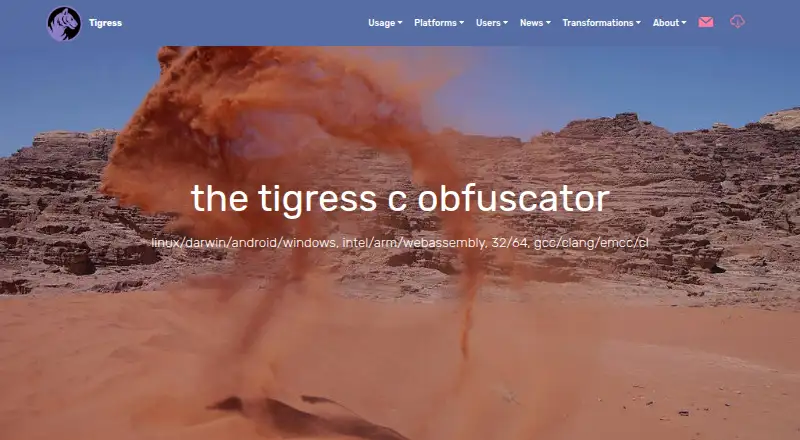
Tigress converts C99 source into alternative C programs by applying command-line transformation sequences. Its listed destinations include Linux, Darwin, Android, and Windows, along with Intel, ARM, and WebAssembly targets and cross-compilation settings. Nonprofits may use it without charge; commercial organizations need a University of Arizona license. The tool runs locally through the command line, and very large inputs may take a long time.
Review
In a line
Tigress protects software against static and dynamic reverse engineering by obfuscating C. It turns source code into varied C output through selected transformations.
What it does
Provide Tigress with a single C99 file, then select transformation sequences and options on the command line. Available families cover control flow, data, functions, integrity, and anti-analysis, with features such as anti-tamper controls and string encryption.
One input program can yield several distinct outputs. Runtime performance varies with the transformations and options, and the resulting code may be slower.
How it connects
Tigress is self-hosted and used through a command-line build process. Its target list covers Linux, Darwin, Android, and Windows, together with Intel, ARM, and WebAssembly architectures. Cross-compilation uses its compiler and environment settings.
Programs with several source files must be merged into one C file before transformation. It can work with GCC, Clang, and Emscripten. The source is not generally open source, though the maker may share it with university or research labs on request. It belongs in the wider code obfuscation software category.
Good fit
Tigress suits teams protecting C software, researchers studying reverse engineering, and students creating obfuscation exercises or reverse-engineering challenges.
It also fits projects that need different builds from one input or cross-compilation across listed operating systems and processor types. Consulting is available for unsupported features or target platforms.
Watch for
Tigress takes a single C file, so projects spread across multiple files need preparation first. The issues page notes that it is slow on huge programs, and generated code can lose speed.
For-profit deployment requires a license from the University of Arizona. Before relying on protection techniques, assess the assets being protected, available performance budget, and likely adversary capabilities.
Pricing
Tigress has a free plan for nonprofit organizations and a free trial that can last as long as needed before deployment.
Commercial use is price on request. A for-profit organization must contact the University of Arizona licensing department for a license.
Verdict
Choose Tigress when you need C-focused obfuscation, varied builds, and listed desktop, mobile, or WebAssembly targets under your own control.
Look elsewhere if your project cannot be reduced to one C file, needs consistently fast transformed code, or requires generally open-source tooling. Commercial buyers should settle licensing terms before deployment.
Our take
Tigress is a specialized choice for C protection rather than a general application security tool. Its varied outputs, many transformation families, and cross-compilation targets can support research, teaching, and software-protection work. Nonprofits get free use, but commercial organizations must arrange licensing. The single-file input model and possible performance loss add build and runtime work. A detailed threat and performance review is important before release, especially for large programs or demanding applications.
- Transforms C99 source through many obfuscation families
- Can create multiple outputs from one input program
- Covers Linux, Darwin, Android, Windows, Intel, ARM, and WebAssembly targets
- Free for nonprofit organizations
- Includes control-flow, string-encryption, and anti-tamper options
- Multi-file projects need to be combined into one C file
- Transformed programs may run slowly
- Very large programs can be particularly slow
- Commercial deployment needs a University of Arizona license
- The source is not generally open source
- Pick it ifC protection and reverse-engineering research; Students building obfuscation or reverse-engineering challenges; Projects targeting Intel, ARM, or WebAssembly
- Skip it ifYou need a tool that accepts multi-file projects directly; Runtime speed cannot vary with transformation choices; You require generally open-source source code
Pricing
Nonprofits may use Tigress free. The trial can continue for any length of time before deployment. For-profit use needs a University of Arizona license, with pricing available on request.
- Research useFree for non-profit organizationsFree
- Commercial licenseContact the University of Arizona licensing department for a license · Required for use in a for-profit organizationOn request
As tigress.wtf lists them, checked 4 Oct 2026.
Questions
Is Tigress free?
Nonprofit organizations can use it at no cost. For-profit deployment needs a University of Arizona license, with pricing available on request.
What languages does Tigress support?
Tigress transforms C99 source code and takes one C file as input.
Which platforms can Tigress target?
Its listed destinations are Linux, Darwin, Android, and Windows, with Intel, ARM, and WebAssembly architectures.
Can Tigress handle a project with several C files?
Not directly. A multi-file program has to be combined into one C file before transformation.
Does Tigress have a free trial?
Yes. Users may test Tigress for any length of time before commercial deployment.
Is Tigress open source?
The source is not generally open source, although the maker may provide it to university or research-lab researchers on request.
Can Tigress slow down my program?
Generated code may lose speed depending on selected transformations and options, and the issues page highlights slow performance on huge programs.
Does Tigress offer support?
The maker provides consulting and asks users to get in touch about unsupported features or target platforms.