tldw: A research workspace you can self-host
tldwproject.com · checked 7 Oct 2026
An open-source research system for searching and querying transcripts and documents.
How it plugs in
Signal on AI Video Summarizers5.2#24 of 25
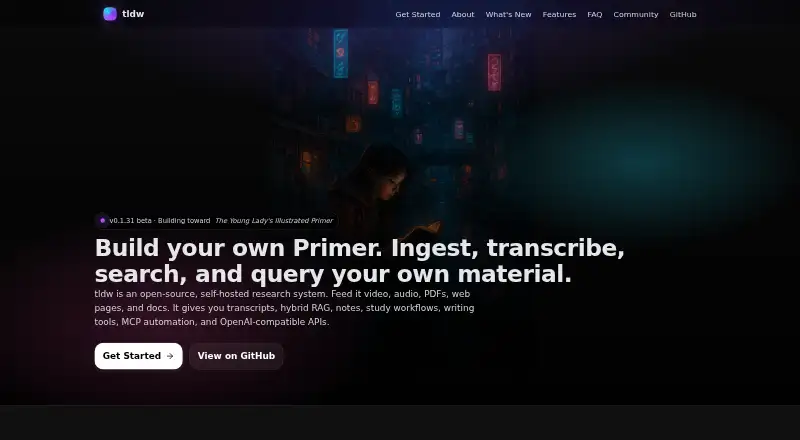
tldw brings recordings and documents into one research workspace. Audio and video become searchable transcripts, which can be queried alongside notes and documents. You can use local AI models, hosted model services, or both. It is free and self-hosted, but remains in beta; installation is not yet generally available through PyPI.
Review
In a line
tldw is a free, open-source research system that you run on infrastructure you control. It collects source material so you can transcribe, search, and ask questions about it.
What it does
Bring in YouTube links, video files from your device, audio, PDFs, web pages, EPUBs, Word documents, Markdown, XML, and more. Recordings become searchable text for quoting, summarizing, or reuse.
Its search covers transcripts, notes, and documents. A shared workspace holds source material, notes, prompts, chats, and other saved work. The beta also offers Study Packs, flashcard templates, study suggestions, and a recipe-based evaluation framework.
How it connects
tldw can use hosted AI services, local models, or a mix. Listed hosted providers include OpenAI, Anthropic, Google, Cohere, DeepSeek, Groq, Mistral, OpenRouter, HuggingFace, and Qwen. For local inference, it lists Ollama, vLLM, and llama.cpp.
It provides an API compatible with OpenAI's formats for chat, audio, embeddings, and evaluations. It also supports MCP automation, a way for connected tools to run approved actions within a workspace.
Web access, an API, and self-hosting are available for this open-source project. The documented setup routes include Docker for single-user or multi-user deployments, plus a local single-user option.
Good fit
tldw may suit researchers, students, or teams who want one place to collect varied source material and search across it. It may also work for people seeking flexibility between hosted and local models, or who want data on infrastructure they manage.
Watch for
The project remains in beta; its maintainers say it is usable for people who are comfortable with beta software. There is no general PyPI installation at present, so setup starts with a repository checkout.
The setup paths include Docker and local installation. Check which deployment option fits your needs before committing.
Pricing
tldw is open source and free to use.
Verdict
Consider tldw if you need to gather recordings and documents, search them together, and want control over where the system runs. Its broad input support, transcript search, model choices, and shared workspace cover several research tasks in one place.
It is a less suitable choice if you need software outside beta or a simple PyPI install. Before adopting it, weigh the setup work against the value of self-hosting and confirm that its beta status fits your tolerance for change.
Our take
tldw is worth considering for people who want a self-hosted place to collect source material, make recordings searchable, and query across transcripts and documents. Its no-cost, open-source setup and choice of hosted or local models offer flexibility, while its workspace adds notes and study tools. The key compromise is its early stage: tldw is still beta, and installation currently requires a repository checkout rather than a generally available PyPI package. Choose it if that status and setup are acceptable; otherwise, look for a more established fit.
- Free and open source.
- Accepts recordings, documents, and web pages.
- Searches transcripts, notes, and documents together.
- Can use hosted models, local models, or both.
- Offers an OpenAI-compatible API for four functions.
- The project is labeled beta.
- A general PyPI installation is not available.
- The documented setup paths require a local or Docker installation.
- Pick it ifPeople who want to search recordings and documents in one workspace; Users who want self-hosting and a choice of AI models
- Skip it ifYou need a project that is not in beta.; You require general availability through PyPI for installation.
Pricing
The open-source project is free; no paid plan is listed.
Questions
Is tldw free?
Yes. The project is free to use and open source.
What can I add to tldw?
Inputs include YouTube links, local video files, audio, PDFs, web pages, EPUBs, DOCX, Markdown, XML, and other formats.
Can tldw transcribe video or audio?
Yes. Recordings are converted to searchable text that you can quote, summarize, or reuse.
Which AI models can it use?
It works with hosted providers such as OpenAI, Anthropic, Google, and Mistral, as well as local options like Ollama, vLLM, and llama.cpp.
Can I keep data on my own infrastructure?
The project says users keep data on infrastructure they control and that tldw has no telemetry, analytics, or phone-home behavior.
Is tldw ready for general use?
It is in beta, and the project says it is usable for people comfortable with beta software. General PyPI installation is not available yet.