Tokenbooks: Crypto Accounting and Treasury Software
tokenbooks.io · checked 15 Oct 2026
Crypto accounting and treasury workflows for Web3 teams, with wallet, exchange and bank syncing, payments and reports.
How it plugs in
Signal on Crypto Accounting Software6.3#5 of 25
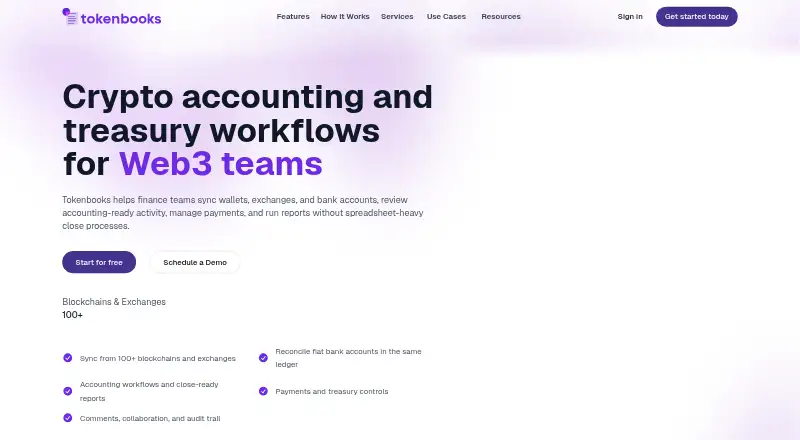
Tokenbooks combines crypto accounting and treasury work in one web and API service. It syncs activity from more than 100 blockchains and exchanges, turns it into reviewable books and reports, and supports payment approvals and fiat payouts. A public API and MCP server let other products and AI agents use its accounting functions.
Review
In a line
Tokenbooks is a crypto accounting and treasury workspace for Web3 finance teams. It brings wallet, exchange and bank activity together with payments, journals and reporting.
What it does
The service turns synchronized activity into reviewable transactions, journals, ledgers, cost-basis records and financial reports. It supports fair-market-value processing, exports, multiple entities and responsibility-center dimensions that can be split by percentage.
Payment workflows cover requests, approval routing, Safe execution and fiat payouts linked to accounting. Comments, collaboration tools and an audit trail keep review context with each workflow.
How it connects
Tokenbooks says it syncs more than 100 blockchains and exchanges. Named connections include EVM chains, Coinbase, Kraken, Ledger, Solana and NEAR. QuickBooks Online and Xero connections are listed on the Growth plan for journal entries.
A public API supports onboarding, portfolios, wallets, asynchronous sync jobs, transactions, balances and report exports. Interactive OpenAPI documentation and a generated TypeScript SDK are provided. Its first-party MCP server exposes the same accounting surface to Claude, ChatGPT, Cursor and Codex.
The product is available on the web and through an API. It is not open source and says it never stores private keys; wallet connections are read-only. Current bank support is statement-file import, while live bank feeds are described as planned.
Good fit
Tokenbooks suits Web3 finance teams and crypto-native businesses that need one workspace for wallets, exchanges, fiat accounts and entities. It also fits portfolio apps, wallets and trading products that want embedded multi-chain accounting through the API.
Teams needing payment requests, approvals, consolidation, cost-basis tracking or close-ready journals can use the accounting and treasury workflows. Bookkeeping services add monthly crypto and fiat reconciliation with the workspace included.
Watch for
Check the bank workflow before buying: the stated current option is importing statement files, not live feeds. The bookkeeping provider says it is not a CPA or tax adviser and does not file taxes.
Tokenbooks' terms do not promise uninterrupted, timely, secure or error-free operation and allow the service to be discontinued without notice. Its privacy policy describes safeguards but disclaims absolute security. The accounting product is proprietary rather than open source.
Pricing
There is a free plan with one portfolio, five wallets and 1,000 total transactions. Solo costs $99 a month when billed annually; Growth is $399 a month billed annually; Treasury is $999 a month billed annually.
Books Diagnostic costs $250 one time and is refunded if Tokenbooks cannot scope the work, then credited against the first paid month. Bookkeeping plans start at $2,000 a month: Starter is $2,000, Growth $3,000 and Treasury $6,000, all billed monthly. Catch-up starts at $2,500 one time after a diagnostic, and Enterprise uses a custom annual agreement.
Verdict
Choose Tokenbooks if your organization needs crypto-native accounting joined to treasury controls, payment approvals and reporting, or if you are building a product that needs those functions through an API. The free tier gives small portfolios a way to start.
Look elsewhere if you require open-source software, live bank feeds today, or tax filing from the bookkeeping service. Compare wallet, exchange and transaction limits with your expected volume before selecting a paid plan.
Our take
Tokenbooks is aimed at organizations whose financial activity spans crypto wallets, exchanges, banks and multiple entities. Its accounting records, payment controls, exports and API cover both internal finance work and embedded product use. The free tier may suit a small portfolio, while annual paid plans increase portfolio, wallet and transaction capacity. Bank activity currently depends on statement-file imports, and the service is not open source. Businesses needing tax filing, guaranteed uptime or live bank feeds should confirm those requirements elsewhere before committing.
- Syncs data from more than 100 blockchains and exchanges.
- Tracks journals, ledgers, cost basis, fair-market value and reports.
- Payment requests include approvals, Safe execution and fiat payouts.
- Public API and MCP server support embedded and agent-driven workflows.
- Free plan includes one portfolio, five wallets and 1,000 transactions.
- Live bank feeds are not available; current support is statement-file import.
- The product is proprietary, not open source.
- Bookkeeping service does not provide tax filing or tax advice.
- Terms disclaim uninterrupted, timely, secure or error-free operation.
- Paid plans can start at $99 a month billed annually.
- Pick it ifWeb3 finance teams managing crypto and fiat accounts; Products embedding multi-chain accounting through an API; Businesses needing crypto bookkeeping and treasury controls
- Skip it ifYou need open-source accounting software or live bank feeds now.; You require a provider that files taxes or guarantees continuous service.; Your activity exceeds a plan's wallet or transaction limits.
Pricing
A no-charge tier covers one portfolio, five wallets and 1,000 transactions.
- FreeNo charge · 1 portfolio · 5 wallets · 1,000 total transactionsFree
- Solobilled annually · 2 portfolios · 25 wallets · 10,000 total transactions · daily wallet/exchange refresh · financial statements and exports$99/mo
- Books DiagnosticRefunded if Tokenbooks cannot scope the work; credited against first paid month · 3 business days · source inventory · volume estimate · coverage check · written unsupported-items list · recommended plan$250 one-time
- Growthbilled annually · 3 portfolios · 50 wallets · 50,000 total transactions · QuickBooks Online and Xero · classification rules · general ledger and cost-basis ledger$399/mo
- Treasurybilled annually · 5 portfolios · 100 wallets · 150,000 total transactions · payment requests · counterparties · cost centers · secure API keys · consolidation · Slack integration · fiat payout workflows$999/mo
- Starter bookkeepingmonthly · 250 close credits · workspace included · monthly crypto and fiat reconciliation · close by 10th business day · Slack or Telegram accountant access$2,000/mo
- Catch-upFrom $2,500 quoted after diagnostic · Historical rebuild · transfer matching · statement reconciliation · journal posting$2,500 one-time
- Growth bookkeepingmonthly · 400 close credits · everything in Starter · cost-center and project reporting · payout runs prepared for approval$3,000/mo
As tokenbooks.io lists them, checked 15 Oct 2026.
Questions
Does Tokenbooks have a free plan?
Yes. Free includes one portfolio, five wallets and 1,000 total transactions, with no charge.
What systems can Tokenbooks connect to?
Named connections include EVM chains, Coinbase, Kraken, Ledger, Solana and NEAR. Growth adds QuickBooks Online and Xero journal connections.
Does Tokenbooks offer an API?
Yes. The public API handles onboarding, portfolios, wallets, sync jobs, transactions, balances and report exports. Interactive OpenAPI docs and a TypeScript SDK are available.
Can AI agents use Tokenbooks?
Its first-party MCP server exposes the accounting API surface to agents such as Claude, ChatGPT, Cursor and Codex, with audit trails and sign-off gates described.
Are bank feeds live?
Current bank support is statement-file import. Live feeds through Plaid-like providers are described as being on the roadmap.
Does Tokenbooks store private keys?
Tokenbooks says it never stores users' private keys and connects read-only for wallet data.
Does the bookkeeping service file taxes?
No. The bookkeeping page says the provider is not a CPA or tax adviser and does not file customers' taxes.