Typerighter: Open-Source Document Rule Checker
github.com · checked 9 Oct 2026
An open-source checker that applies custom writing rules to documents through an API or self-hosted setup.
How it plugs in
Signal on Writing Style Checkers6.1#13 of 29
Typerighter applies user-defined rules to documents as an open-source checker. It can flag text with regular expressions, LanguageTool patterns, or built-in LanguageTool rules, then return explanations and suggestions. It runs as API or self-hosted services and includes a ProseMirror editor plugin. The Guardian uses it for style-guide checks.
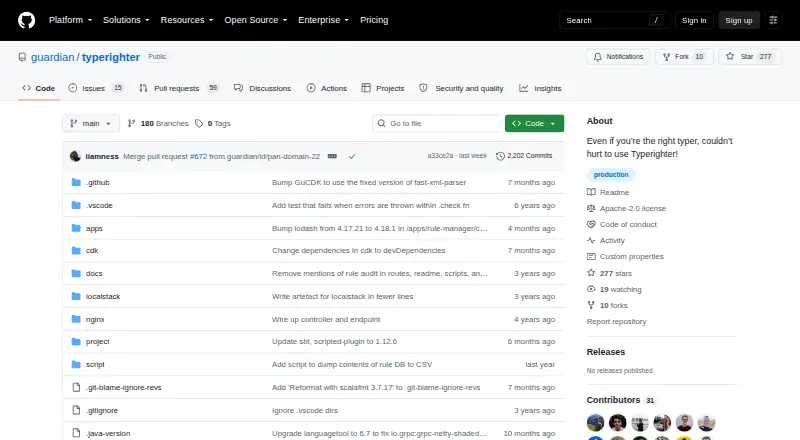
Review
In a line
Documents pass through Typerighter's writing-rule checks in a workflow comparable to spelling or grammar software. It is open-source software that can run through an API or on your own systems.
What it does
You create a set of rules and send document-check requests to the Checker service. Each match gives the relevant text range, an explanation, and applicable suggestions.
The rule set may combine your regular expressions, LanguageTool XML patterns that you define, and built-in LanguageTool core rules. The Guardian uses Typerighter to check copy against its style guide.
How it connects
Typerighter has a standalone REST service for sending checks and receiving matches. Access requests must carry a valid pan-domain authentication cookie. An API is available, and the project can be self-hosted.
The prosemirror-typerighter companion links Typerighter with the ProseMirror rich text editor so users can inspect suggestions and make changes. The code is published under the Apache-2.0 license.
Its Rule Manager stores rules in PostgreSQL and publishes a JSON rules artifact on Amazon S3 for the Checker to consume. The repository assumes AWS services, defaults to eu-west-1, and uses the Guardian's riff-raff deployment platform.
Good fit
Typerighter suits teams with a house style or other rules that writers must follow. Rule owners maintain and publish the rule set, while rule users check their copy against it.
It fits internal editors and applications that publish text, especially where authors need explanations and control over suggested changes. Its ProseMirror plugin is useful when that editor is part of your workflow.
Watch for
The repository carries assumptions specific to the Guardian and invites contributions that could broaden its usefulness in other institutional settings.
This is software you deploy and configure rather than a hosted subscription. Check whether your team can provide the required AWS setup, deployment platform, authentication, and PostgreSQL and S3 services.
Pricing
The software is free and released under the Apache-2.0 open-source license. There is no free trial because the software itself is already free.
The free plan still requires your own deployment and configuration, including the infrastructure described in the project documentation.
Verdict
Choose Typerighter if you need an extensible rule-based checker for a team style guide and can operate its services. It offers API access, a ProseMirror connection, and a workflow that separates rule maintenance from copy checking.
Skip it if you want a ready-made hosted checker or cannot support its Guardian-oriented AWS and deployment assumptions. Teams using another editor should also confirm that a custom integration meets their needs.
Our take
Typerighter is a sensible option for organizations that want their own writing rules enforced inside publishing tools. Its open license and API allow internal teams to shape the checking service, while the ProseMirror plugin covers one documented editor path. The trade-off is operational: you must deploy and configure the software, handle authentication, and account for AWS and Guardian-specific assumptions. It is not a plug-in subscription for casual users. Decide based on your ability to run the services and maintain a rule set.
- Free Apache-2.0 open-source software
- Accepts custom regular expressions and LanguageTool patterns
- REST API and self-hosted deployment options
- The ProseMirror plugin supports suggestion review and applying edits
- Matches include explanations and text ranges
- Requires deployment and configuration
- Repository carries Guardian-specific assumptions
- REST access requires a pan-domain authentication cookie
- Deployment assumes AWS and the Guardian's riff-raff platform
- No hosted plan or free trial is listed
- Pick it ifTeams enforcing a shared style guide; Organizations running their own publishing tools; ProseMirror applications needing rule-based checks
- Skip it ifYou need a hosted checker with no infrastructure work; Your team cannot support the stated AWS and deployment assumptions; You do not use ProseMirror and lack resources for a custom integration
Pricing
Typerighter is free, open-source Apache-2.0 software. Buyers still need to provide deployment, configuration, and supporting services.
- Open sourceApache-2.0 licensed software · requires deployment and configurationFree
As github.com lists them, checked 9 Oct 2026.
Questions
Is Typerighter free?
Yes. It is Apache-2.0 software available at no cost. Running it still requires your own deployment and configuration.
What rules can Typerighter use?
You can define regular expressions and LanguageTool XML patterns, and you can use predefined LanguageTool core rules.
Does Typerighter have an API?
Yes. The Checker is able to operate as a standalone REST service. Requests require a valid pan-domain authentication cookie.
Which editor does Typerighter support?
The prosemirror-typerighter plugin brings Typerighter into the ProseMirror rich text editor, allowing users to inspect suggestions and apply edits.
How is Typerighter deployed?
The project presumes AWS cloud services, uses eu-west-1 by default, and relies on the Guardian's riff-raff deployment platform.
Who maintains the rules?
Rule owners maintain and publish the rule corpus. Rule users submit copy for checking and review the returned matches.
Can Typerighter check a custom style guide?
Yes. Teams can define rules that reflect their own style requirements. The Guardian uses it with its style guide.