
Upstash Redis: Managed Redis With REST and TCP Access
upstash.com · checked 15 Oct 2026
Managed, serverless Redis database with REST and TCP access, global reads, and pay-per-request pricing.
How it plugs in
Signal on Key-Value Databases6.3#6 of 31
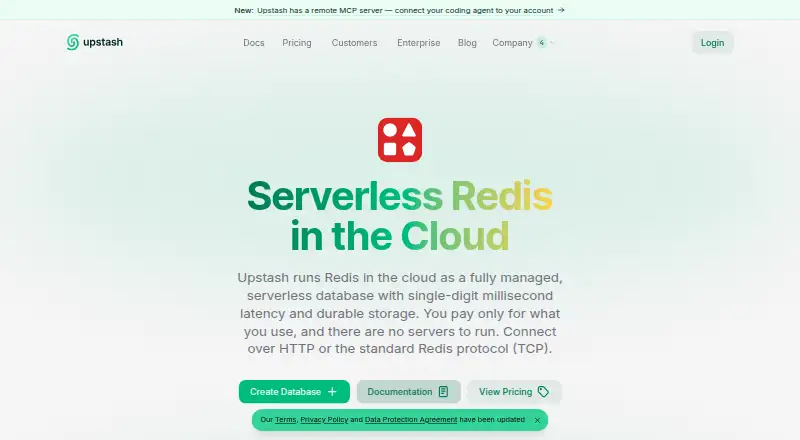
Upstash Redis is a cloud-hosted Redis-compatible database managed by Upstash. It stores data in memory and cloud block storage, handles replication, backups and scaling, and can charge by commands or by fixed plan. Applications connect through Redis TCP or an HTTPS REST API. A free plan and free trials are available.
Review
In a line
Upstash Redis is a fully managed, serverless Redis database in the cloud. It offers durable storage, pay-per-request billing and fixed-price plans.
What it does
Upstash runs the Redis servers, provisioning, replication, backups, durability and scaling for you. Pay-as-you-go databases can scale to zero when idle, while every write is stored in memory and cloud block storage.
It supports caching, rate limiting, queues and streams, session storage, search and AI-agent memory. Redis Search adds full-text search that stays in sync with JSON, hashes and strings.
Global databases can copy data to several read regions so users read from a nearby location. Upstash also describes automatic failover and persistence across restarts and failures.
How it connects
Applications can use the standard Redis TCP protocol or an HTTPS REST API. Any Redis client can connect, including clients for TypeScript, Python, Go and Java. Official SDKs include @upstash/redis for TypeScript and JavaScript, Python, Go, Java and rate limiting.
The REST API covers strings, bitmaps, hashes, lists, sets, sorted sets, geospatial commands, HyperLogLog, transactions, scripting, pub/sub, JSON and streams. It does not support Redis Cluster commands, blocking list or sorted-set commands, or WATCH, UNWATCH and DISCARD transactions.
A documented Vercel integration creates or manages databases from the Vercel dashboard and supplies environment variables to projects. The HTTP client is designed for environments such as AWS Lambda, Cloudflare Workers, Fastly Compute@Edge, Next.js, Jamstack, browsers, mobile and WebAssembly. The JavaScript client is MIT licensed.
TLS is on by default and cannot be disabled. Paid databases support Redis ACLs. IP allowlisting, VPC peering and AWS PrivateLink have plan restrictions. Prod Pack adds encryption at rest, Prometheus metrics, Datadog integration and SOC-2 report access; HIPAA enablement is available with Enterprise.
Good fit
It suits teams that want Redis behavior without operating Redis servers. Common jobs include caching, request limits, queues, streams, sessions, search and storing memory for AI agents.
It can fit applications that need HTTP access, Redis TCP compatibility, regional reads or a serverless billing model. Fixed plans are available when a predictable monthly charge matters.
Watch for
The REST interface has command limits, including no Redis Cluster commands and no blocking list or sorted-set commands. Check command compatibility before choosing REST.
The free plan includes 250 MB of data, 10 GB of monthly bandwidth, 500K commands per month and one database. Maximum value size is 100 MB, and clustering support is not available.
Prod Pack and Enterprise provide additional monitoring, compliance and support features; check the required plan before committing.
Pricing
Upstash uses a freemium model. The Free plan costs $0 a month, billed monthly, with 250 MB of data, 10 GB bandwidth, 500K commands per month and one database. Free trials are available by email request, and an unclaimed temporary free database expires after 72 hours.
Pay as You Go is billed at $0.20 per 100K commands. It includes 100 GB of data and unlimited commands; storage beyond 1 GB and bandwidth over 200 GB may add charges. Fixed plans start at $10 a month for 250 MB, with higher tiers from $20 to $1500 a month. Read regions add fees on those plans.
The Prod Pack add-on costs $200 a month per database. Enterprise pricing is by request and includes 100K+ commands per second, unlimited bandwidth and databases, dedicated resources, professional SLA support and HIPAA compliance.
Verdict
Choose Upstash Redis if you need managed Redis access through TCP or HTTP, want regional reads, or prefer command-based billing that can scale to zero. Its SDKs and Vercel integration help connect applications without running database servers.
Look elsewhere if your application depends on Redis Cluster commands through REST, needs clustering, or requires paid compliance and monitoring features without their added plan costs.
Our take
Upstash Redis is a practical choice for applications that need Redis commands, HTTP access or regional reads without managing infrastructure. The free plan gives a small starting point, while pay-per-command billing can suit uneven workloads. Fixed tiers cover predictable usage, but read regions and operational add-ons raise the bill. Confirm that the REST command set fits your application, since several Redis features are excluded. Teams needing clustering, larger guarantees or enterprise controls should review the paid tiers before deciding.
- Managed provisioning, replication, backups and scaling
- Redis TCP and HTTPS REST access
- Free plan and free trial options
- Global read regions for lower latency
- Official SDKs and Vercel integration
- REST lacks several Redis command groups
- No clustering support
- Free tier has 250 MB, 10 GB and 500K-command limits
- Read regions add charges on fixed plans
- Some monitoring and compliance features are part of paid plans
- Pick it ifServerless apps needing managed Redis; HTTP, edge or Vercel projects; Workloads with variable command volume
- Skip it ifYou require Redis Cluster commands through REST; You need clustering support; You need enterprise controls without add-on costs
Pricing
Free plan available. Pay as You Go is $0.20 per 100K commands.
- Freemonthly · 250 MB data · 10 GB bandwidth · 500K commands/month · 1 databaseFree
- Pay as You Go$0.20 per 100K commands; storage beyond 1 GB and bandwidth over 200 GB may add charges · 100 GB data · unlimited commands · unlimited listed bandwidth · 10 MB request · 100 MB record$0.20/mo
- Fixed 250MBmonthly; +$5/month per read region · 250 MB data · 50 GB bandwidth · unlimited commands · 10,000 commands/sec$10/mo
- Fixed 1GBmonthly; +$10/month per read region · 1 GB data · 100 GB bandwidth · unlimited commands · 10,000 commands/sec$20/mo
- Fixed 5GBmonthly; +$50/month per read region · 5 GB data · 500 GB bandwidth · unlimited commands · 10,000 commands/sec$100/mo
- Prod Pack add-onper database · 99.99% uptime SLA · multi-zone HA · encryption at rest · SOC-2 · Prometheus · Datadog$200/mo
- Fixed 10GB$200/month · 10 GB max data · 1 TB monthly bandwidth · +$100/region · unlimited commands$200/mo
- Fixed 50GB$400/month · 50 GB max data · 5 TB monthly bandwidth · +$200/region · unlimited commands$400/mo
As upstash.com lists them, checked 15 Oct 2026.
Questions
Does Upstash Redis have a free plan?
Yes. The Free plan is billed monthly at no charge and includes 250 MB of data, 10 GB bandwidth, 500K commands per month and one database.
How can applications connect?
Use the standard Redis TCP protocol or an HTTPS REST API. Official SDKs cover TypeScript/JavaScript, Python, Go, Java and rate limiting.
Can it serve users in different regions?
Yes. Global databases replicate data to multiple read regions, allowing reads closer to users. Fixed plans charge extra for read regions.
Does the REST API support every Redis command?
No. REST does not support Redis Cluster commands, blocking list and sorted-set commands, or WATCH, UNWATCH and DISCARD transactions.
Is TLS included?
TLS is enabled by default for every Upstash Redis database and cannot be turned off.
What is the pay-as-you-go price?
Pay as You Go is billed at $0.20 per 100K commands. Storage beyond 1 GB and bandwidth over 200 GB may add charges.