WaniKani: Japanese Kanji and Vocabulary Learning
wanikani.com · checked 15 Oct 2026
A web app that teaches Japanese kanji and vocabulary with mnemonics and spaced reviews.
How it plugs in
Signal on Language learning apps6.3#137 of 278
WaniKani is a web-based Japanese reading course focused on kanji meanings, readings, and vocabulary. It teaches radicals as building blocks, then uses mnemonics and spaced repetition to schedule reviews. The first three levels are free; paid access starts at $9 a month. It needs an internet connection and has no official iOS or Android app.
Review
In a line
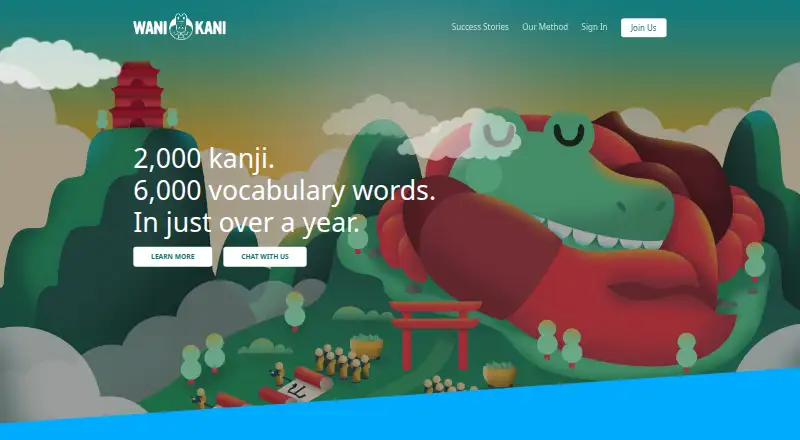
WaniKani is a web application for learning Japanese kanji and vocabulary. Its course covers more than 2,000 kanji and 6,000 vocabulary words.
What it does
Lessons introduce radicals, kanji, and vocabulary, then reviews test meanings and readings separately. Radicals act as building blocks for later kanji and mnemonic construction.
Each item has a mnemonic. WaniKani’s spaced-repetition system changes the time before the next review according to your previous session performance. Kanji are selected and ordered for learning efficiency, while vocabulary is described as checked for common or useful usage.
How it connects
WaniKani runs on the web and offers a public REST API. The API returns account progress and general subject reference data in JSON, using personal bearer tokens over HTTPS. Documented data includes assignments, levels, reviews, statistics, subjects, users, voice actors, and study materials.
The service is proprietary, not open source. WaniKani requires an internet connection and has no offline mode. It has no official iOS or Android app; mobile apps mentioned in its help material are made by users. API use is limited to 60 requests per minute.
Good fit
WaniKani suits people who want to learn to read Japanese through a structured kanji-and-vocabulary course. It is useful if you want mnemonics, separate meaning and reading practice, and review timing that adapts to your results.
The free levels let you start without paying. People building their own tools can use progress and reference data through the API.
Watch for
There is no placement test or way to skip ahead, including for advanced learners. You must progress through the levels in order.
You need internet access for lessons and reviews. There is no official phone app and no offline option. WaniKani’s privacy policy says it collects personal information and browser logs, uses cookies, and cannot promise absolute security. Telephone support is not offered.
Pricing
The Free plan covers Levels 1–3, with about 100 kanji and 200 vocabulary words. Level 4 and above require premium access, and there is no free trial.
Premium costs $9 a month on a recurring monthly bill or $89 a year on a recurring annual bill. A Lifetime plan costs $299 as a one-time payment and provides access for the lifetime of the service. Customers may request a refund within 60 days of payment.
Verdict
Choose WaniKani if your main goal is reading Japanese and you want a fixed sequence built around mnemonics and adaptive review. The free opening levels make it possible to judge the method before subscribing.
Look elsewhere if you need offline study, an official mobile app, placement testing, or the ability to jump directly to advanced material. Developers should also check the API’s token, HTTPS, rate-limit, and subscription rules before building an app.
Our take
WaniKani is a focused choice for learners who want systematic Japanese kanji and vocabulary study rather than a broad language course. Its mnemonic lessons and performance-based review schedule give the program a clear routine, and the free first three levels reduce the initial cost. The trade-offs are firm: no placement test, no skipping, no offline mode, and no official mobile apps. The $299 lifetime option may suit long-term learners, while monthly or annual billing lowers the commitment. Review the privacy terms and API limits if connected tools matter to you.
- More than 2,000 kanji and 6,000 vocabulary words
- Mnemonics cover radicals, kanji, and vocabulary
- Spaced repetition adjusts review intervals
- First three levels are free
- Public API provides progress and reference data
- No placement test or skip-ahead option
- Requires internet access; no offline mode
- No official iOS or Android app
- Collects personal and browser log data
- API is limited to 60 requests per minute
- Pick it ifLearners focused on reading Japanese; People who prefer mnemonic lessons and scheduled reviews; Builders needing WaniKani progress data through an API
- Skip it ifYou need offline lessons or an official mobile app; You want a placement test or to start at an advanced level; You prefer open-source software
Pricing
Free access covers Levels 1–3. Premium is $9/month or $89/year, and Lifetime access is $299 one time. There is no free trial; refunds can be requested within 60 days of payment.
- Monthlyrecurring monthly · All WaniKani content · progress through levels still required$9/mo
- Annualrecurring annually · All WaniKani content · progress through levels still required$89/yr
- FreeLevels 1–3 · about 100 kanji · about 200 vocabulary wordsFree
- Monthly SubscriptionUSD 9.00/month; recurring monthly charge · Premium access$9/mo
- Annual SubscriptionUSD 89.00/year; recurring annual charge · Premium access$89/yr
- Lifetimeone-time payment · Lifetime access to all WaniKani content$299 one-time
- Lifetime AccountOne-time payment of USD 299.00 · Access for the lifetime of the service$299 one-time
As knowledge.wanikani.com lists them, checked 15 Oct 2026.
Questions
What does WaniKani teach?
It teaches Japanese kanji meanings and readings plus vocabulary. The stated course includes more than 2,000 kanji and 6,000 vocabulary words.
How much is WaniKani?
Levels 1–3 are free. Premium costs $9 a month or $89 a year. A lifetime plan costs $299 one time.
Does WaniKani have a mobile app?
WaniKani says it has no official iOS or Android app. Mobile apps referenced in its help pages are made by users.
Can I use WaniKani offline?
No. The web app requires an internet connection and has no offline mode.
Can advanced learners skip levels?
No. WaniKani has no placement test or mechanism to skip ahead.
Does WaniKani offer an API?
Yes. Its public REST API provides account progress and general subject reference data in JSON. Requests use personal bearer tokens over HTTPS and are limited to 60 per minute.
Is WaniKani open source?
No. Its service code and design are proprietary and copyrighted by Tofugu.