Wazuh: Open-Source XDR and SIEM Monitoring
wazuh.com · checked 15 Oct 2026
Open-source XDR and SIEM security monitoring for endpoints, clouds, and networks.
How it plugs in
Signal on Endpoint Security Software7.7#1 of 41
Wazuh combines endpoint agents, a server, indexer, and dashboard to analyze security data. It detects threats, watches file changes, finds vulnerable software, supports incident responses, and maps rules to several compliance frameworks. The platform is open source and self-hostable, with Wazuh Cloud plans starting at $571 per month and a 14-day trial.
Review
In a line
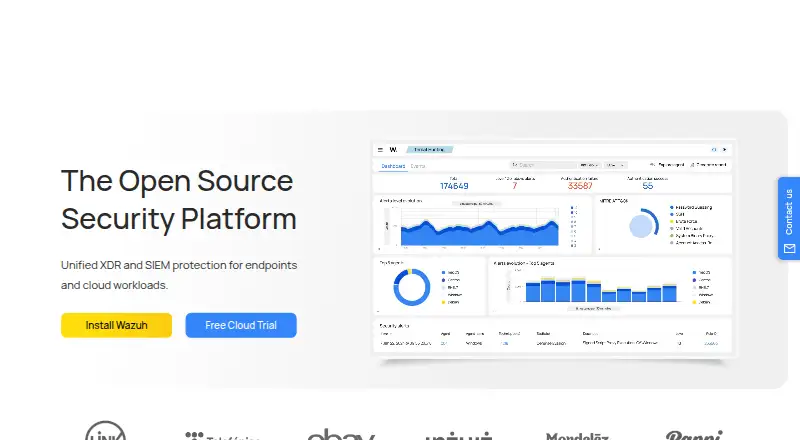
Wazuh is an open-source security platform that brings XDR and SIEM monitoring together. Its analysis covers endpoint, cloud, and network data to support threat detection, response, and compliance work.
What it does
A multi-platform agent sends telemetry to Wazuh server, indexer, and dashboard components. Operating-system and application logs are checked for errors, configuration problems, malicious behavior, and policy breaches.
Its file-integrity module records file and directory creation, changes, and deletion using checksums and attributes. Scans can run continuously or on a schedule. Endpoint software inventories are matched against updated CVE databases to find known vulnerable programs.
Configuration checks look for gaps against policies, standards, and hardening guides. Built-in active responses can take countermeasures, including blocking network access from a threat source.
How it connects
Wazuh is distributed under GPLv2 and Apache 2.0 licenses, and its main repository is GPLv2. You can self-host the server, indexer, and dashboard on 64-bit Linux, with Docker and Kubernetes deployment options documented.
Cloud coverage includes AWS, Microsoft Azure, Google Cloud, Microsoft 365, and GitHub services, virtual machines, and activity. Integration guidance extends to Elastic Stack, OpenSearch, Splunk, and Amazon Security Lake. Threat-intelligence connections include VirusTotal, MISP, URLHaus, and AlienVault.
An open-source REST API covers agents, managers, clusters, file-integrity monitoring, MITRE, rules, decoders, security configuration assessment, inventory, and access control. API access uses HTTP Basic authentication to obtain a JWT token; the default token lifetime is 900 seconds. cURL, Python, and PowerShell examples are provided.
The agent supports Linux, Windows, macOS, Solaris, AIX, and HP-UX. Enrollment needs outbound manager connectivity, including configurable TCP ports 1514, 1515, and 55000.
Good fit
Wazuh suits individuals, small businesses, and large organizations that need centralized security monitoring. It can support threat detection, incident response, vulnerability checks, file monitoring, configuration assessment, and compliance tracking.
Its default rulesets provide mappings for PCI DSS, HIPAA, NIST 800-53, TSC, and GDPR. These mappings help organize monitoring but do not certify compliance. Wazuh Cloud says its service is independently audited for PCI DSS and SOC 2.
Watch for
Self-hosting requires Linux central components and responsibility for deployment and maintenance. Wazuh Cloud updates its environments automatically, while self-hosted installations use the documented upgrade process.
The agent averages 35 MB of RAM. Check operating-system support, network enrollment ports, retention needs, and the work required to manage your own infrastructure. Wazuh says its former Splunk and Elastic apps receive only critical updates from version 4.6.
Pricing
The Wazuh open-source offering has no charge and is self-hosted. Wazuh also offers a 14-day trial.
Wazuh Cloud starts at $571 per month for Small, covering up to 100 active agents, one month of indexed-data retention, three months of archive retention, and standard support. Medium costs $923 per month for up to 250 agents, with three months indexed and one year archived. Large costs $1,467 per month for up to 500 agents, with the same retention as Medium. Custom pricing is available on request.
Verdict
Choose Wazuh if you want open-source control, broad endpoint coverage, a public API, and security data in one system. It is a practical option for teams able to run Linux infrastructure or pay for managed Cloud hosting.
Consider SIEM Software and File Integrity Monitoring Software categories when comparing approaches.
Our take
Wazuh is a sensible choice when centralized monitoring, open-source licensing, and many deployment options matter. The free self-hosted plan lowers the entry cost, while paid Cloud tiers add managed updates and defined retention. Before choosing it, confirm that your team can support Linux components, agent enrollment, and the required network ports. Treat the compliance mappings as monitoring aids rather than certification. Organizations wanting a managed service can start with the trial and compare agent limits and retention across the paid tiers.
- No-cost self-hosted open-source tier
- Monitors endpoints, clouds, and networks
- File, vulnerability, and configuration monitoring
- Public REST API with documented examples
- Supports many security and cloud integrations
- Self-hosting requires Linux central components
- Compliance mappings alone are not certification
- Former Splunk and Elastic apps get critical updates only
- Agent enrollment needs specific outbound connectivity
- Pick it ifTeams needing open-source security monitoring; Organizations managing endpoints and cloud services; Buyers wanting self-hosted or managed deployment
- Skip it ifYou cannot operate Linux-based central components; You need compliance certification from mappings alone; Your retention or agent count exceeds a plan's limits
Pricing
Free self-hosting is available. A 14-day trial is offered.
- Wazuh open sourceFree and open source · self-hostedFree
- SmallStarting at $571/month · Up to 100 active agents · 1 month indexed-data retention · 3 months archive retention · Standard support$571/mo
- MediumStarting at $923/month · Up to 250 active agents · 3 months indexed-data retention · 1 year archive retention · Standard support$923/mo
- LargeStarting at $1467/month · Up to 500 active agents · 3 months indexed-data retention · 1 year archive retention · Standard support$1,467/mo
- CustomCustom agents, retention, support and settingsOn request
As wazuh.com lists them, checked 30 Sept 2026.
Questions
Is Wazuh free?
Yes. The open-source Wazuh offering has no charge and is self-hosted. Managed Cloud plans are paid, starting at $571 per month.
What systems can the Wazuh agent monitor?
Official agent packages support Linux, Windows, macOS, Solaris, AIX, and HP-UX. The average agent memory requirement is 35 MB of RAM.
Does Wazuh have an API?
Yes. Its open-source REST API covers agents, managers, clusters, file-integrity monitoring, rules, inventory, and access control. Authentication uses HTTP Basic credentials to obtain a JWT token.
Which cloud services does Wazuh monitor?
Wazuh documents coverage for AWS, Microsoft Azure, Google Cloud, Microsoft 365, and GitHub, including their services, virtual machines, and activity.
Does Wazuh certify compliance?
Default rulesets provide mappings for PCI DSS, HIPAA, NIST 800-53, TSC, and GDPR, but Wazuh says the mappings themselves do not certify compliance. Wazuh Cloud states it is independently audited for PCI DSS and SOC 2.
What does Wazuh Cloud cost?
The Small tier starts at $571/month for up to 100 active agents. Medium starts at $923/month for up to 250, and Large at $1,467/month for up to 500. Custom pricing is available.
Near it
All alternatives →- F
 FortiClient#2 on this board
- CA
 Comodo Advanced Endpoint Protection#3 on this board
- L
 LimaCharlie#4 on this board
- CF
 CrowdStrike Falcon for Mobile#5 on this board
- MDMicrosoft Defender for Business#6 on this board
- ES
 Elastic Security#7 on this board
- BG
 Bitdefender GravityZone Small Business Security#8 on this board
- TThreatLocker#9 on this board
- KNKaspersky Next#10 on this board
- SI
 Symantec IT Management Suite#11 on this board