Data Mining And Extraction Software
Weka Review: Open-Source Machine-Learning Workbench
weka.waikato.ac.nz · checked 15 Oct 2026
Open-source Java workbench for preparing data, building models, and visualizing results.
How it plugs in
Signal on Data Mining And Extraction Software7.6#1 of 29
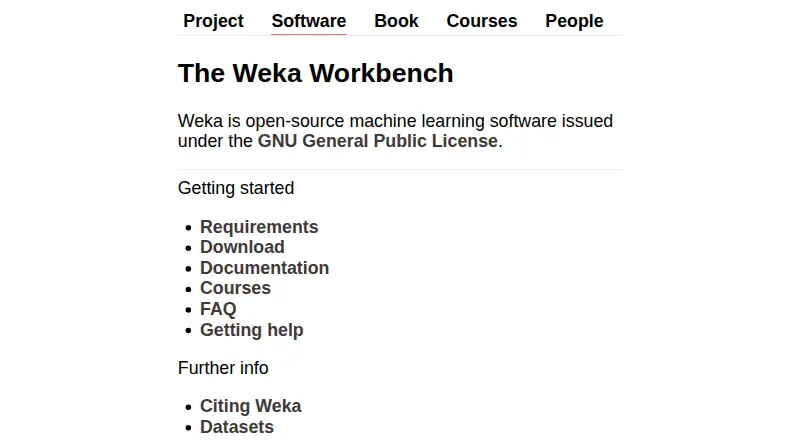
Weka is free, open-source machine-learning software from the University of Waikato. Its Java workbench supports data preparation, classification, regression, clustering, association rules, visualization, forecasting, model evaluation, and automated machine learning. It runs on Windows, macOS, and Linux, with a Java API, database connectivity, Python bridges, and Jupyter notebook support.
Review
In a line
Weka is an open-source machine-learning workbench written in Java. It is distributed under the GNU General Public License and has stable and development branches.
What it does
Weka helps prepare and transform datasets, then build models for classification, regression, clustering, association-rule mining, forecasting, and time-series work. It also supports model evaluation and automated machine learning.
Graphical tools let users inspect data and model results. The software is designed for batch deployment and includes built-in help and a manual.
How it connects
Weka can read transactional database data through database connectivity and JDBC drivers. Its Java API exposes classes for use in other programs, with Javadoc and command-line documentation.
Python users can connect through python-weka-wrapper3, sklearn-weka-plugin, Jython, JPype, or related bridges. Official documentation also covers Jupyter notebooks. A package manager adds community features, but downloading packages needs an internet connection.
Release distributions include source code, and the project maintains a public Git repository. Downloads are available for Windows, macOS, and Linux on Intel and ARM systems.
Good fit
Weka suits people who want a free desktop workbench for common machine-learning tasks without buying a commercial plan. It can help with dataset preparation, predictive models, grouping records, finding transaction relationships, and reviewing results visually.
It also fits Java developers who need an API, and Python users who are willing to use a bridge. Teams working with database data or notebooks have documented connection options.
Watch for
Current official releases require Java 8 or newer; Windows high-resolution displays may need Java 9 or later.
Weka 3.8 is the stable branch, while 3.9 is for development and may change compatibility. Models saved in version 3.7 do not work in 3.8, and the documented migration tool has an exception for RandomForest.
GPL rules apply to distributed derivative works. Commercial projects that need Weka code inside a non-GPL program may need a different license.
Pricing
Weka is free and has no free trial because the software itself is free. The Weka 3.8 Stable plan costs free and is open-source software under the GNU General Public License.
The Weka 3.9 Development plan also costs free, but it may contain changes that break compatibility with earlier releases. The general Weka open-source software plan is free and covers the Java desktop workbench, both branches, and its internet-dependent package manager.
Verdict
Choose Weka if you need a no-cost, self-hosted workbench covering many standard machine-learning methods, with desktop downloads and documented Java, Python, database, and notebook connections.
Look elsewhere if you dislike Java dependencies, need unrestricted proprietary redistribution, or depend on model files moving cleanly between older and newer Weka versions.
Our take
Weka is a practical choice for learners, researchers, and analysts who want broad machine-learning functions in a free desktop package. Its API and connection options make it useful beyond the graphical interface, especially for Java-based work and notebook workflows. The main decisions are technical: install Java, manage a self-hosted setup, and check GPL obligations before distributing software that includes Weka. Version planning also matters because the development branch and older serialized models can create compatibility problems.
- Free and open-source under the GPL
- Runs on Windows, macOS, and Linux, including Intel and ARM downloads
- Covers classification, regression, clustering, association rules, and visualization
- Java API plus Python bridges and Jupyter notebook support
- Connects to transactional databases through JDBC
- Requires Java 8 or newer
- Package downloads need an internet connection
- Weka 3.7 models are incompatible with 3.8
- GPL terms can limit proprietary distribution
- The 3.9 branch may break compatibility
- Pick it ifFree desktop machine-learning work; Java, Python, database, and notebook workflows; Data preparation, modeling, and visual review
- Skip it ifYou need a hosted service instead of self-hosted software; You cannot meet Java or GPL requirements; You rely on model files across Weka versions
Pricing
All listed plans are free. Choose 3.8 for the stable branch or 3.9 for development features that may affect compatibility; there is no trial plan.
- Weka 3.8 StableOpen-source software under the GNU General Public LicenseFree
- Weka 3.9 DevelopmentDevelopment version; may include features that break compatibility with earlier releasesFree
- Weka open-source softwareDesktop Java workbench · stable and development branches · package manager requires internetFree
As weka.waikato.ac.nz lists them, checked 3 Oct 2026.
Questions
Is Weka free?
Yes. Weka's listed stable, development, and open-source software plans are free, and the project is GPL-licensed.
Which operating systems does Weka support?
Official downloads cover Windows, macOS, and Linux, with Intel and ARM options for each.
Does Weka have an API?
Yes. Weka provides a Java API with Javadoc and command-line documentation. Python users can connect through several documented bridges.
Can Weka work with Jupyter notebooks?
Yes. Weka's API documentation describes using it through Jupyter notebooks.
What Java version is required?
Current official releases require Java 8 or newer. Windows high-resolution displays may require Java 9 or later.
Are older Weka models compatible with newer versions?
Models serialized in Weka 3.7 are not compatible with 3.8. The documented migration tool also has an exception for RandomForest.
What is the difference between Weka 3.8 and 3.9?
Weka 3.8 is the stable branch with compatibility-focused fixes. Weka 3.9 is the development branch and may include breaking changes.
Near it
All alternatives →- AA
 Azure AI Speech#2 on this board
- AApify#3 on this board
- AT
 Amazon Textract AnalyzeExpense#4 on this board
- NA
 Nanonets Approval Routing Agent#5 on this board
- KA
 KNIME Analytics Platform#6 on this board
- VAVeryfi API#7 on this board
- ODOrange Data Mining#8 on this board
- S
 ScrapingBee#9 on this board
- AAgenty#10 on this board
- O
 Octoparse#11 on this board