Wholechain Traceability Software Review
wholechain.com · checked 15 Oct 2026
Blockchain traceability for tracking products from source to delivery.
How it plugs in
Signal on Food Traceability Software6.6#1 of 18
Wholechain records product movements and supply-chain events from origin to final delivery. It supports GS1 and GDST traceability frameworks, QR-code product details, lot tracking, labels, APIs, and connections to business systems. People can enter events on phones, tablets, or computers, including offline on Android. A free Lite plan is available; larger plans require a quoted price.
Review
In a line
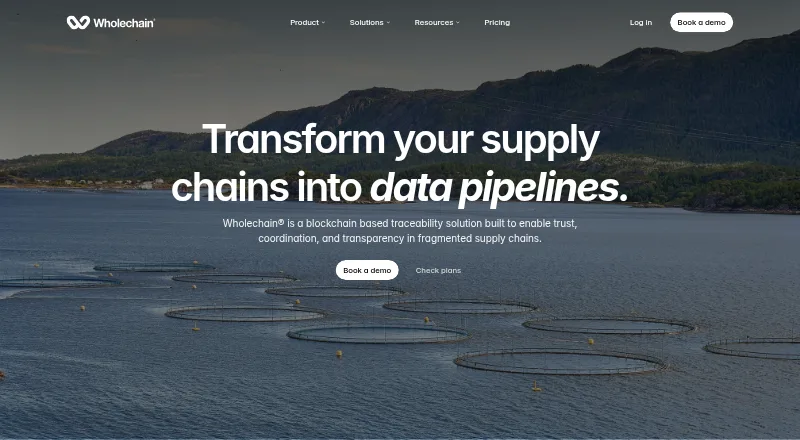
Wholechain is a blockchain-based platform for recording and sharing traceability information across fragmented supply chains. It follows products from their source through final delivery.
What it does
The service maps product movements and other events across a product's life. Records can include sourcing information down to farms, fisheries, and vessels, with visibility at batch or lot level.
Users can enter events from mobile devices, tablets, or desktop computers. The Android app can scan barcodes and capture events offline, then sync them when a connection returns.
QR codes let consumers and business partners view sourcing, quality, sustainability, and product-journey details. Wholechain also supports product genealogy, recalls, serialization, and supply-chain event tracking.
Label tools handle GS1-128, DataMatrix, SSCC, GS1 application identifiers, and PTI-compliant labels. Users can make case and pallet labels and share approved templates between facilities.
How it connects
Wholechain advertises a public API and Zapier connectivity. Its developer documentation covers authentication, a test sandbox, products, locations, partners, event operations, and EPCIS exchange.
Published business-system connections include Microsoft Dynamics, Oracle NetSuite, SAP, and SeaSoft. Listed GDST-connected systems include Agritrack, AP2HI/PasarMIKRO, FIA PNG/FIMS, Koltiva, OpsSmart, Pacifical/SmarTuna, SFS Trace, ThisFish, and Trace Register. Compliance connections include FoodLogiQ by Trustwell, iFoodDS, and ReposiTrak.
Data can use EPCIS or GDST frameworks and CSV, XML, or JSON formats. Exchange is available by email, SFTP, or API. Customers can choose Mastercard Provenance Solution or Stellar for blockchain records; uploaded documents are hashed and recorded even if later deleted.
The platform lists live chat, email support, onboarding and training resources, and a help center. Higher plans list phone support or a dedicated account manager.
Good fit
Wholechain is aimed at small producers, processors, enterprise buyers, brands, manufacturers, wholesalers, exporters, importers, distributors, certifiers, and cooperatives.
It suits organizations that need shared records across many supply-chain parties, farm-to-delivery sourcing details, lot-level visibility, QR-code disclosure, or connections to ERP and traceability systems.
Watch for
Workflow and party mappings need governance so different participants record events consistently. Results also depend on suppliers providing data at a consistent level of detail, and preparing audit packages may require manual work.
Plan limits vary by products, locations, users, documents, monthly events, and retention. Check those allowances, required integrations, blockchain choice, and support level before signing up.
The free Lite plan is limited to two products, two locations, one user, five documents, and 500 events per month, with three-year retention.
Pricing
Wholechain uses a freemium model. Lite is free and includes two products, two locations, one user, five documents, 500 events each month, three-year retention, and shared data templates.
Essentials is price on request for 10 products, 10 locations, three users, 250 documents, 500 monthly events, three-year retention, and shared templates. Premium is price on request, starting at 20 products and 20 locations, with 10 users, 500 documents, 1,500 monthly events, four-year retention, and create-and-share templates.
Enterprise is price on request with custom products, locations, users, documents, and retention. It starts at 2,500 monthly events and adds API access, SSO, and a dedicated account manager.
Verdict
Choose Wholechain if your supply chain spans multiple organizations and you need a common record from origin to delivery. Its mobile capture, offline Android mode, lot tracking, labeling, QR-code sharing, API, and data-format options cover operational and customer-facing needs.
The free plan gives small teams a defined starting point, while paid tiers add capacity and administration. Confirm that suppliers can provide consistent event data and that the listed integrations and plan limits match your rollout.
Our take
Wholechain fits businesses that must trace goods across farms, fisheries, factories, logistics partners, and buyers. It combines mobile and desktop entry with lot-level records, labels, QR-code disclosures, and exchange formats used by supply-chain systems. The free Lite tier may work for a small operation, but its limits are tight. Larger deployments need a quote and may require governance work to keep supplier events consistent. Teams without a need for shared, end-to-end traceability may find its setup and coordination requirements unnecessary.
- Free Lite plan supports two products and 500 events per month.
- Captures events on mobile, tablet, desktop, and offline Android.
- Public API, Zapier, ERP, GDST, and compliance connections.
- QR codes can show sourcing, quality, and sustainability details.
- Supports GS1 labels, lot tracking, recalls, and serialization.
- Workflow and party mappings require ongoing governance.
- Traceability depends on consistent supplier event data.
- Lite limits users, products, locations, documents, and retention.
- Essentials, Premium, and Enterprise prices require a quote.
- Audit packages may need manual preparation.
- Pick it ifSupply chains needing shared origin-to-delivery records; Teams using lot tracking, QR codes, and GS1 labels; Organizations connecting ERP and traceability systems
- Skip it ifYou do not need end-to-end supply-chain traceability.; Your suppliers cannot provide consistent event details.; You need published prices for paid plans.
Pricing
Lite is free with fixed limits. Essentials, Premium, and Enterprise are price on request, with plan-specific limits for products, locations, users, documents, events, retention, and templates; Enterprise also lists API access, SSO, and a dedicated account manager.
- Lite2 products · 2 locations · 1 user · 5 documents · 500 events/month · 3-year retention · shared data templatesFree
- EnterpriseCustom products and locations · custom users · custom documents · starting at 2,500 events/month · custom retention · API access · SSO · dedicated account managerOn request
- Essentials10 products · 10 locations · 3 users · 250 documents · 500 events/month · 3-year retention · shared data templatesOn request
- PremiumStarting at 20 products · starting at 20 locations · 10 users · 500 documents · 1,500 events/month · 4-year retention · create-and-share templatesOn request
As wholechain.com lists them, checked 15 Oct 2026.
Questions
Is Wholechain free?
Yes. The Lite plan is free and includes two products, two locations, one user, five documents, 500 events per month, three-year retention, and shared data templates.
Where can I use Wholechain?
Wholechain runs on the web, iOS, Android, and through an API. Android supports barcode scanning and offline event capture.
Does Wholechain connect to ERP systems?
Published connections include Microsoft Dynamics, Oracle NetSuite, SAP, and SeaSoft. It also lists GDST and compliance-system connections.
Does Wholechain have an API?
Yes. Wholechain advertises a public API, Zapier connectivity, documentation, and a sandbox for testing requests before production.
What data formats does Wholechain support?
The pricing information lists EPCIS and GDST frameworks plus CSV, XML, and JSON formats. Data can move by email, SFTP, or API.
Can customers see product details?
QR codes can expose sourcing, quality, sustainability, and product-journey details to consumers and partners.
What blockchain does Wholechain use?
Customers can choose Mastercard Provenance Solution or Stellar for blockchain records. Recorded events are described as tamper-evident.