Infrastructure as Code Security Software
Winfunc Infrastructure Scanner
winfunc.com · checked 21 Oct 2026
Pre-production security analysis for infrastructure code, cloud environments, and containers, with compliance validation.
How it plugs in
Signal on Infrastructure as Code Security Software5.5#18 of 22
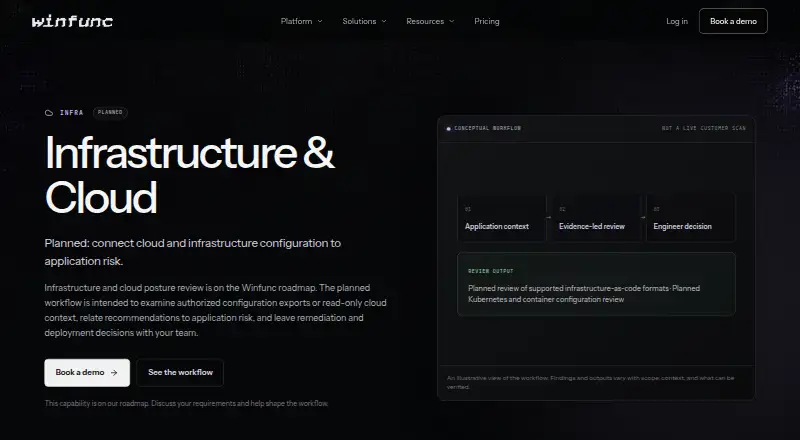
Winfunc Infrastructure Scanner examines infrastructure definitions, cloud configuration, and container artifacts for security weaknesses and compliance gaps. It handles Terraform, CloudFormation, Pulumi, Kubernetes manifests, and Dockerfiles, and uses provider APIs to assess AWS, GCP, and Azure. Results cover leaked secrets, excessive permissions, exposed networks, configuration drift, CVEs, and remediation suggestions.
Review
In a line
Winfunc Infrastructure Scanner evaluates infrastructure-as-code, cloud setups, and container definitions ahead of production. Its checks target configuration errors, disclosed secrets, security weaknesses, and compliance breaches.
What it does
The scanner analyzes Terraform, CloudFormation, Pulumi, Kubernetes manifests, Dockerfiles, and container images. Its review covers IAM roles and credentials, publicly reachable resources, unrestricted security groups, absent transit encryption, unsafe routes, and secrets including keys, tokens, passwords, and certificates.
It compares declared resources with live cloud state to identify drift, and measures AWS, GCP, and Azure posture against CIS benchmarks. Dockerfile and image analysis looks for known CVEs, permission mistakes, and unsafe base images, with CI gates available before deployment.
Results receive severity and business-context prioritization. Winfunc can recommend remediation, create infrastructure-as-code patches, and deliver evidence-backed reports mapped to CIS, SOC 2, ISO 27001, PCI DSS, and HIPAA. A hypothesis scan explores a bounded security question in selected repositories and records traces, evidence, conclusions, and limitations.
How it connects
Provider API connections let Winfunc assess current AWS, GCP, and Azure posture. Its listed development and workplace connections cover GitHub, GitLab, Bitbucket, Azure DevOps, GitHub Actions, Jenkins, CircleCI, Jira, Slack, and Microsoft Teams.
Through MCP, snippet, codebase, and change-review checks are available in Cursor, Claude Desktop, Windsurf, and Cline. Access is offered through an API, web console, or self-hosted installation. The reviewed pages do not provide public endpoint or SDK specifications.
Enterprise self-hosting can place data within a customer premises or private cloud. Source is handled in ephemeral workspaces and removed after analysis, with finding metadata retained.
Good fit
This suits teams seeking continuous cloud posture assessment, policy enforcement, and security review before release. One workflow covers infrastructure code, Kubernetes, containers, cloud permissions, secrets, and network exposure.
Regulated organizations can use evidence-based compliance reporting and Enterprise features such as customer-controlled hosting and organization policies. Teams using the listed source-control, CI, ticketing, chat, or editor products can connect those tools directly.
Watch for
Winfunc has neither a free tier nor a trial. Its web console is invite-only and requires an invited GitHub sign-in. The reviewed pages specify no client operating-system or hardware prerequisites.
The roadmap gives dates for an alpha in November 2025 and beta in March 2026, but no general-availability date. Public endpoint and SDK documentation is not shown on the reviewed pages, so verify access requirements before purchase.
Enterprise support provides a dedicated security engineer, priority Slack access, critical-issue response targets below one hour, and quarterly security reviews.
Pricing
One-time pricing begins at $500 for a single surface scan; deep-scan cost depends on scope. That option includes a findings workspace, report, prioritized results, and suggested remediation without a subscription.
Pay-as-you-go pricing is available on request. Purchased credits cover incremental, scheduled, and pull-request reviews, patch pull requests, AI triage, MCP, team access, Slack notifications, and analytics.
Enterprise pricing is also on request under committed usage. Terms include customer-controlled hosting, isolated tenants, customer model keys, organization policies, and named support.
Verdict
Consider Winfunc when pre-production review must span infrastructure definitions, cloud accounts, and containers, particularly where compliance evidence and drift checks are important. Connections to AWS, GCP, and Azure enable continuing posture review, while CI, pull-request, and editor links fit existing development processes.
Plan for a paid service without a trial, and check that the invite-only console, GitHub authentication, deployment choices, and pricing fit your workflow. Teams seeking a publicly documented SDK, free starting tier, or scheduled general-availability launch may prefer another option or wait.
Our take
Winfunc suits security and platform groups responsible for infrastructure code, cloud environments, and containers on AWS, GCP, or Azure. It combines secret discovery, IAM and network analysis, drift detection, container CVE checks, compliance mapping, and infrastructure patch suggestions. Downsides include paid-only access, an invite-gated console, sparse public API material, and an undated general-availability release. Enterprise purchasers should examine hosting, support, and usage terms; smaller teams should compare the $500 one-time option and on-request plans with their review cadence.
- Analyzes Terraform, CloudFormation, Pulumi, Kubernetes, Dockerfiles, and container images
- Uses provider APIs to assess AWS, GCP, and Azure posture
- Relates results to CIS, SOC 2, ISO 27001, PCI DSS, and HIPAA
- Offers remediation advice and infrastructure-as-code patch generation
- Connects with major code hosts, CI systems, chat tools, and editors
- No free tier or trial
- Web access depends on an invited GitHub account
- No public endpoint or SDK details are presented
- General availability is not dated
- Pick it ifTeams protecting infrastructure code, cloud configuration, and containers; Regulated organizations that need evidence-backed compliance reporting; Organizations seeking Enterprise self-hosting
- Skip it ifYou need a free tier or trial before purchase; You need public API or SDK endpoint documentation; You require a dated general-availability launch
Pricing
- One-timefrom $500 per surface scan; deep scan priced by scope · one surface or deep scan · findings workspace and report · prioritized findings · suggested remediation · no subscription$500 one-time
- Enterprisecommitted usage; terms set in agreement · customer-controlled hosting · isolated tenants · bring-your-own model keys · organization policies · named supportOn request
- Pay as you gocredits bought as needed · incremental, scheduled and pull-request review · reproduction evidence where feasible · patch pull requests · AI triage · MCP · team access · Slack alerts · analyticsOn request
- Recurringmonthly credit allowance; discounted annual billing · everything in Pay as you go · allowance renews monthly · reconciled usage per scanOn request
As winfunc.com lists them, checked 21 Oct 2026.
Questions
What does Winfunc Infrastructure Scanner check?
It examines infrastructure-as-code, cloud configuration, Kubernetes manifests, Dockerfiles, and container images for configuration errors, secrets, permission issues, CVEs, exposed networks, drift, and compliance gaps.
Which cloud providers are supported?
Provider API connections cover AWS, GCP, and Azure for live posture checks and CIS benchmark assessment.
Does it support pull requests and editors?
Yes. Pull-request reviews and integrations are available for GitHub Actions, Jenkins, GitLab, Bitbucket, Cursor, Claude Desktop, Windsurf, and Cline.
Is Winfunc open source or free?
No. Winfunc is proprietary, has no free plan, and offers no free trial.
Can the scanner be self-hosted?
Enterprise supports customer-managed hosting on premises, in a customer cloud, or in a private environment, keeping data inside the customer perimeter.
How is source code retained?
Code is analyzed in ephemeral workspaces and deleted after each scan. Finding metadata remains, and customer code is not used to train AI models.
What does the one-time plan cost?
The One-time option starts at $500 for one surface scan. Deep scans are scoped separately, and there is no subscription.
Near it
All alternatives →- DS
 DryRun Security IaC Security#17 on this board
- K
 KICS#19 on this board
- CNcfn-nag#16 on this board
- SISafeguard IaC Security#20 on this board
- KKubeLinter#15 on this board
- SISnyk IaC#21 on this board
- CCheckov#14 on this board
- TITigerGate IaC Security#22 on this board
- GA
 Gomboc AI Code Security Platform#13 on this board
- KIKloudSec IaC Security#12 on this board