
Akmatori: Open-Source AI Incident Response
akmatori.com · checked 15 Oct 2026
Open-source, self-hosted incident response with AI agents for alerts, investigation, and approved remediation.
How it plugs in
Signal on AI DevOps Assistants7.7#1 of 26
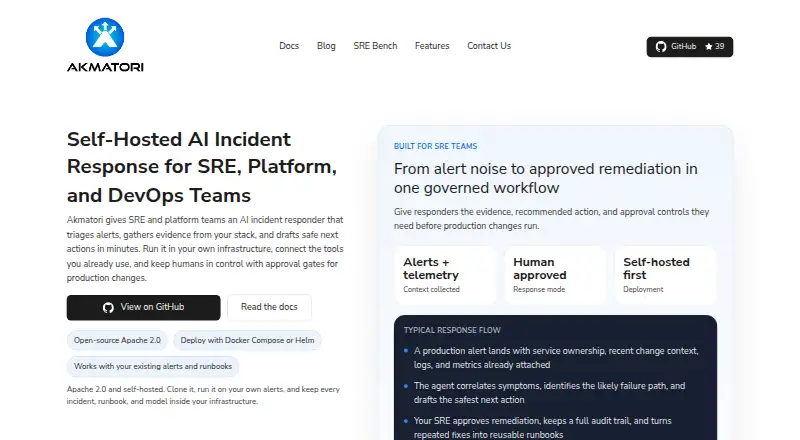
Built for SRE, platform, and DevOps teams, Akmatori provides self-hosted incident response and AIOps. It receives alerts, uses agents to collect logs, metrics, deployment details, and runbook information, then suggests next steps. Operators can approve risky actions in its web interface or Slack. It supports Docker Compose, Helm, local models, and a REST API.
Review
In a line
Akmatori turns production alerts into AI-assisted incident-response workflows. It is open source and can run in your own infrastructure, including air-gapped environments.
What it does
Akmatori accepts alerts from monitoring and incident tools, then starts an agent session for each incident. Agents gather logs, metrics, deployment context, runbooks, and related incident memory before recommending next actions.
Its agents can examine infrastructure using SSH, Kubernetes, scripts, and API clients. Any proposed fix judged risky waits for an operator’s approval through the web interface or Slack.
Scheduled investigations can run from cron jobs with set prompts and allowed tools, then post results to Slack. Reference documents can also be uploaded as context for analysis.
How it connects
Monitoring and incident inputs include Alertmanager, PagerDuty, Grafana, Datadog, Zabbix, Slack channels, and cron jobs. Built-in tool types include SSH, VictoriaMetrics, Grafana, PagerDuty, Kubernetes, Zabbix, and declarative HTTP connectors.
A versioned REST API covers incidents, alerts, events, skills, tools, runbooks, memories, integrations, and channels. Installations provide interactive Swagger docs and an OpenAPI 3.1 contract. Most requests use JWT or API-key authentication. No official language SDKs are listed.
Supported model connections span OpenAI, Anthropic, Google, OpenRouter, NVIDIA NIM, MiniMax, and OpenAI-compatible endpoints, with on-premises models also supported. It runs through Docker Compose or Helm on Linux, macOS, Windows, web, API, or self-hosted setups.
Slack can receive alerts, show investigation progress in threads, and receive scheduled results. The project is Apache 2.0 software developed in the open; its skills use SKILL.md and can be managed through the API.
Good fit
SRE, platform, and DevOps teams can use Akmatori to combine alert intake, infrastructure investigation, runbook automation, and controlled remediation in one workflow.
It fits organizations that need self-hosting, local models, or data kept inside their own infrastructure. Kubernetes support and scheduled investigations are included.
Watch for
You must operate the deployment yourself with Docker 20.10 or newer, Docker Compose v2, and an API key for a supported LLM provider. Slack is optional.
External model providers can receive data when configured; local-model mode avoids that external AI connection. Risky actions still need human approval, so this is not unattended remediation by default.
The reviewed documentation does not list official language SDKs. Vendor pricing is not publicly posted, and Capterra lists no free trial or free version for that vendor-priced option.
Pricing
The Open-source plan is free, uses the Apache 2.0 license, and requires self-hosted deployment.
A separate Vendor pricing option is listed as price on request. Capterra says buyers must contact the vendor and lists no free trial or free version.
Verdict
Choose Akmatori if your team can run its own infrastructure and wants alert investigations, runbook knowledge, and approval-controlled fixes in one system. Its API, broad alert intake, Kubernetes tools, and local-model support make it adaptable to existing operations.
Look elsewhere if you need a hosted-only service, official language SDKs, or a clearly published commercial price. Teams without Docker and LLM-provider access should also account for the setup work before committing.
Our take
Akmatori is a fit for operations teams that want to keep incident data on their own systems while using language models to investigate alerts. It covers common monitoring sources, Kubernetes and SSH access, scheduled checks, and approval steps for risky actions. The trade-off is operational responsibility: deployment, model access, credentials, and integrations are yours to manage. The open-source edition is free, but a separate vendor-priced option has no public amount, free trial, or listed free version. Consider it when self-hosting and control matter more than a hosted buying process.
- Open-source Apache 2.0 license with self-hosted deployment
- Ingests alerts from Alertmanager, PagerDuty, Grafana, Datadog, Zabbix, and Slack
- Approval gates let operators review risky remediation actions
- Supports local or on-prem models for air-gapped setups
- REST API with OpenAPI documentation
- Requires Docker, Docker Compose, and an LLM provider API key
- Vendor pricing is available only on request
- No official language SDKs are listed
- External model providers may receive incident data when configured
- Pick it ifSRE, platform, and DevOps teams running their own deployments; Teams operating Kubernetes and runbook-based incident response; Organizations needing local-model or air-gapped options
- Skip it ifYou need a hosted-only service with no deployment work; You require published commercial pricing or a free trial; You expect official SDKs for a programming language
Pricing
The Open-source plan is free under Apache 2.0 but is self-hosted. Vendor pricing is on request; Capterra lists no free trial or free version for that option.
- Open-sourceApache 2.0 · Self-hosted deploymentFree
- Vendor pricingPricing supplied by vendor on request · Capterra lists no free trial · Capterra lists no free versionOn request
As akmatori.com lists them, checked 7 Oct 2026.
Questions
Is Akmatori free?
Its Open-source plan is free under Apache 2.0 with self-hosted deployment. A separate vendor-priced option is listed as price on request.
Where can Akmatori run?
It supports API, Linux, macOS, self-hosted, web, and Windows environments. Deployment uses Docker Compose or Helm.
Which alert systems does it accept?
Alert intake covers Alertmanager, PagerDuty, Grafana, Datadog, Zabbix, Slack channels, and scheduled cron jobs.
Does Akmatori support local AI models?
Yes. Documentation supports on-prem or air-gapped operation with local OpenAI-compatible models, including Ollama, vLLM, GLM, Kimi, Mistral, and LLaMA.
Can Akmatori run fixes automatically?
Infrastructure actions can run, but an operator must first approve proposed risky actions in the web interface or Slack.
Does it have an API?
Yes. A versioned REST API covers incidents, alerts, events, skills, tools, runbooks, memories, integrations, and channels. Swagger and an OpenAPI 3.1 contract are provided.