
Database Performance Monitoring Software
Amazon RDS Review
aws.amazon.com · checked 21 Oct 2026
Managed relational databases in AWS with automated upkeep, backups, scaling and several database engines.
How it plugs in
Signal on Database Performance Monitoring Software6.3#3 of 25
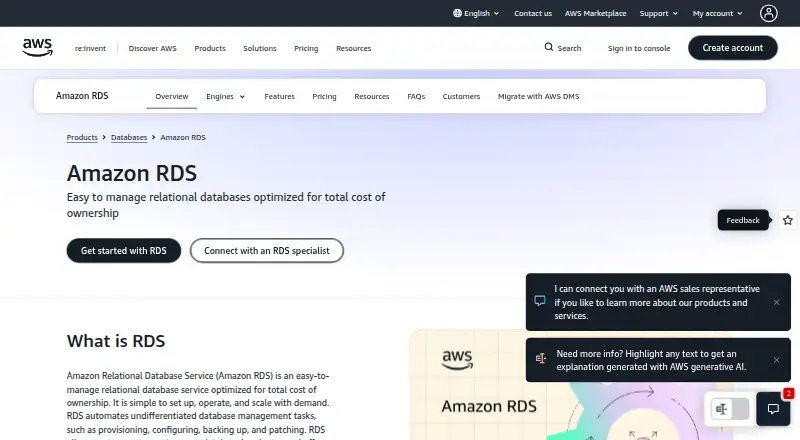
Amazon RDS provides AWS-hosted relational databases while AWS handles routine server administration. It provisions, patches, backs up and scales engines such as MySQL, PostgreSQL, MariaDB, SQL Server, Oracle, Db2 and Aurora variants. You manage it through AWS tools, APIs and database drivers.
Review
In a line
AWS provides Amazon RDS as a fully managed relational database service. It runs supported database engines while automating much of the routine administration.
What it does
RDS handles database setup, configuration, monitoring and maintenance, covering tasks such as patching software, taking backups and recovering from failures. Automated backups are enabled by default, with point-in-time recovery available throughout the retention period you select, up to 35 days.
Multi-AZ deployments keep a synchronous standby copy and can fail over automatically. Read replicas asynchronously duplicate data for read-focused workloads and can become independent database instances. Cross-Region read replicas copy data between AWS Regions for disaster recovery or performance needs.
Eight engine families are available, including Aurora PostgreSQL-Compatible, Aurora MySQL-Compatible, PostgreSQL, MySQL, MariaDB, SQL Server, Oracle and Db2. Feature documentation describes push-button compute scaling to 128 vCPUs, storage reaching 256 TiB for some engines, and up to 15 read replicas for several engines.
How it connects
You can administer RDS from the AWS Management Console, AWS CLI, Amazon RDS APIs, SDKs and CloudFormation. Standard database drivers connect applications to the databases, and the public API documents operations, data types, parameters and errors.
For monitoring and audit, RDS integrates with Amazon CloudWatch, CloudWatch Logs, CloudTrail, Performance Insights and Database Activity Streams. Its partner program covers products for monitoring, security, SQL tuning, migration and business applications; see database performance monitoring software for related tools.
The hosted RDS service is proprietary to AWS, while its database engines can carry separate open-source or commercial licences. Access comes through AWS web, API, CLI and driver interfaces, so there is no local installation.
Good fit
RDS suits teams running relational workloads in AWS that want AWS to handle provisioning, patching, backups, monitoring and recovery. Its controls include VPC isolation, security groups, IAM permissions, SSL/TLS connections and AES-256 encryption through AWS KMS.
Teams with read-heavy workloads can use read replicas, while applications needing standby failover can choose Multi-AZ deployments. AWS states that every RDS engine is HIPAA-eligible when used under an executed Business Associate Agreement.
Watch for
RDS is an AWS-hosted service, not software installed on a local machine. Your costs can vary with Multi-AZ, storage, I/O, transfer, backups and optional features, while replicas copy data asynchronously.
The free offer excludes custom engines, Reserved Instances, deployments other than Single-AZ, snapshot migration, Query Editor and Aurora read replicas. Check engine-specific limits before relying on the listed maximum storage, compute or replica counts.
Pricing
The AWS Free Tier is free. For sign-ups after July 15, 2025, credits can last up to 12 months in participating AWS Regions, and foundational services may qualify for another $100.
DB instances accrue charges by the second, with no minimum or long-term commitment; storage, I/O, transfer and optional features cost extra. Reserved pricing is also not listed: reservations run for one or three years with no-upfront, partial-upfront or all-upfront payment options, while discounts apply to eligible instance usage and storage, backup and I/O remain separate.
Verdict
Amazon RDS is a fit when your applications already run in AWS and you want managed relational databases across several familiar engines. Its automated operations, standby failover, replicas, security controls and API access cover many production setups.
Look elsewhere if you need a local installation, open-source database-management software or a single predictable bundled price. Review the free-tier exclusions, regional credit rules, engine limits and separate usage charges before selecting a configuration.
Our take
For AWS workloads needing managed relational databases and engines such as MySQL or PostgreSQL, Amazon RDS offers a practical route. It removes much of the maintenance work and provides backup recovery, standby failover, replicas, encryption and several management interfaces. The trade-off is dependence on AWS, separate charges for many resources and exclusions in the free offer. Organizations with strict local deployment needs or a preference for self-managed, open-source infrastructure should consider other approaches.
- Automates provisioning, patching, backups, monitoring and recovery
- Supports eight database engines, including MySQL and PostgreSQL
- Multi-AZ standby instances can fail over automatically
- Read replicas and cross-Region replicas support scaling and recovery
- Provides VPC, IAM, SSL/TLS and AWS KMS encryption controls
- Requires access as an AWS cloud service instead of a local installation
- Storage, I/O, transfer, backup and optional features bill separately
- The free offer excludes Multi-AZ and several Aurora actions
- Read replicas copy data asynchronously
- Hosted RDS software is proprietary
- Pick it ifAWS applications needing managed relational databases; Teams using MySQL, PostgreSQL, MariaDB, SQL Server, Oracle or Db2; Read-heavy workloads needing replicas
- Skip it ifYou need software installed outside AWS; You require open-source database-management software; You prefer a single bundled charge for storage, I/O and transfer
Pricing
A free AWS and RDS tier is available with credit, region and feature restrictions.
- AWS Free TierCredits valid up to 12 months for customers signing up after July 15, 2025 · Participating AWS Regions only · Additional $100 may be available for foundational servicesFree
- AWS Free Tier for RDSFree Tier credits are valid for up to 12 months; legacy accounts may receive 750 hours per month for up to 12 months · new sign-ups receive $100 credits plus up to $100 additional credits; legacy offer includes select Single-AZ instances, 20 GB storage, and 20 GB automated backup storageFree
- On-demandPer-second instance billing with no long-term commitment; storage, I/O, transfer and optional features billed separately · No minimum fees · No upfront commitmentOn request
- On-Demand Instancesper second while the DB instance runs; no long-term commitment · compute, storage, backup, and data-transfer charges apply separatelyOn request
- Reserved InstanceOne- or three-year reservation; payment choices are no upfront, partial upfront or all upfront · Up to 69% savings versus on-demand for steady usageOn request
- Reserved Instances1-year or 3-year term; No Upfront, Partial Upfront, or All Upfront payment options · discount applies to hourly instance usage; storage, backup, and I/O are billed separatelyOn request
As aws.amazon.com lists them, checked 21 Oct 2026.
Questions
Is Amazon RDS free?
Amazon RDS offers a free tier. Eligibility depends on credit validity, region, account age and supported configurations, and several features are left out.
Which databases does RDS support?
RDS supports Aurora PostgreSQL-Compatible, Aurora MySQL-Compatible, PostgreSQL, MySQL, MariaDB, SQL Server, Oracle and Db2.
Can I manage RDS with an API?
Yes. You can administer it using the Amazon RDS APIs, AWS CLI, SDKs, CloudFormation and the AWS Management Console.
Does RDS make backups automatically?
RDS enables automated backups by default; point-in-time restoration covers the retention period you configure, up to 35 days.
Does RDS provide high availability?
A Multi-AZ deployment maintains a synchronous standby and supports automatic failover. RDS deployments have a stated availability SLA of up to 99.95%.
Can RDS scale reads?
Asynchronous read replicas handle read-heavy workloads and may be promoted to standalone database instances. Several engines allow as many as 15 replicas.
Is Amazon RDS open source?
No. AWS hosts RDS as proprietary software, while the engines offered through it may be licensed commercially or as open source.
Near it
All alternatives →- M
 MySQL#2 on this board
- Ppgwatch#4 on this board
- GCGrafana Cloud Application Observability#1 on this board
- D
 DBmarlin#5 on this board
- SDSite24x7 Database Monitoring#6 on this board
- GC
 Google Cloud SQL#7 on this board
- PM
 Percona Monitoring and Management#8 on this board
- P
 pganalyze#9 on this board
- DdbWatch#10 on this board
- GAGrafana Alerting#11 on this board