Amphion: Open-Source Audio Generation Toolkit
github.com · checked 5 Oct 2026
Open-source, self-hosted toolkit for generating speech, music, and audio on Linux.
How it plugs in
Signal on AI Voice Conversion Software6.3#12 of 29
Amphion offers a no-cost, MIT-licensed toolkit for creating audio, music, and speech. It operates as self-hosted Linux software, with features for text-to-speech, singing, voice conversion, accent conversion, and text-to-audio. It includes research models, evaluation measures, visual tools, and dataset preprocessing. Text-to-music remains under development.
Review
In a line
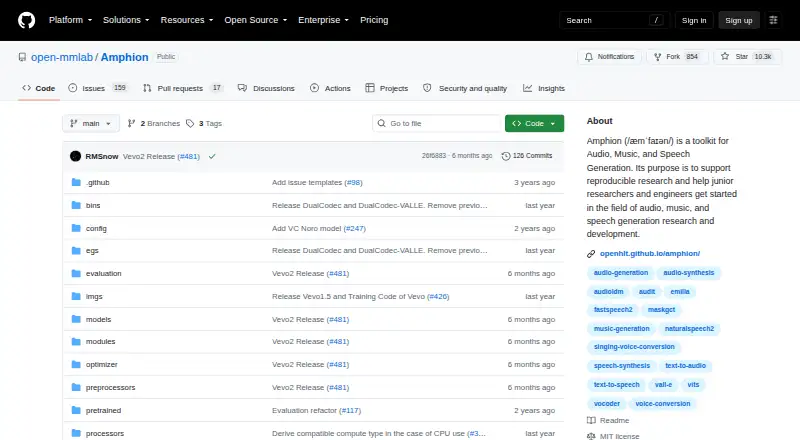
Amphion provides open-source components for making speech, singing, music, and other audio. The project targets reproducible research and gives junior researchers and engineers a way into this area.
What it does
The toolkit handles text-to-speech, singing voice synthesis, voice conversion, accent conversion, singing voice conversion, and text-to-audio. Text-to-music remains unfinished. It can also clone voices and export audio as WAV files.
Its model collection includes FastSpeech2, VITS, VALL-E, NaturalSpeech2, MaskGCT, Vevo-TTS, Vevo, FACodec, and Noro. Vevo2 adds controllable speech and singing features such as melody control, singing edits, and style conversion.
Amphion includes objective checks for pitch, energy, intelligibility, spectrogram distortion, and speaker similarity. Interactive views explain classic model processing, including SingVisio for a singing voice conversion diffusion model.
How it connects
Amphion runs on Linux and is self-hosted. The MIT license covers its code, and the project says it can be used at no cost for research or commercial work. Audio can be provided in WAV, MP3, or FLAC, while output export is WAV.
You can set it up with Python 3.9.15 through Conda or use the documented Docker image. The Docker route calls for Docker, an NVIDIA driver, NVIDIA Container Toolkit, and CUDA, with the dataset mounted inside the container.
For content features, the project lists pretrained tools such as WeNet, Whisper, and ContentVec. It also unifies preprocessing for several open-source datasets, including Emilia and the Emilia-Pipe pipeline.
Good fit
Amphion suits researchers, engineers, and learners who want to run audio-generation work on their own Linux machine. Speech, singing, voice conversion, and text-to-audio projects can all be handled within the toolkit.
It is a reasonable starting point for reproducible experiments that need model architectures, evaluation measures, visual explanations, and shared dataset preparation.
Watch for
This is self-hosted software rather than a hosted service, so you must handle the Linux setup and local computing environment. Running it through Docker means providing NVIDIA drivers, the NVIDIA Container Toolkit, and CUDA, and mounting datasets in the container.
Text-to-music has not yet been marked as supported. Export is listed as WAV, so check that this format fits your workflow before choosing Amphion.
Pricing
Amphion is free. It uses the MIT License, with the project describing both research and commercial use as free; no paid plan is listed.
Verdict
Choose Amphion if you need an open toolkit for speech, singing, voice conversion, or text-to-audio work and can run Linux software yourself. Its models, evaluation measures, visualizations, and dataset tools make it suited to research and learning.
Look elsewhere if you need a hosted app, a simpler installation, or supported text-to-music generation today. For other options, compare AI voice conversion software or text-to-speech software.
Our take
Amphion is a strong fit for technically minded users who want free, modifiable audio-generation software on Linux. Its range of tasks and research-oriented tooling supports work in speech, singing, and voice conversion, while the MIT license allows commercial use. The trade-off is setup: you manage the machine, Python or Docker environment, NVIDIA components, and datasets yourself. Text-to-music is unfinished, and WAV is the only listed export format. Pick it when control and reproducible research matter more than a ready-made online service.
- Free MIT-licensed toolkit for research and commercial use
- Handles speech, singing, voice conversion, and text-to-audio
- Provides evaluation metrics and interactive model visualizations
- Accepts WAV, MP3, and FLAC audio
- Runs self-hosted on Linux
- Self-hosted Linux setup requires technical environment work
- Docker use requires NVIDIA drivers, Toolkit, and CUDA
- Text-to-music remains in development
- Listed export format is WAV
- Pick it ifResearchers and engineers building audio-generation experiments; Learners exploring speech, singing, and voice-conversion models; Teams needing self-hosted, MIT-licensed software
- Skip it ifYou need a hosted service instead of Linux software you run yourself; Text-to-music must be supported now; Your workflow requires exports other than WAV
Pricing
Amphion is available at no cost under the MIT License for research and commercial use. No paid tier is listed.
- AmphionMIT-licensed · free for research and commercial useFree
As github.com lists them, checked 5 Oct 2026.
Questions
What is Amphion?
Amphion is open-source software for producing audio, music, and speech, with an emphasis on reproducible research and helping junior researchers and engineers enter the field.
What can Amphion generate?
Supported work includes text-to-speech, singing voice synthesis, voice conversion, accent conversion, singing voice conversion, and text-to-audio. Text-to-music remains under development.
Where does Amphion run?
It runs as self-hosted software on Linux. You can install it with Python 3.9.15 and Conda or use a Docker image.
What hardware does Docker setup need?
The Docker instructions call for Docker, an NVIDIA driver, NVIDIA Container Toolkit, and CUDA. The dataset also needs to be mounted inside the container.
Is Amphion free for commercial use?
Yes. Amphion is released under the MIT License, and the project says research and commercial use are free.
What audio formats does it support?
Listed input formats are WAV, MP3, and FLAC, while WAV is the listed export format.
Does Amphion support voice cloning?
Yes. Voice cloning is listed as a supported capability.
Near it
All alternatives →- MMorphic#11 on this board
- AA
 Audific AI Voice Changer#13 on this board
- TTunela#10 on this board
- OAOn4t AI Voice Cover#14 on this board
- A
 Audimee#9 on this board
- IMIK Multimedia ReSing#15 on this board
- KAKits AI#8 on this board
- RWRVC WebUI#16 on this board
- AA
 AudioPod AI#7 on this board
- VRVoice Replacer#17 on this board