Apache HBase: Free, Open-Source Big Data Database
hbase.apache.org · checked 15 Oct 2026
Open-source, self-hosted database for consistent real-time reads and writes across very large datasets.
How it plugs in
Signal on Wide-Column Databases7.3#2 of 22
Apache HBase is a free, open-source database for random, real-time reads and writes on big data. It runs on Linux or other self-managed setups, uses Hadoop HDFS, and can split tables across servers as data grows. Java, REST, and Thrift clients are supported, but setup, security, and daily operations require specialist skills.
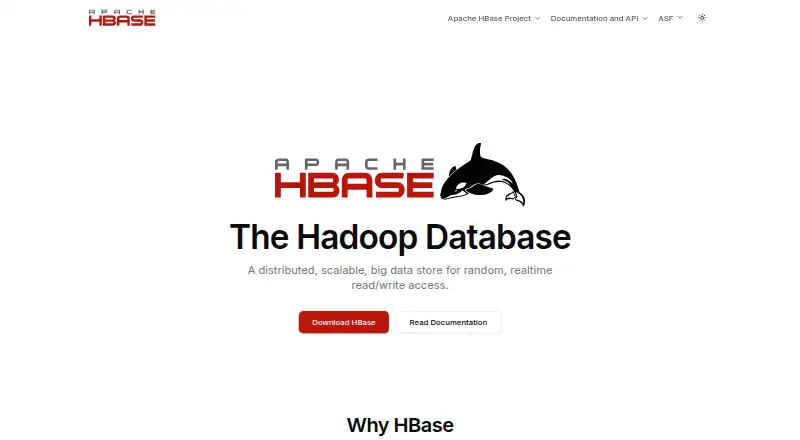
Review
In a line
Apache HBase is a distributed database for random, real-time reads and writes on large datasets. It is an Apache top-level project released under the Apache License, Version 2.0.
What it does
HBase stores tables that can grow to billions of rows and millions of columns on ordinary server clusters. Operations are strictly consistent, and tables split into regions that move between servers as data grows.
It provides automatic RegionServer failover and uses Hadoop HDFS as its distributed file system. Common uses include time-series data, IoT telemetry, ad personalization, logs, security analytics, and genomics research.
How it connects
You can connect through Java, REST, or Thrift. HBase also includes a REST server, using port 8080 by default. Its Spark connector exposes HBase data as Spark DataFrames that can work with Hive, ORC, Parquet, and JSON sources.
Phoenix adds SQL and JDBC access over HBase and connects with Spark, Hive, Pig, Flume, and MapReduce. HBase is open source and can be deployed as a standalone, pseudo-distributed, or fully distributed system that you download and run yourself. See wide-column databases for related options.
Good fit
HBase suits teams that need fast key-based access, strict consistency, horizontal scaling, and large tables. It fits workloads such as metrics, telemetry, audit logs, personalization, and research data.
It is a natural choice when your stack already uses Hadoop HDFS or related tools. A standalone setup can run the Master, RegionServer, and ZooKeeper in one Java process with data on the local file system.
Watch for
HBase does not provide typed columns, secondary indexes, triggers, or the advanced query languages found in relational databases. Phoenix can add SQL and JDBC, but it is an additional component.
Operators must handle systems, software, and networking. Misconfiguration or hardware faults can reduce performance, and the project does not take responsibility for your clusters, settings, or data.
Authentication and authorization are off by default for development and testing. Production deployments need to configure controls such as Kerberos, SASL, access-control lists, visibility labels, and optional TLS. The project recommends keeping services inside a trusted network rather than exposing them directly to the public internet.
Pricing
Apache HBase is free. There is no paid plan or free trial; operators download, configure, and manage their own deployment. Commercial technical support comes from Hadoop vendors rather than the project team.
Verdict
Choose HBase when your application needs consistent, real-time access to very large tables and your organization can operate a distributed system. Its Hadoop foundation, automatic sharding, failover, and several client gateways support demanding data workloads.
Look elsewhere if you need a relational database with built-in indexes, triggers, typed columns, and a rich query language, or if you lack staff for security and cluster operations.
Our take
Apache HBase is a strong match for organizations managing large, fast-changing tables that need predictable reads and writes. Its free license and Hadoop compatibility can keep software costs low, but they do not remove the work of running servers, securing access, and diagnosing failures. The lack of relational features makes application design more specialized. Pick it when your team can support self-hosting and your data model suits key-based access; avoid it when you want a managed service or simple SQL-first administration.
- Free and open source
- Strictly consistent real-time reads and writes
- Automatic sharding and RegionServer failover
- Java, REST, and Thrift client options
- Works with Hadoop HDFS and Spark
- Self-hosted operations require specialist skills
- Relational features such as indexes and triggers are missing
- Security is disabled by default
- Services should not face the public internet
- No built-in transaction support
- Pick it ifLarge, real-time tables on Hadoop-based infrastructure; Teams that can run and secure distributed clusters; Time-series, telemetry, logs, and analytics workloads
- Skip it ifYou need a managed database rather than self-hosting; Your application depends on rich relational queries, indexes, or triggers; You lack staff for distributed-system operations and security
Pricing
Free open-source software with no trial. You download, configure, and operate the deployment yourself; commercial support is supplied by Hadoop vendors.
- Apache HBaseOpen-source distributed database; operators configure and manage deploymentsFree
As hbase.apache.org lists them, checked 30 Sept 2026.
Questions
Is Apache HBase free?
Yes. HBase is free and open source. There is no paid plan or free trial.
Where can Apache HBase run?
It supports self-hosted deployments, including standalone, pseudo-distributed, and fully distributed setups. The platform list includes Linux and an API.
How do applications connect to HBase?
Official client options include Java, REST, and Thrift. The built-in REST server uses port 8080 by default.
Does HBase work with Hadoop?
Yes. HBase uses Hadoop HDFS as its distributed file system out of the box and can connect with Spark and related tools.
Is HBase a relational database?
No. It lacks typed columns, secondary indexes, triggers, and advanced relational query languages. Phoenix can add SQL and JDBC access.
Is HBase secure by default?
No. Authentication and authorization are disabled in the default development and testing setup. Production operators must configure security and keep services inside a trusted network.
Can HBase scale across servers?
Yes. Tables are split into regions that are distributed as data grows, with automatic RegionServer failover.
Near it
All alternatives →- AC
 Apache Cassandra#1 on this board
- SDSWC-DB#3 on this board
- AK
 Amazon Keyspaces#4 on this board
- BTBaidu Tera#5 on this board
- AC
 Azure Cosmos DB for NoSQL#6 on this board
- AAApache Accumulo#7 on this board
- HEHPE Ezmeral Data Fabric#8 on this board
- GC
 Google Cloud Bigtable#9 on this board
- EElassandra#10 on this board
- AT
 Azure Table Storage#11 on this board