
Arroyo stream processing software review
arroyo.dev · checked 15 Oct 2026
Open-source stream processing engine for SQL over live and bounded data streams.
How it plugs in
Signal on Stream Processing Software7.6#4 of 26
Arroyo is a Rust-based, distributed stream-processing engine for stateful SQL pipelines. It handles windows, joins, checkpointed recovery and exactly-once processing, with sub-second results. You can run it through a web interface or REST API, self-host it on Linux or macOS, and connect it to common event, database and storage systems.
Review
In a line
Arroyo is an open-source engine for running SQL over live or bounded data streams. It is designed for stateful calculations with results in under a second.
What it does
You build streaming pipelines with analytical SQL. Queries can use tumbling, sliding or session time windows, plus inner, left, right and full joins. Watermark-aware processing handles event-time data.
Arroyo supports checkpointed state, pipeline recovery and exactly-once processing, including when data arrives out of order or machines fail. It includes more than 300 window, aggregate and scalar SQL functions.
The engine is intended to scale to millions of events per second and supports both horizontal and vertical rescaling.
How it connects
Connectors cover Kafka, Confluent Cloud, Kinesis, MQTT, NATS, MySQL, Redis, Redpanda, Delta Lake, Iceberg, HTTP, WebSocket and webhooks. Postgres currently connects through Debezium over Kafka; a native connector is planned.
Arroyo reads and writes JSON, Avro, Parquet, text and binary data. Rust and Python scalar user-defined functions can extend SQL; aggregate and asynchronous functions are Rust-only, and Python functions need Python 3.12 or later plus manually installed packages.
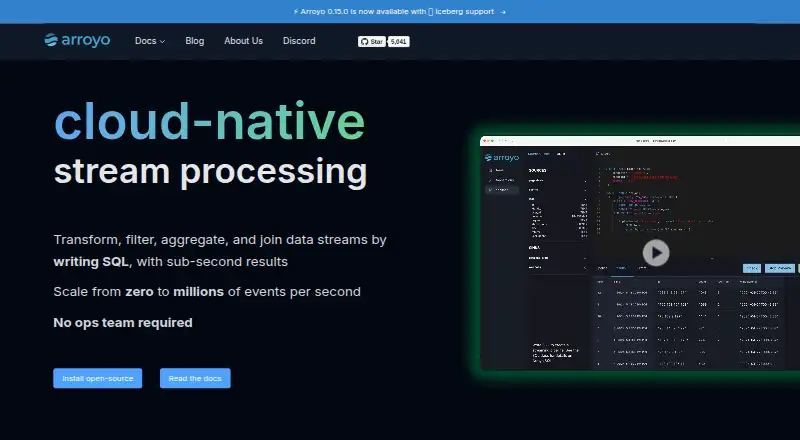
A web interface manages connections, SQL development and testing, user-defined functions and pipeline monitoring. A public REST API can create, operate and manage pipelines and connections. Stream processing software users can deploy a single binary or use Docker and Kubernetes.
Checkpoint and artifact storage can use S3-compatible services, R2, Google Cloud Storage, Azure Blob Storage or local files.
Good fit
Arroyo suits teams that need SQL-based processing for continuous events, with state, windows, joins and recovery controls. It can run locally on Linux or macOS, or as a distributed production cluster.
The single-node setup is aimed at testing and development. Production deployments use Arroyo’s scheduler or Kubernetes, with external checkpoint storage available.
Watch for
A single-node cluster is not intended for production. Running a production cluster requires deployment work, storage configuration and, with Kubernetes, access settings such as AWS IAM roles for service accounts.
Python user-defined functions require Python 3.12 or newer and manual package installation. Python functions cannot be asynchronous, while asynchronous Rust functions have configurable concurrency and timeout limits.
Arroyo collects limited anonymous usage telemetry by default; you can disable it with DISABLE_TELEMETRY=true.
Pricing
The Arroyo engine is free and open source under the Apache 2.0 license. The open-source options are self-hosted on Linux or macOS, Docker or Kubernetes, or available as a single binary.
A Cloudflare Workers Paid with Pipelines plan costs $5 a month, billed monthly. It includes 50 GB a month of SQL transforms, 50 GB a month of sink delivery and unlimited stream ingress. Extra usage is $0.04 per GB for SQL, $0.03 per GB for JSON sinks and $0.06 per GB for Parquet or Iceberg sinks.
Verdict
Choose Arroyo if you want open-source, self-hosted stream processing built around SQL and need stateful windows, joins or exactly-once recovery. Its REST API and web interface also suit teams that want pipeline control without writing every operation by hand.
Plan for infrastructure work when moving beyond local tests: production uses a distributed cluster, and you must arrange checkpoint storage and deployment access.
Our take
Arroyo is a fit for teams that need continuous SQL processing with state, joins, event-time windows and recovery guarantees, while keeping the engine self-hosted and open source. Linux and macOS support make local development accessible, and the web UI plus REST API cover day-to-day pipeline work. The main trade-off is operational: production requires a distributed deployment and configured checkpoint storage. Python extensions also have version and packaging requirements.
- Open-source Apache 2.0 engine with free self-hosted plans
- SQL supports windows, joins and more than 300 functions
- Checkpointing enables recovery and exactly-once processing
- Connectors cover Kafka, cloud streams, databases and storage
- Web UI and REST API manage pipelines and connections
- Single-node deployment is for testing, not production
- Production requires distributed-cluster and storage setup
- Python UDFs need Python 3.12+ and manual packages
- Postgres currently relies on Debezium through Kafka
- Python UDFs do not support asynchronous functions
- Pick it ifTeams building stateful SQL pipelines over event streams; Self-hosted deployments on Linux, macOS, Docker or Kubernetes; Users needing REST control and exactly-once processing
- Skip it ifYou need a single-node production deployment; You want a fully managed service without cluster operations; Your extensions depend on asynchronous Python UDFs
Pricing
The core Arroyo engine is free and Apache 2.0 licensed for self-hosting. A Cloudflare Workers Paid with Pipelines option costs $5 a month, with included monthly data allowances and usage charges after them.
- Arroyo open-sourceApache 2.0 engine · self-hosted on Linux/macOS, Docker or KubernetesFree
- Open-source Arroyo EngineApache 2.0 licensed; single binary; self-hostedFree
- Cloudflare Workers Paid with Pipelinesmonthly · 50 GB/month SQL transforms · 50 GB/month sink delivery · unlimited stream ingress · $0.04/GB additional SQL · $0.03/GB JSON sink · $0.06/GB Parquet/Iceberg sink$5/mo
As doc.arroyo.dev lists them, checked 15 Oct 2026.
Questions
Is Arroyo free?
Yes. The open-source Arroyo engine is free under the Apache 2.0 license. A Cloudflare Workers Paid with Pipelines plan costs $5 a month.
Where can Arroyo run?
Local support covers Linux and macOS. You can also run it as a self-hosted binary, with Docker or on Kubernetes.
What data systems connect to Arroyo?
Connectors include Kafka, Confluent Cloud, Kinesis, MQTT, NATS, MySQL, Redis, Redpanda, Delta Lake, Iceberg, HTTP, WebSocket and webhooks. Postgres uses Debezium through Kafka for now.
Does Arroyo have an API?
Yes. Its public REST API can create, operate and manage pipelines, connections and related resources.
Can Arroyo process data exactly once?
It supports exactly-once processing with checkpointed state, including out-of-order data and machine failures.
Can I add custom functions?
Yes. Scalar functions can be written in Rust or Python. Aggregate and asynchronous functions are currently Rust-only; Python requires version 3.12 or later.