AsyncUp: Open-Source Google Chat Standups
github.com · checked 15 Oct 2026
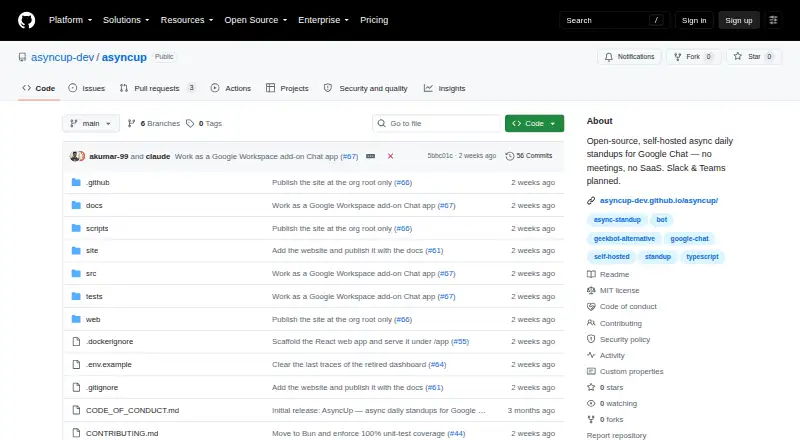
Open-source, self-hosted asynchronous standups for Google Chat.
How it plugs in
Signal on Daily Standup Software7.3#1 of 24
AsyncUp runs asynchronous daily standups inside Google Chat. It sends question cards, collects mood and work updates, posts team threads, and tracks blockers. Teams can customize questions, manage time zones and leave, review reports, and connect webhooks to other services. Alongside the self-hosted service, it offers a web app and JSON API.
Review
In a line
AsyncUp brings asynchronous daily standups to Google Chat as an open-source project. You can host the web service yourself or work through its API.
What it does
Each workday, AsyncUp sends participants a direct-message card with three questions and a mood control. It then places their replies in a dated team-space thread; when the deadline arrives, the service reports how many submissions it received and flags required participants who stayed silent. Administrators can set different questions for each standup, turn mood collection on or off, and mark participants as mandatory or optional.
Participants can set a local time zone, use vacation or skip controls, and receive reminders or late flags. If enabled, Google Calendar out-of-office data automatically marks people as away. Blocker records support teammate acknowledgments and updates, while stale items trigger nudges and escalation DMs.
The bundled web app includes Google sign-in, guided setup, standup management, blocker views, reports, team settings, and personal pages. A poll command creates a live card for voting, changing votes, and closing results.
How it connects
Google Chat is the current chat adapter. Slack and Microsoft Teams appear on the project’s planned list rather than among available integrations. An optional Google Calendar out-of-office link can mark participants away.
Per-standup JSON webhooks fire on submissions and wrap-ups, allowing data to flow to Sheets, Zapier, n8n, or another service. The project also exposes a JSON API, an MCP server for Claude Code, and a ChatAdapter interface for adding chat platforms.
AsyncUp is released under the MIT license. Its Docker deployment starts with embedded SQLite, and a DATABASE_URL setting switches it to PostgreSQL. The maker says it has no telemetry and keeps operation inside the operator’s infrastructure.
Good fit
AsyncUp suits Google Workspace teams that want standups to happen in chat without relying on a hosted vendor. It fits groups that need local-time prompts, optional leave handling, blocker follow-up, and participation reports.
It is also a fit for teams that can operate a small container and want to change the source code or connect standup events to other services through webhooks or the API.
Watch for
For now, Google Chat is the required platform; Slack and Microsoft Teams cannot be used. Initial setup calls for a Google Workspace domain, a one-time Google Chat app configuration, and a host that exposes a small container at an HTTPS URL.
You are responsible for running the service. The project describes a deployment using one vCPU and 512 MB of memory, with SQLite or a configurable PostgreSQL database. Check that your team can manage Docker, storage, updates, and access controls.
The project includes SAML 2.0 sign-in for Google Workspace, Okta, Entra, and OneLogin, plus a SCIM 2.0 provisioning endpoint.
Pricing
AsyncUp is free. It is open source and self-hosted, and no paid plan is listed. There is no free trial because the available plan is already free.
Your costs may come from the host and from operating the container, rather than from an AsyncUp subscription.
Verdict
Choose AsyncUp if your team already works in Google Chat and wants control over where standup data runs. Its web app, reports, blocker workflow, webhooks, and API cover more than a simple question bot.
Pass if Slack or Microsoft Teams is a current requirement, or if maintaining a Docker deployment and database is not acceptable. The free, MIT-licensed code makes it worth considering for teams comfortable with self-hosting.
Our take
AsyncUp is a practical choice for Google Workspace teams that want daily check-ins, blocker follow-up, and reporting without a subscription. It lets teams customize questions and participation categories, while deployment choices keep the service in the operator’s infrastructure. The trade-off is operational: you need a Google Chat app, an HTTPS host, and someone to run the container and database. Its current chat support is limited to Google Chat, while other major chat platforms are only planned. Pick it when self-hosting and open code matter more than a fully managed service.
- Free and open-source under the MIT license
- Runs on your own infrastructure with no telemetry claimed
- Google Chat cards, threads, reminders, and blocker tracking
- JSON API, webhooks, CSV export, and reporting tools
- SAML sign-in and SCIM provisioning are included
- Google Chat is the only supported chat adapter today
- Requires Google Workspace setup and an HTTPS host
- You must operate the Docker container and its database
- Slack and Microsoft Teams support is only planned
- No paid hosted plan or free trial is listed
- Pick it ifGoogle Workspace teams running self-hosted standups; Teams that need blocker tracking and participation reports; Operators connecting standups to Sheets, Zapier, or n8n
- Skip it ifYou need Slack or Microsoft Teams support now; You want a managed service instead of running Docker and a database; Your team cannot complete Google Chat app setup
Pricing
AsyncUp has a free plan, with no paid starting price listed. The project is open source and self-hosted, so hosting and maintenance remain your responsibility. There is no separate free trial.
- Freeopen source · self-hosted · one container · forever freeFree
As github.com lists them, checked 15 Oct 2026.
Questions
Is AsyncUp free?
Yes. The available plan is free, and the project is open source and self-hosted. No paid starting price is listed, and there is no separate free trial.
Which chat apps does AsyncUp support?
Google Chat is the currently supported adapter. Slack and Microsoft Teams are planned but are not available integrations.
Can AsyncUp track blockers?
Yes. It records blockers, supports teammate acknowledgment and updates, and sends reminders and escalation messages for stale blockers.
Can teams change the standup questions?
Yes. Administrators can define different questions for each standup and switch the mood selector on or off. Participants can be mandatory or optional.
Does AsyncUp connect to Google Calendar?
An optional Google Calendar out-of-office connection can mark people away automatically. Participants can also use vacation and skip controls.
Can AsyncUp send data to other tools?
Per-standup JSON webhooks fire on submissions and wrap-ups and can deliver data to Sheets, Zapier, n8n, or another service. A JSON API is also available.
What does self-hosting require?
You need a Google Workspace domain, a one-time Google Chat app configuration, and a host for a small Docker container with an HTTPS URL. The project describes a one-vCPU, 512 MB deployment.
Does AsyncUp offer single sign-on?
SAML 2.0 sign-in is available for Google Workspace, Okta, Entra, and OneLogin, together with a SCIM 2.0 provisioning endpoint.