AutomaDocs Review: GitHub Documentation Generation
automadocs.com · checked 15 Oct 2026
AutomaDocs turns GitHub code into documentation and keeps it updated after pushes.
How it plugs in
Signal on AI Documentation Generators6.3#10 of 28
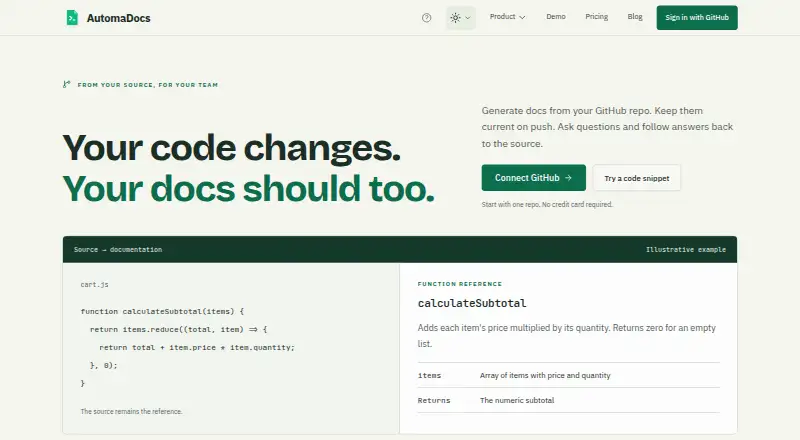
AutomaDocs builds README files, API references, function notes, architecture overviews, and setup guides from GitHub repositories. It refreshes pages after code pushes, offers chat answers with file and line citations, and exports Markdown. The service runs as hosted cloud software, an API, or self-hosted deployment.
Review
In a line
Documentation is built from GitHub repositories and regenerated when pushed code changes. AutomaDocs also handles plain-language codebase questions, pointing to the pertinent files and functions.
What it does
After you connect a repository, the service can produce README files, API references, function notes, architecture overviews, and getting-started guides. You can edit the resulting pages, and AutomaDocs says those changes are preserved and merged into subsequent AI updates.
GitHub webhooks start regeneration for changed files after a push. Jobs typically finish in under two minutes. Health scores report the share of functions that have documentation: 80% or more is green, while below 40% is red.
Its chat uses keyword and meaning-based search to answer code questions in plain language, with links to files and line numbers. Documentation can be exported as Markdown.
How it connects
AutomaDocs connects to GitHub with OAuth and webhooks. An optional GitHub App can provide extra permissions. The product also advertises a command-line tool, a GitHub Action, an MCP server, and integrations with Claude Code, Cursor, Windsurf, and VS Code. Claude Code and Cursor can use the documentation through MCP.
Pro and Team plans include a REST API for creating, updating, and querying documentation. The MCP server provides tools to list repositories, search and read documents, check coverage, and ask questions.
JavaScript, TypeScript, Python, Go, Rust, and Java receive full Tree-sitter code-structure parsing. Other languages receive best-effort analysis by Claude. The reviewed pages do not state an open-source license.
Good fit
The stated audience is engineering managers and technical leads at small and mid-size product teams that ship in GitHub. It suits teams that want documentation generated from source code, refreshed after pushes, and available to AI coding tools.
It can help with repository guides, API explanations, architecture summaries, and finding code details through cited chat answers.
Watch for
Treat generated pages as drafts and review examples, edge cases, and names before publishing. Other languages rely on Claude analysis rather than full Tree-sitter parsing.
Repository content is processed by Anthropic Claude, Pinecone, and sometimes OpenAI. The policy says subprocessors do not train models on customer code. Documentation and embeddings are removed within 24 hours after repository deletion; account deletion removes associated data immediately.
AutomaDocs describes TLS, ownership checks, signed webhook validation, rate limiting, and several login protections, but does not claim a specific third-party certification. Support is self-serve email, with no phone line, SLA, or account manager.
Pricing
The Free plan costs $0 and includes one repository, 50 AI chat messages per month, core documentation generation, GitHub integration, push auto-sync, and self-serve help.
Pro costs $39 a month, billed at $470 per year. It adds 20 repositories, unlimited AI chat, full API and MCP access, and email support for account and billing matters.
Team costs $119 a month, billed at $1,430 per year. It includes unlimited repositories, 10 seats, custom documentation domains, SSO, API access, audit logs, and unlimited AI chat. Custom pricing is available by request with annual invoicing for volume or unusual procurement; it has no custom SLAs or dedicated representatives.
Verdict
Choose AutomaDocs if your source code lives in GitHub and you want documentation that follows code changes without maintaining every page by hand. Its cited chat, Markdown export, health scores, API, and MCP access cover both readers and developer tools.
Check language coverage, review generated drafts, and confirm your data requirements before adopting it. The free tier is limited to one repository and 50 monthly chat messages. Teams needing formal certification, guaranteed response terms, phone support, or a dedicated contact should look elsewhere.
Our take
AutomaDocs fits GitHub-based product teams that need recurring documentation from source code and want answers tied to files and lines. The free plan offers a way to start with one repository, while Pro and Team add broader repository limits, API or MCP access, seats, and administration features. Before choosing it, confirm that your languages receive the desired analysis, review AI-written pages, and accept the stated processing by Claude, Pinecone, and sometimes OpenAI. Its published support model has no phone service, SLA, or dedicated account manager.
- Produces multiple documentation formats from GitHub source code
- Regenerates changed documentation after pushes, typically under two minutes
- Chat responses point to relevant files and line numbers
- Markdown export and REST API, with MCP included on Pro
- Docker Compose and setup scripts enable a self-hosting option
- The free plan permits one repository and 50 AI chat messages each month
- Non-listed languages receive best-effort Claude analysis
- Generated pages need human review before publication
- No stated third-party security certification
- Support has no phone line, SLA, or dedicated representative
- Pick it ifSmall and mid-size GitHub product teams; Engineering managers and tech leads responsible for code documentation; Teams using Claude Code, Cursor, Windsurf, or VS Code
- Skip it ifYou need a stated third-party certification, formal SLA, or phone support; Your repositories use languages that need more than best-effort analysis; You want unlimited free repositories or chat
Pricing
The free option allows one repository and 50 AI chat messages per month. Pro is $39/mo when billed annually at $470/year; Team is $119/mo billed annually at $1,430/year. Custom pricing is available on request.
- Free1 repository · 50 AI chat messages/month · core documentation generation · GitHub integration · auto-sync on push · self-serve helpFree
- ProBilled $470/year · 20 repositories · unlimited AI chat · auto-sync · full API + MCP access · async account and billing email$39/mo
- TeamBilled $1430/year · Unlimited repositories · 10 seats · custom documentation domains · SSO (SAML, OIDC) · API access · audit logs · unlimited AI chat$119/mo
- CustomAnnual invoicing available · Volume or unusual procurement · same platform and features as Team · no custom SLAs · no dedicated representativesOn request
As automadocs.com lists them, checked 15 Oct 2026.
Questions
Does AutomaDocs update documentation automatically?
Yes. GitHub webhooks trigger regeneration for changed files after pushes, typically finishing in under two minutes.
Which programming languages get full parsing?
JavaScript, TypeScript, Python, Go, Rust, and Java receive full Tree-sitter parsing. Other languages receive best-effort Claude analysis.
Can I ask questions about my code?
Yes. AI chat handles plain-language repository questions and points to relevant files and line numbers.
Can I export the generated documentation?
Yes. Documentation can be exported as Markdown.
Is there a free plan?
Yes. The free option provides one repository, 50 AI chat messages per month, core generation, GitHub integration, push auto-sync, and self-serve help.
Can AutomaDocs be self-hosted?
Yes. Docker Compose and setup scripts are described as supporting self-hosting; managed cloud is the default.
How is repository data handled?
Repository content may be processed by Anthropic Claude, Pinecone, and sometimes OpenAI. The policy says subprocessors do not train models on customer code.