Bagisto: Self-Hosted Laravel Ecommerce
bagisto.com · checked 15 Oct 2026
Open-source Laravel commerce software for stores, marketplaces, and B2B operations.
How it plugs in
Signal on Ecommerce platforms7.8#4 of 280
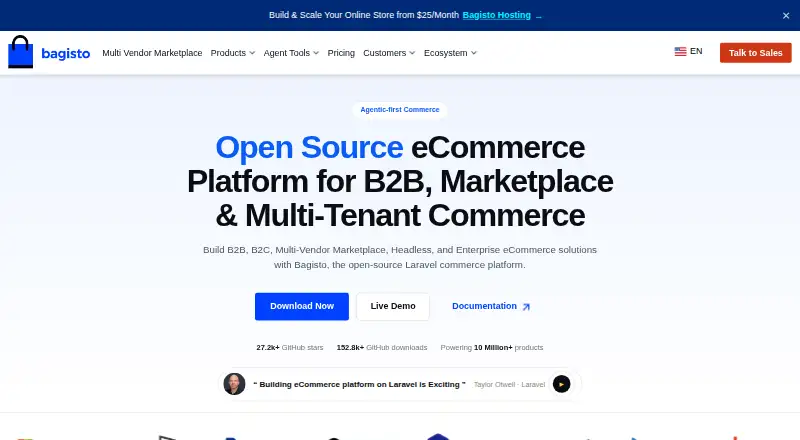
Built with Laravel, Bagisto provides open-source ecommerce software that you host yourself. It supports stores, marketplaces, B2B commerce, and multi-tenant SaaS stores. Features include multiple storefronts, product and inventory management, payments, reporting, APIs, and headless frontends. It is available for web, mobile, Linux, Windows, and self-hosted deployments.
Review
In a line
Built on Laravel, Bagisto gives teams open-source software for operating online stores, marketplaces, and B2B commerce sites. Deployment is self-hosted rather than subscription-hosted.
What it does
Products may be simple, configurable, virtual, downloadable, grouped, bundled, or booking-based. A single administration panel can run several storefront channels, each with its own domain, theme, catalog, language, and currency.
Inventory is tracked across warehouses and physical stores, while the platform handles invoices, shipments, refunds, returns, and EU withdrawal requests. Promotion tools include catalog and cart rules, coupons, email campaigns, sitemaps, and search optimization; reporting and a multivendor marketplace are included as well.
Point-of-sale tools let retailers synchronize orders and inventory between physical outlets and their online store. Magic AI can write product descriptions, generate product imagery, and translate reviews. Progressive Web App support provides app-like mobile storefront experiences.
How it connects
The integration catalog covers marketplaces, payments, shipping, analytics, CRM, ERP, and product information management. Examples include Amazon, eBay, PayPal, Stripe, FedEx, Google Analytics, and Akeneo.
REST and GraphQL endpoints handle commerce tasks such as carts, checkout, shipping, and payments. They are documented for headless storefronts, mobile applications, third-party integrations, PWAs, and custom administration interfaces. The separate bagisto/bagisto-api Composer package supplies these APIs.
With headless deployment, the storefront and backend remain separate, and frontends can be built with React, Vue, Angular, or Next.js. Bagisto is open source, and its documentation covers merchant setup, development, themes, extensions, integrations, APIs, and architecture.
Good fit
Bagisto suits teams that want to operate ecommerce software on their own servers and can meet its hosting requirements. It can serve a single store, several regional storefronts, a marketplace with multiple sellers, or a B2B operation.
It fits projects that need multiple languages, right-to-left support, several currencies, warehouse inventory, digital products, mobile storefronts, or custom frontends. Its APIs and package-based Laravel architecture also suit businesses building their own interfaces and extensions.
Watch for
Self-hosting calls for Apache 2 or NGINX, at least 4 GB of RAM, a 1 GHz-or-faster processor, Node 18.12.0 LTS or later, and Composer 2.5 or later. Downloads are offered through Composer, a source package, or cloud and AWS deployment.
Bagisto has no abandoned-cart recovery. Shop API storefront keys start with a 100-requests-per-minute limit, which can be configured as high as 5,000 requests per minute or set to unlimited.
Check whether your team can maintain a Laravel installation and its extensions. Headless-platform support includes three months of free support, but the facts do not describe broader support terms.
Pricing
The Bagisto plan costs nothing and provides an open-source download for self-hosting. Requirements include PHP 8.3 or later, MySQL 8.0.32 or later or MariaDB 10.3 or later, and at least 4 GB of RAM.
Bagisto Open Source likewise has no charge; its source code is included and there is no subscription fee.
Verdict
Choose Bagisto if you want open-source ecommerce software that you control on your own infrastructure, especially for several storefronts, marketplace selling, B2B work, or a custom headless frontend.
It is a poor match if you need a hosted service, do not want to manage server requirements, or depend on built-in abandoned-cart recovery.
Our take
Bagisto makes sense for organizations seeking a no-subscription ecommerce system with source code, multiple storefronts, marketplace support, and documented REST and GraphQL APIs. Its self-hosted approach lets technical teams control deployment and custom frontends, while built-in tools address products, inventory, orders, payments, promotions, and reporting. The tradeoff is operational responsibility: compatible infrastructure and Laravel maintenance are required. Stores that rely on abandoned-cart recovery should look elsewhere because that feature is not included.
- Free download with source code and no subscription fee
- Supports stores, B2B commerce, marketplaces, and multiple storefronts
- Commerce APIs handle carts, checkout, shipping, and payments
- Runs self-hosted with web, mobile, Linux, and Windows options
- Includes multi-language, multi-currency, and warehouse inventory tools
- Requires self-hosting and specific server, PHP, database, Node, and Composer versions
- Abandoned-cart recovery is unavailable
- Shop API storefront keys begin at 100 requests per minute
- Headless support lists three months of free support only
- Pick it ifTeams building self-hosted stores or marketplaces; Businesses needing multiple storefronts and custom frontends; Developers seeking open-source Laravel ecommerce software
- Skip it ifYou need a hosted ecommerce service with no server maintenance; Built-in abandoned-cart recovery is essential; Your infrastructure cannot meet the listed requirements
Pricing
Both plans carry no charge. Bagisto is a self-hosted open-source download, while Bagisto Open Source includes the source code without a subscription fee. Compatible hosting and infrastructure remain your responsibility.
- BagistoFree open-source download · self-hosted requirements: PHP 8.3+, MySQL 8.0.32+ or MariaDB 10.3+, 4 GB RAM or higherFree
- Bagisto Open Sourceself-hosted Laravel eCommerce platform · source code included · no subscription feeFree
As bagisto.com lists them, checked 4 Oct 2026.
Questions
Is Bagisto free?
Yes. Both Bagisto offerings are listed at no cost, and the open-source plan has no subscription fee.
Can Bagisto run on my own server?
Yes. It is self-hosted and lists Apache 2 or NGINX, at least 4 GB of RAM, Node 18.12.0 LTS or later, and Composer 2.5 or later as requirements.
Does Bagisto have an API?
Yes. REST and GraphQL interfaces cover commerce work including cart, checkout, shipping, and payment, delivered through the bagisto/bagisto-api Composer package.
Can Bagisto run multiple stores?
Yes. One administration panel can operate multiple storefront channels with distinct domains, themes, catalogs, languages, and currencies.
Does Bagisto support marketplaces?
Yes. Its multivendor capability lets multiple sellers manage their own products.
Does Bagisto recover abandoned carts?
No. Abandoned-cart recovery is not available in the listed feature set.
Which payment services does Bagisto document?
Documented methods include Stripe, PayPal, Razorpay, PayU, PhonePe, PayGlocal, cash on delivery, and money transfer.