Sylius: Open-Source Headless Ecommerce Framework
sylius.com · checked 15 Oct 2026
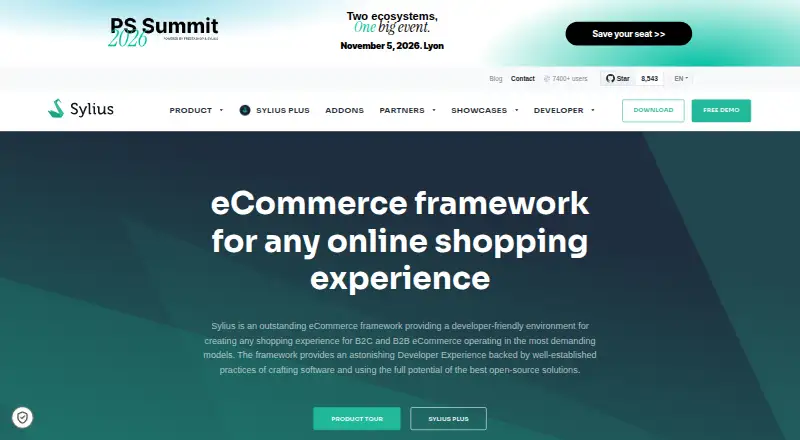
Open-source, headless ecommerce for customizable B2C and B2B stores.
How it plugs in
Signal on Ecommerce platforms7.7#6 of 280
Sylius is a Symfony-based, self-hosted framework released as open source. It can power tailored B2C and B2B stores with multiple currencies, languages and sales channels, alongside catalog, promotion, payment, shipping and tax features. Headless storefronts and integrations can use its customizable REST API. Standard is free with community support, while Sylius Plus provides commercial modules and SLA-backed assistance for €800 a year.
Review
In a line
Sylius provides open-source building blocks for custom online stores. Its headless design lets teams alter data, business rules, checkout and the customer-facing site independently.
What it does
The platform covers B2C and B2B commerce. Its catalog handles products, variants, attributes, images, descriptions, categorization and channel-specific pricing.
One administration area can manage stores across currencies, languages and channels. Core tools include promotions, coupons, shipping and tax rules, while optional Plus modules add multi-source inventory, returns, loyalty, partial shipments and requests for quotation.
Sylius also offers suites for organization-focused B2B buying and for marketplaces with vendor onboarding, payment splitting, reporting and document processing.
How it connects
Sylius uses a self-managed hosting model, with deployments possible on a virtual private server, Docker or Kubernetes. The software is distributed as Symfony packages and can be extended with plugins from its addons marketplace and Packagist.
Headless storefronts and other services can connect through Sylius's REST interface, which uses API Platform. Official and ecosystem payment connections include Stripe, PayPal, Mollie and Adyen. An app marketplace lists additional plugins and integrations.
The Community Edition is open source under the MIT license. Standard can be installed with Composer or Docker; Windows use is through WSL.
Good fit
Sylius suits mid-market and enterprise brands that need a tailored ecommerce setup rather than a fixed storefront. It can support demanding B2C and B2B business models.
It is a fit for teams that want to host the software themselves, build their own frontend, or connect commerce services through an API. Multi-channel pricing and international storefront management help when one administration area must serve several markets.
Watch for
Self-hosting means your team handles the server environment. Current requirements include PHP 8.2 or newer, several PHP extensions and Composer; Windows users run it through WSL.
Standard has community support with no response-time guarantee. It also lacks a native quotation process, so customers cannot start price inquiries online. The full reference book in the documentation requires a login.
A September 2026 Sylius advisory described four security flaws, two of which could enable administrator takeover. Its 2026 Mollie plugin update addressed payment-status forgery and order-ID data exposure, so keep plugins and releases maintained.
Pricing
Sylius Standard is free under the MIT license. It is an on-premise edition with community support and no guaranteed response time.
Sylius Plus costs €800 a year. It is a commercial, on-premise license with SLA-backed support, a one-day response time and enterprise modules such as advanced multi-store, returns, multi-source inventory, loyalty, partial shipment and quotation tools.
Verdict
Choose Sylius when your business needs a self-hosted commerce foundation that can be reshaped around unusual B2C or B2B processes. Its open code, API and Symfony package structure leave room for custom storefronts and integrations.
Avoid it if you need a managed service, guaranteed help without paying for Plus, or built-in online quotation handling in the free edition.
Our take
Sylius makes sense for organizations with developers and infrastructure skills that need control over commerce logic, storefronts and hosting. Standard removes the licensing cost, while Plus supplies enterprise modules and defined support for €800 a year. However, running it is your responsibility, and Standard support has no response promise. Businesses needing a ready-made hosted service, simple setup or online quotation requests should look elsewhere.
- Free MIT-licensed Standard edition
- Custom REST API for storefronts and integrations
- Supports B2C, B2B and marketplace models
- Multi-currency, multi-locale and multi-channel management
- Deploys on VPS, Docker or Kubernetes
- Self-hosting and PHP administration are required
- Community support for Standard has no response-time guarantee
- Standard lacks native online quotation requests
- Complete reference documentation requires a login
- Security updates and plugin maintenance remain important
- Pick it ifMid-market and enterprise brands seeking custom ecommerce; Teams building headless B2C or B2B storefronts; Businesses requiring self-hosted, multi-channel commerce
- Skip it ifYou want a managed storefront instead of running servers; Guaranteed support is required without purchasing Sylius Plus; Online quotation requests must be built into the free edition
Pricing
Standard has no charge; Plus is €800 per year and adds commercial licensing, enterprise modules and SLA-backed support with a one-day response time.
- Sylius Plusstarts from 800€ / year · Commercial license · on-premise · SLA-backed support · one-day response time · enterprise modules€800/yr
- Sylius StandardMIT license · on-premise · community support · no response guaranteeFree
As sylius.com lists them, checked 15 Oct 2026.
Questions
Is Sylius free?
The Standard edition is MIT-licensed free software. Sylius Plus is the paid edition and costs €800 a year.
Where can Sylius run?
Deploy it on a virtual private server or use Docker or Kubernetes. Windows users run it through WSL.
Can Sylius expose an API?
Yes. Its customizable REST interface, built with API Platform, serves headless storefronts and integrations.
What payment services connect to Sylius?
Official and ecosystem integrations include Stripe, PayPal, Mollie, Adyen and other payment providers.
What support comes with each plan?
Standard offers community support without a response-time guarantee. Plus lists SLA-backed support with a one-day response time.
Can Sylius handle B2B commerce?
Yes. It supports B2B models, and Sylius Plus adds organization-focused shopping, tailored price lists and order-management tools.
What does Sylius Standard lack for quotations?
There is no native quotation workflow in Standard, so customers cannot initiate price inquiries online.