BAP (Binary Analysis Platform) Review
binaryanalysisplatform.github.io · checked 7 Oct 2026
BAP is a free, open-source toolkit for analyzing compiled programs and firmware.
How it plugs in
Signal on Reverse Engineering Tools6.3#11 of 73
BAP (Binary Analysis Platform) is a free, MIT-licensed toolkit for examining programs in their machine-level form. It runs on Linux or as self-hosted software, with command-line and library use. Its tools cover disassembly, control-flow graphs, interpretation, symbolic execution, and custom analysis through plugins. BAP is aimed at security analysis, verification, and reverse engineering.
Review
In a line
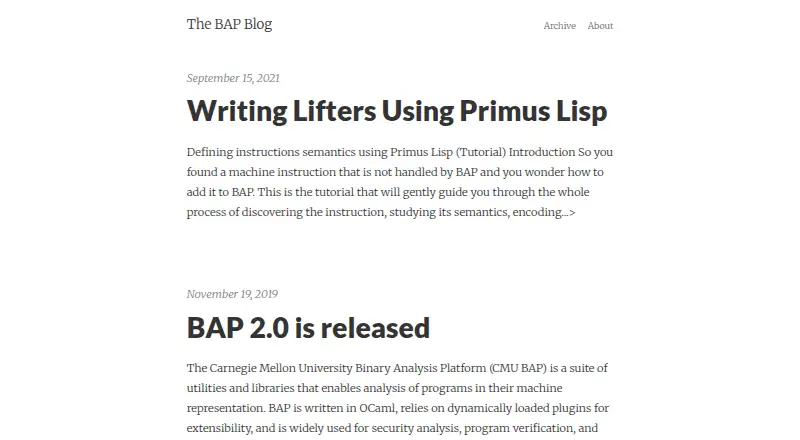
BAP is a collection of utilities and libraries for studying compiled programs in their low-level machine form. It is free, open-source software under the MIT License.
What it does
Its command-line `disassemble` tool converts a binary into an architecture-neutral form, creates a control-flow graph, and runs analysis passes you define.
BAP includes standard and microexecution interpreters, plus a symbolic executor. It is used for security analysis, program verification, reverse engineering, and firmware analysis.
How it connects
BAP supports x86, x86-64, ARM, MIPS, and PowerPC. Plugins can add more architectures, add analyses, or change existing behavior without rebuilding BAP.
The default LLVM loader reads ELF, Mach-O, and COFF files, including Windows PE. Documented interfaces and plugins connect BAP with IDA Pro, Ghidra, and LLVM.
You can run BAP from the command line or embed it in OCaml and other-language applications through C bindings. Primus Lisp is its language for writing analyses, describing verification conditions, modeling functions, and working with an SMT solver. Python support is minimal.
Good fit
BAP suits researchers and security or reverse-engineering teams that need programmable binary analysis. Its plugin system and library mode help when built-in analysis needs to be extended or placed inside another application.
It runs on Linux and can be self-hosted. The project also lists support for Android, iOS, macOS, VxWorks, FreeBSD, OpenBSD, Windows, MS-DOS, UEFI, and standalone use.
Watch for
BAP does not include a decompiler. Python access is described as minimal, and writing analyses in OCaml requires a source installation because binary packages do not include the OCaml development environment.
Prebuilt packages target Debian and Red Hat derivatives; other distributions use tgz archives. OCaml developers are directed to install through opam. Missing system dependencies may require help through the project's chat.
Pricing
BAP has one free plan. There is no paid tier and no free trial because the software itself is free.
Verdict
Choose BAP if you need a no-cost, extensible framework for analyzing binaries or firmware and can work with its Linux, self-hosted, or library-based setup.
Look elsewhere if you need a decompiler, more than minimal Python support, or a packaged OCaml development environment.
Our take
BAP is a practical choice for people who need programmable analysis of compiled code without a software bill. Its coverage spans common processor families, several executable formats, firmware work, and connections to established analysis tools. The trade-off is a technical setup: Linux or self-hosting, plugin-based extension, and limited Python support. OCaml development also requires installing from source. Teams wanting a decompiler or a simpler desktop workflow should consider a different tool.
- Free plan with no license charge
- MIT License permits modification and redistribution
- Supports five processor families and plugin-added architectures
- Includes interpreters, symbolic execution, and control-flow analysis
- Works with IDA Pro, Ghidra, and LLVM
- No decompiler
- Python support is minimal
- OCaml analysis work needs a source installation
- Prebuilt packages cover selected Linux distributions
- Pick it ifSecurity analysis and reverse engineering; Researchers building custom binary-analysis passes; Firmware and verification work
- Skip it ifYou need a decompiler; You require more than minimal Python support; You want a turnkey desktop application
Pricing
BAP is free under its single free plan. There is no paid tier or free trial.
- BAPOpen source binary analysis platformFree
As github.com lists them, checked 7 Oct 2026.
Questions
What is BAP?
BAP is a suite of utilities and libraries that analyzes programs in their machine-level representation.
Which processors does BAP support?
It supports x86, x86-64, ARM, MIPS, and PowerPC. Plugins can add other architectures.
Can BAP analyze firmware?
Yes. Firmware analysis is listed as a supported use.
Does BAP include a decompiler?
No. The listed capabilities cover disassembly, interpreters, symbolic execution, and other analyses.
Can I connect BAP to other tools?
Documented interfaces and plugins connect it with IDA Pro, Ghidra, and LLVM.
How can I extend BAP?
Plugins can add analyses or alter existing functions without recompiling BAP. Primus Lisp can define analysis logic and verification conditions.
Where can BAP run?
It runs on Linux and can be self-hosted. The project also lists Android, iOS, macOS, Windows, FreeBSD, OpenBSD, VxWorks, MS-DOS, UEFI, and standalone support.
What license does BAP use?
The repository uses the MIT License, allowing use, copying, modification, distribution, sublicensing, and sale under its terms.