
Billingly Utility Billing Software
billingly.com · checked 9 Oct 2026
Configurable utility billing and customer information software for meter-to-cash operations.
How it plugs in
Signal on Utility Billing Software5.1#18 of 26
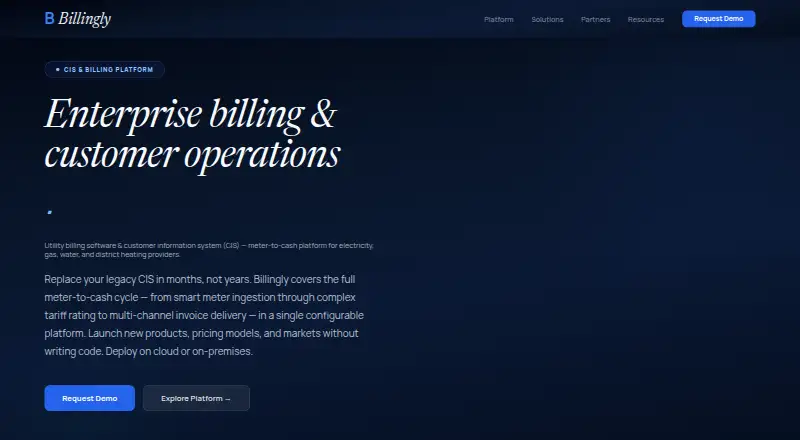
Billingly combines utility billing with customer and contract records. It supports electricity, gas, water, district heating and other recurring services. The system handles mass invoicing, configurable tariff formulas, meter-data imports, supplier switching and customer portals. It runs as web software, an API, SaaS or on-premises deployment. Pricing is available by request.
Review
In a line
Billingly is a configurable utility billing and customer information system for meter-to-cash work. It is aimed at utilities and other providers that bill recurring services.
What it does
The billing engine creates periodic mass invoices, applies consumption charges and corrections, groups invoices, and sends them by email, paper or electronic invoice. Pricing rules use configurable formulas for rates, corrections and invoice lines.
Its customer system links records, contacts, contracts, premises, connection points, metering points, properties and GDPR consents. It also supports contract lifecycle work, network hierarchies, automated supplier switching, payment processing and a customer account portal.
Meter readings enter through an asynchronous meter-data pipeline using REST requests and Amazon S3 staging. The site describes retries and forecast fallback for that process.
How it connects
Billingly lists REST APIs, meter-data and national address registry integrations, financial-system exports, and pre-built Amazon S3 and SQS connectors. It can run through a web interface or API and can be deployed as SaaS or on-premises.
The platform states that it has ISO 27001 security compliance, role-based access controls and structured audit logs. It lists GDPR support with an EU-only data-residency option. For its AI reporting assistant, customer data stays out of external AI services, and the reporting dataset excludes or masks personal information.
Good fit
Billingly is presented for energy retailers, water utilities, district heating providers, telecom and internet operators, waste-management companies and SaaS businesses. It covers electricity, gas, water, district heating and other recurring services.
It fits teams that need mixed billing, rate management, meter-data imports, customer and contract records, supplier switching, payment processing and a customer portal in one system.
Watch for
Billingly is focused on utilities and recurring-service operations. Check that its configurable formulas, meter-data process and required integrations match your billing rules and systems.
The site describes 99.9% platform uptime, capacity for 600K+ invoices per run and 200 concurrent users. These are stated capacity figures, so confirm the fit for your own workload.
The site offers tailored product demos, and technical documentation or tailored walkthroughs can be requested from its team.
Pricing
Billingly is paid software, with pricing available on request. Product pages point buyers to request a demo or speak with sales; they do not state plan prices.
Verdict
Choose Billingly if you run a utility or recurring-service operation that needs billing, customer information, meter data and contract workflows together, with API access and SaaS or on-premises deployment. Its stated security, privacy and EU data-residency options may matter for regulated operations.
Budgeting requires contacting sales because no prices are shown.
Our take
Billingly is a fit for organizations managing recurring utility services and needing one system for rates, invoices, meters, customers and contracts. Its REST interfaces, exports, S3 and SQS connectors, plus SaaS or on-premises deployment, support different operating setups. Security and EU residency statements may help teams with compliance requirements. The main buying drawback is limited public pricing: costs are not shown publicly and require contacting sales. It is less suitable for buyers who need a simple, self-priced product or who do not operate recurring-service billing.
- Handles mass invoices, consumption charges, corrections and grouped invoices
- Supports electricity, gas, water and district heating billing
- Offers REST APIs, exports, S3 and SQS connectors
- SaaS and on-premises deployment options are listed
- Includes customer records, contracts, meters and a portal
- States ISO 27001 compliance and an EU data-residency option
- Plan prices are not published
- Built for utilities and other recurring-service providers
- Meter data relies on a defined asynchronous pipeline
- Capacity and uptime figures are stated claims to verify for your workload
- Pick it ifUtilities and recurring-service providers; Teams needing billing, meter data and customer records together; Organizations requiring SaaS or on-premises deployment
- Skip it ifYou need publicly listed plan prices before contacting sales; Your work does not involve utility or recurring-service billing; You need a product outside the listed integration and deployment models
Pricing
Billingly is paid software, with pricing available on request. Product pages do not publish plan prices and direct buyers to request a demo or contact sales.
Questions
What is Billingly?
Billingly is a configurable utility billing and customer information system covering meter-to-cash operations.
Which industries does Billingly target?
It is presented for electricity, gas, water, district heating, telecom and internet providers, waste management, SaaS businesses and other recurring-service providers.
Can Billingly import meter data?
Yes. Meter readings can enter through an asynchronous pipeline using REST requests and Amazon S3 staging, with retries and forecast fallback described.
Does Billingly have an API?
Yes. Billingly lists REST APIs, along with meter-data and national address registry integrations, financial exports, Amazon S3 and Amazon SQS connectors.
Can Billingly run on premises?
Yes. The site says it can be deployed as SaaS or on-premises, and it is available through web and API platforms.
How much does Billingly cost?
Billingly is paid software, but product pages do not publish plan prices. They direct buyers to request a demo or contact sales.
How does Billingly handle AI reporting privacy?
Billingly says customer data is not sent to external AI services. Its reporting dataset excludes or masks personal information.
Near it
All alternatives →- M
 MuniBilling#17 on this board
- MUMuniSoft Utility Billing and Receivables#19 on this board
- URUtility Redefined CIS#16 on this board
- CCCayenta Customer Information System#20 on this board
- VUVIP Utility Billing#15 on this board
- NC
 NorthStar CIS#21 on this board
- VVoltio#14 on this board
- MLMuni-Link#22 on this board
- AU
 AMCS Utility Billing#13 on this board
- GUgWorks Utility Billing#23 on this board