
CI Failure Analysis And Flaky Test Tools
BuildPulse software review
buildpulse.io · checked 15 Oct 2026
BuildPulse monitors CI reliability, flaky tests, coverage, engineering metrics and code review.
How it plugs in
Signal on CI Failure Analysis And Flaky Test Tools6.7#1 of 21
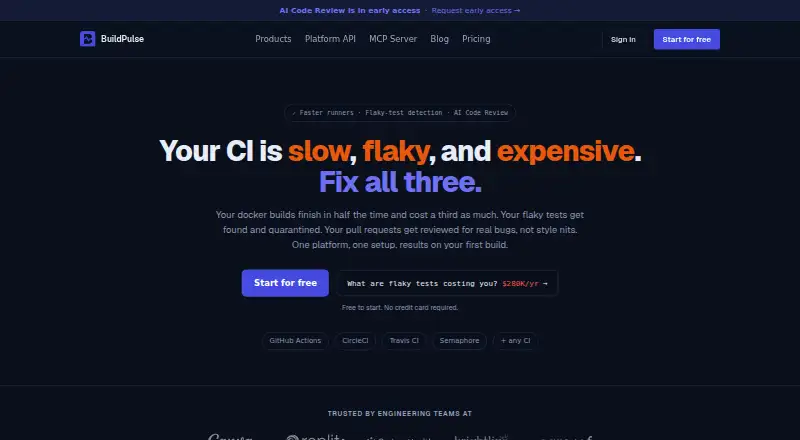
BuildPulse connects to continuous-integration systems and analyzes test results, coverage files and build data. It finds and quarantines flaky tests, tracks repository trends, supplies hosted runners and offers an early-access AI pull-request reviewer. Plans start at $99 a month, with a free runner allowance and a free plan available.
Review
In a line
BuildPulse is a service for monitoring CI and test health. It combines flaky-test handling, coverage reports, repository metrics, hosted runners and an early-access AI code reviewer.
What it does
Across branches and pull requests, BuildPulse analyzes CI results for flaky tests. It orders those tests by engineering time and can quarantine the worst cases, keeping them from blocking merges and reruns. JUnit XML from an existing runner is supported through a single workflow step, with no annotations or SDK required.
Coverage reporting accepts LCOV and Cobertura XML and shows branch- and file-level trends. Repository pages show pass rate, test volume, build duration, flaky-test disruption and recent builds across 7-, 30- and 90-day windows.
BuildPulse Runners serve as drop-in alternatives to hosted runners from GitHub Actions, Semaphore and CircleCI. Billing is per minute without minimums. In early access, the AI reviewer examines pull requests for correctness bugs, missing edge cases and obvious regressions.
How it connects
Native CI connections include GitHub Actions, Bitbucket Pipelines, CircleCI, Travis CI and Semaphore; other providers need extra configuration. Its listed tools also include GitLab CI, Jenkins and Buildkite, while GitHub and Bitbucket handle source control, Jira issue tracking and Slack notifications.
A REST API is available at platform.buildpulse.io for organizations, repositories, usage, submissions, test results, flaky tests and badges. API access requires an eligible plan and bearer tokens. An MCP server exposes flaky-test history, CI runs and coverage to Claude Desktop, Cursor, ChatGPT, Windsurf, VS Code Copilot and Zed.
The public test reporter and GitHub Action are MIT licensed, but the hosted service is proprietary. The reporter runs on 64-bit Linux, macOS and Windows.
Good fit
Teams seeking a repository-wide picture of test reliability, coverage and CI performance may find BuildPulse suitable. Examples of supported frameworks include Jest, Vitest, RSpec, pytest, Playwright, Go test, JUnit and xUnit.
It can help teams reduce merge-blocking flaky tests, review build trends and choose hosted runner sizes. Startup provides flaky detection and quarantine, coverage, repository metrics, plus GitHub, Bitbucket, Jira and Slack connections.
Watch for
DORA metrics are not currently part of BuildPulse, and deployment is not self-hosted. The service says it works with test results, coverage reports and CI metadata instead of full source-code copies.
API access is limited to eligible plans. Test-result allowances reset monthly in UTC and count individual outcomes, including reruns and matrix jobs. AI Code Review is invite-only beta. Check your provider setup and expected test volume before choosing a plan.
Pricing
BuildPulse has a free plan and a 14-day trial. At $99 monthly, or $1,188 when billed annually, Startup allows 3,000,000 tests per month for one organization and five seats. Team is $249 a month, or $2,988 billed yearly, and Growth is $499 a month, or $5,988 billed yearly. Enterprise pricing is on request.
The free BuildPulse Runners allowance provides 3,000 minutes each month, then per-minute billing, with Linux x64 and arm64 sizes from 2 to 64 vCPUs. Runner 2x is free; Runner 4x is $0.01 one-time, Runner 8x $0.02 one-time, Runner 16x $0.03 one-time, Runner 32x $0.06 one-time and Runner 64x $0.13 one-time, all billed by usage per minute.
AI Code Review costs $29 a month per seat, includes 50 reviews per seat monthly and charges $0.75 per additional review.
Verdict
Choose BuildPulse if flaky tests, CI cost, coverage trends and repository-level test metrics are central to your workflow. Its existing-runner setup and broad CI connections reduce the need to change test code.
Look elsewhere if you need DORA reporting, self-hosting or an AI reviewer that is generally available. Teams should also confirm that their expected test volume fits the monthly allowance and that the required API features are included in their plan.
Our take
BuildPulse is a practical option for teams trying to control flaky tests and understand CI performance without replacing their existing test frameworks. The free runner minutes and 14-day trial make a limited evaluation possible, while paid tiers add larger test allowances, seats, API access and support. Its main gaps are the lack of self-hosting and DORA metrics, plus an invite-only AI reviewer. Review your CI provider, monthly test outcomes and compliance needs before committing.
- Finds and orders flaky tests across branches and pull requests.
- Can quarantine flaky tests to prevent merge and rerun blockage.
- Shows coverage movement by branch and file.
- Provides hosted runners with per-minute billing and no minimums.
- Provides REST API and MCP access on eligible plans.
- Self-hosted deployment is unavailable.
- DORA metrics are not currently reported.
- AI code review remains an invite-only beta.
- API access requires an eligible plan.
- Enterprise SOC 2 Type I attestation remains in progress.
- Pick it ifTeams managing flaky tests across multiple repositories; Groups tracking CI speed, coverage and test-health trends; Teams wanting hosted CI runners with usage billing
- Skip it ifYou require self-hosting or DORA metrics.; You need a generally available AI code reviewer.; Your test volume exceeds plan allowances without a clear budget.
Pricing
A free plan and 14-day trial lower the entry barrier.
- BuildPulse Runners3,000 free minutes every month, then per-minute pricing · Linux x64 and Linux arm64 · 2–64 vCPU sizes · no minimumsFree
- Runner 2xusage-based per minute · 2 vCPU · 8 GB RAMFree
- Runner 4xusage-based per minute · 4 vCPU · 16 GB RAM$0.01 one-time
- Runner 8xusage-based per minute · 8 vCPU · 32 GB RAM$0.02 one-time
- Runner 16xusage-based per minute · 16 vCPU · 64 GB RAM$0.03 one-time
- Runner 32xusage-based per minute · 32 vCPU · 128 GB RAM$0.06 one-time
- Runner 64xusage-based per minute · 64 vCPU · 256 GB RAM$0.13 one-time
- AI Code Review$29 per seat / month; $0.75 per additional review · Invite-only beta · 50 reviews per seat / month$29/mo
As buildpulse.io lists them, checked 7 Oct 2026.
Questions
Does BuildPulse need changes to my tests?
Using JUnit XML from an existing runner, flaky-test detection needs one workflow step and no test annotations or SDK.
Which CI systems can BuildPulse connect to?
Native integrations cover GitHub Actions, Bitbucket Pipelines, CircleCI, Travis CI and Semaphore. GitLab CI, Jenkins and Buildkite are also listed, with extra configuration for other providers.
Is there a free BuildPulse plan?
Yes. BuildPulse offers a free plan, a 14-day trial and 3,000 free runner minutes each month before per-minute billing.
What does BuildPulse track?
Its views cover flaky tests, coverage, pass rate, test volume, build duration, flaky-test disruption and recent builds over 7-, 30- and 90-day periods.
Does BuildPulse provide an API?
Yes. Its REST API covers organizations, repositories, usage, submissions, test results, flaky tests and badges. API access needs an eligible plan and bearer-token authentication.
Can BuildPulse review pull requests with AI?
An early-access AI reviewer checks for correctness bugs, missing edge cases and obvious regressions. The feature is invite-only beta.