
CI Failure Analysis And Flaky Test Tools
Qualflare Test Management and Observability
qualflare.com · checked 15 Oct 2026
AI test management and observability for CI results, failure clusters, flaky tests, and release-risk scoring.
How it plugs in
Signal on CI Failure Analysis And Flaky Test Tools6.7#2 of 21
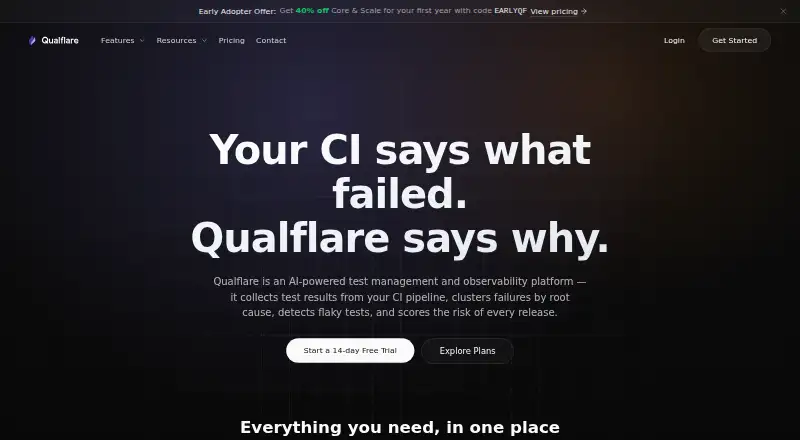
Qualflare is a hosted test-management service for manual and automated testing. It collects CI results through a command-line tool, groups related failures, detects flaky tests, and estimates release risk. Its web app manages cases, suites, plans, launches, runs, defects, and milestones. Quo provides AI-based coverage and test guidance.
Review
In a line
Qualflare is a hosted platform for managing tests and analyzing test results. It combines manual test planning with automated CI result collection, failure grouping, flaky-test detection, and release-risk estimates.
What it does
Teams can organize workspaces, projects, test cases, suites, plans, launches, case runs, defects, and milestones in the web app. A command-line tool uploads automated results from supported testing frameworks and tools.
Its Quo AI assistant looks for coverage gaps, suggests test cases and test steps, answers questions about test data, and helps investigate flaky suites. AI Failure Clusters group similar failures and add likely root causes, fix suggestions, and severity details; root-cause analysis is available on Core and higher plans. All listed plans include flaky-test detection. Qualflare offers execution-trend reports.
How it connects
Qualflare connects with GitHub, GitLab, Jira, Slack, Discord, Jenkins, and custom webhooks for defect syncing, notifications, and CI/CD work. It also lists GitHub Actions, GitLab CI, Jenkins, CircleCI, Travis CI, and Azure DevOps as CI/CD integrations.
Its CLI parses results from 23 frameworks and tools, including JUnit, pytest, Jest, Playwright, Cypress, Selenium, Appium, Newman, k6, OWASP ZAP, Trivy, Snyk, and SonarQube. The qf CLI is available through Homebrew, curl, Chocolatey, Docker, and downloadable binaries.
A REST API uses project-scoped access tokens to manage test cases, upload results, and query launches and other test data. Qualflare also offers a stateless streamable-HTTP MCP endpoint. The service runs in current Chrome, Firefox, Safari, and Edge browsers on web, Windows, macOS, Linux, Android, iOS, and API environments.
Good fit
Qualflare suits software teams that need one place for manual test management and CI result analysis. It is useful for spotting unstable tests, grouping repeated failures, tracking releases with milestones, and reviewing coverage or release risk.
Public, OSI-licensed GitHub projects can use the free Open Source plan, which adds higher limits, public reports, and README badges or banners.
Watch for
Qualflare is not self-hosted. For mobile work, it accepts Android, iOS, and cross-platform test results but does not provide devices or run the tests itself.
Retention defaults vary by plan: 30 days for Starter, 90 days for Core, one year for Scale, and a custom period for Enterprise. Capterra's feature matrix marks task management as unavailable.
Qualflare says customer data is stored in the European Union and describes encryption, access controls, and audit measures. It also states that it does not hold SOC 2 Type II, ISO 27001, or GDPR certification.
Pricing
Qualflare has a free Starter plan with one project, one active user, 200 test cases, 100 test reports, API access, basic analytics, CI/CD integrations, and community support. A 14-day trial is available.
Core is listed at $16/user/mo, with a 40% early-adopter rate of $9.60/user/mo for the first 12 months. It allows three projects and 10 active users, plus 1,000 test cases, 2,000 reports, shared steps and plans, unlimited AI analysis and root-cause analysis, and priority email support.
Scale is listed at $48/user/mo, or $28.80/user/mo for the first 12 months under the same discount. It includes 10 projects, 30 active users, 5,000 test cases, 10,000 reports, advanced analytics, AI suite optimization, and priority email support. Enterprise pricing is custom, with unlimited projects and users, SSO, custom branding, a 99.9% SLA, and 24/7 support.
Verdict
Choose Qualflare if your team wants hosted test records alongside automated CI result analysis, flaky-test detection, and AI help with coverage and failure investigation. The free Starter tier gives small projects a way to begin, while Core adds automated defect creation and deeper failure analysis.
Check retention, mobile-device needs, certification requirements, and the lack of self-hosting before signing up. Teams that need task management inside the test product or require certified SOC 2, ISO 27001, or GDPR status may need another option.
Our take
Qualflare fits teams that want manual test planning and automated CI result analysis in one hosted service. Its CLI covers many test frameworks, while the web app tracks cases, launches, defects, milestones, flaky tests, and release risk. Quo adds AI guidance, while failure clusters provide root-cause analysis on Core and higher plans. The main checks are retention limits, no self-hosted deployment, no built-in mobile device execution, unavailable task management, and the absence of SOC 2 Type II, ISO 27001, or GDPR certification.
- Free Starter plan with API access and CI/CD integrations
- CLI accepts results from 23 testing frameworks and tools
- Flaky-test detection is included on every listed plan
- REST API and streamable-HTTP MCP endpoint are available
- Open Source plan offers higher limits for eligible public projects
- No self-hosted deployment option
- Does not provide devices or run mobile tests
- Task management is marked unavailable
- No SOC 2 Type II, ISO 27001, or GDPR certification
- Retention is limited by plan unless Enterprise is customized
- Pick it ifTeams combining manual test management with CI result analysis; Projects needing flaky-test detection and failure clustering; Eligible public open-source GitHub projects
- Skip it ifYou need to host the service yourself; You need Qualflare to provide or run mobile devices; You require certified SOC 2, ISO 27001, or GDPR status
Pricing
Starter is free. Core and Scale have 40% early-adopter pricing for the first 12 months, then move to their listed rates. Enterprise is custom-priced, and a 14-day trial is available.
- Open source planFree for eligible public GitHub projects · Public OSI-licensed repository · public report page · README badge/banner · higher usage limits than StarterFree
- Starter$0 / user / mo · 1 project · 1 active user · 200 test cases · 100 test reports · API access · basic analytics · CI/CD integrations · community supportFree
- Core$9.60 / user / mo for first 12 months with 40% early-adopter discount, then $16 · 3 projects · 10 active users · 1,000 test cases · 2,000 test reports · shared steps and plans · unlimited AI analysis and RCA · priority email support$16/mo
- Scale$28.80 / user / mo for first 12 months with 40% early-adopter discount, then $48 · 10 projects · 30 active users · 5,000 test cases · 10,000 test reports · advanced analytics · AI suite optimization · priority email support$48/mo
- EnterpriseCustom · Unlimited projects and users · unlimited test cases and reports · SSO · custom branding · 99.9% SLA · 24/7 supportOn request
As qualflare.com lists them, checked 15 Oct 2026.
Questions
Does Qualflare have a free plan?
Yes. Starter costs $0 per user per month and includes one project, one active user, 200 test cases, 100 reports, API access, basic analytics, CI/CD integrations, and community support.
What testing tools can Qualflare import?
Its CLI accepts results from tools and frameworks including JUnit, pytest, Jest, Playwright, Cypress, Selenium, Appium, Newman, k6, OWASP ZAP, Trivy, Snyk, and SonarQube.
Can Qualflare run mobile tests?
No. It ingests Android, iOS, and cross-platform mobile test results but does not provide devices or execute the tests.
Does Qualflare offer an API?
Yes. A REST API uses project-scoped access tokens to manage test cases, upload results, and query launches and other test data. A streamable-HTTP MCP endpoint is also available.
How long does Qualflare keep test data?
Default retention is 30 days on Starter, 90 days on Core, and one year on Scale. Enterprise can use a custom retention period.
Is Qualflare self-hosted?
No. Qualflare is provided as a hosted service.