
Campfire Finance ERP Review
campfire.ai · checked 15 Oct 2026
An AI-native finance platform uniting the ledger, revenue automation, reporting, and financial close.
How it plugs in
Signal on AI Accounting Software5.2#21 of 32
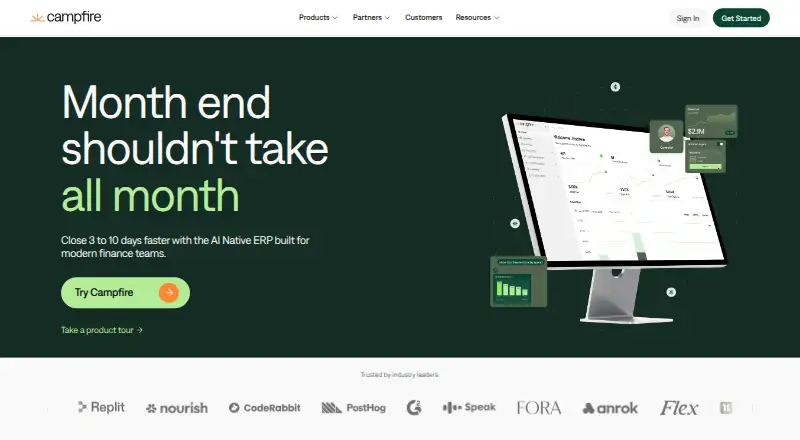
Campfire provides cloud-based finance software for growing SaaS and technology businesses. Its tools span a general ledger, revenue recognition, reporting, close workflows, and Ember, an accounting assistant. Campfire supports multiple entities and currencies, connects with common business systems, and offers an API. Pricing is custom, with no free plan or trial.
Review
In a line
Campfire is an ERP built around AI for modern finance teams. Accounting, revenue automation, reporting, and close management operate within the same hosted platform.
What it does
The ledger automates transaction categorization, subledger postings, close checklists, and journal drafts. Campfire consolidates entities and currencies in real time, supporting 180+ currencies and unlimited entities.
Users can create drag-and-drop reports, inspect source transactions, and maintain live dashboards. Revenue workflows cover subscription, usage-based, milestone, and transaction models, with ASC 606 recognition and timestamped contract changes.
Ember, the accounting assistant, can draft journal entries, perform flux analysis, identify accruals, and answer finance questions. Campfire also says its accounting model was trained on millions of transactions for matching, categorization, and duplicate detection.
How it connects
Campfire has documented connections for systems such as Salesforce, HubSpot, and Stripe. Other named connections include Chargebee, Recurly, Rippling, Gusto, Ramp, Brex, Bill.com, Avalara, and TaxJar.
A public API and webhooks connect software outside its standard catalog. The developer documentation covers API onboarding, accounts payable, accounts receivable, journal entries, MCP integration, and OAuth 2.0 apps.
The service runs in the cloud and is hosted rather than self-managed. It is not open source. Migration can use a full historical import or a clean cutover while keeping earlier records for reference.
Good fit
Campfire is built for high-growth SaaS and technology companies, including finance teams that have outgrown QuickBooks.
It suits organizations needing multi-entity accounting, subscription revenue recognition, continuous reconciliation, close workflows, and real-time reporting. Configurable policies, roles, approval workflows, and 1,200+ granular permissions support controlled processes.
Campfire says implementation and onboarding are included in every plan. Its in-house support team consists of accountants with close experience.
Watch for
Campfire does not cover every ERP job. Its buyer guidance says newer AI-native ERP products generally lack the full inventory, supply-chain, and enterprise-module breadth found in older ERP systems.
Check that its integrations, revenue rules, approval setup, and reporting options match your processes before committing. Campfire is a hosted commercial service, not software you can self-host.
Campfire states that it is SOC 1 and SOC 2 certified and supports SOX audit trails. Customers can request its SOC 2 report from support.
Pricing
Campfire has no free plan and no free trial. Its listed plans are Custom pricing and Custom quote, both priced on request.
The quote reflects considerations such as legal entities, transaction volume, revenue-model complexity, and integration count. The custom-quote plan includes the full platform, implementation and onboarding, ongoing support, and standard integrations.
Verdict
Campfire suits SaaS and technology finance teams seeking accounting, revenue recognition, consolidation, and close capabilities in one hosted system with custom API connectivity. Ember and automated transaction handling may reduce manual review work.
Look elsewhere if you need deep inventory, supply-chain, or broad enterprise ERP coverage, or if self-hosting is required. Because every plan is quoted, ask for a detailed scope covering entities, transaction volume, integrations, and implementation before signing.
Our take
Campfire fits growing SaaS and technology businesses that want one system for the ledger, revenue schedules, reporting, and financial close. Its multi-entity design, API, automation, and accounting assistant are relevant when finance work has outgrown a basic bookkeeping product. The trade-off is a hosted, quote-only service with no trial and less breadth than established enterprise ERP suites. Buyers should confirm required integrations, revenue scenarios, and reporting depth during the sales process.
- Ledger, revenue, reporting, and close capabilities share one platform
- Handles 180+ currencies alongside unlimited entities
- Public API and webhooks support custom connections
- Ember can draft entries and answer accounting questions
- Every plan includes implementation and onboarding
- No free plan or free trial
- Pricing is available only by request
- Hosted service cannot be self-managed
- May lack broad inventory and supply-chain ERP modules
- Highly specific integration and reporting needs require checking
- Pick it ifFinance teams at high-growth SaaS and technology companies; Companies needing multi-entity revenue accounting; Teams replacing QuickBooks with a broader finance system
- Skip it ifYou need inventory, supply-chain, or full enterprise ERP coverage; You require self-hosted software; You want a free plan or transparent listed pricing
Pricing
Campfire is quote-only. Fees vary with entities, transaction volume, revenue complexity, and integrations; the custom-quote plan includes onboarding, support, and standard integrations.
- Custom pricingPrice based on legal entities, transaction volume, revenue model complexity, and integration count · request a demo for a quoteOn request
- Custom quoteQuote based on entities, transaction volume, revenue complexity and integrations · Full platform · implementation/onboarding · ongoing support · standard integrationsOn request
As llms.campfire.ai lists them, checked 5 Oct 2026.
Questions
Does Campfire offer a free plan?
No. Campfire lists no free plan and no free trial.
What does Campfire cost?
Pricing is on request. Quotes consider legal entities, transaction volume, revenue-model complexity, and integration count.
Which systems connect to Campfire?
Named connections include Salesforce, HubSpot, Stripe, Chargebee, Recurly, Rippling, Gusto, Ramp, Brex, Bill.com, Avalara, and TaxJar.
Does Campfire have an API?
Yes. Public documentation covers API onboarding, accounts payable, accounts receivable, journal entries, MCP integration, and OAuth 2.0 apps. Webhooks are also available.
Can Campfire handle revenue recognition?
Yes. It supports subscription, usage-based, milestone, and transaction revenue models with ASC 606 recognition.
Is Campfire open source or self-hosted?
No. Campfire is a commercial cloud service and is not open source or self-hosted.
Who is Campfire designed for?
Campfire serves high-growth SaaS and technology companies, including finance teams that have outgrown QuickBooks.