
Disroot Email review
disroot.org · checked 14 Oct 2026
Open-source email at no cost, with webmail, familiar mail protocols, and support for linking a domain you own.
How it plugs in
Signal on Private Email Services7.7#1 of 29
Disroot Email offers a free mailbox run by volunteers in Amsterdam. It includes Roundcube webmail, desktop and mobile client access, open-source code, custom domains, and standard IMAP, SMTP, and POP connections. Each mailbox includes 1 GB, with 64 MB attachment limits. Messages are not protected end to end unless you encrypt them yourself.
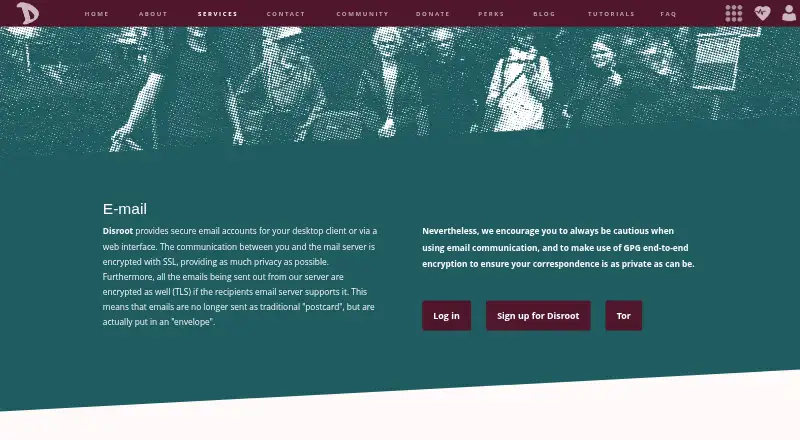
Review
In a line
Disroot Email is an open-source mailbox available without charge from Disroot, whose volunteer project is based in Amsterdam. You can use it in a browser or with ordinary desktop and mobile mail applications.
What it does
The service provides email accounts through Roundcube webmail and standard mail clients. Roundcube offers threaded conversations, folders, drag-and-drop handling, rule-based filters, attachment previews, and MIME and HTML support. The interface is available in more than 80 languages.
A free mailbox comes with 1 GB of space, while a single attachment may be as large as 64 MB. Adding a plus sign to an address makes a sub-address that delivers into the original mailbox and can help with spam filtering or tracing.
How it connects
You can retrieve mail over SSL IMAP on port 993, submit it with STARTTLS on 587 or TLS on 465, and use SSL-protected POP on 995. Suggested applications include Thunderbird, Evolution, KMail, Claws Mail, Mailpile, K-9 Mail, FairEmail, and Apple Mail.
The project publishes open-source code and supports Android, iOS, Linux, macOS, Windows, browser, and extension use. Mailvelope add-ons for Chrome, Edge, and Firefox can add PGP encryption to Disroot webmail. Its documentation explains webmail and mail protocols, without describing a public email API or SDK. No self-hosting package or deployment guide is provided.
Where available, connections use SSL or TLS. Without user-applied GnuPG or PGP, stored messages remain readable on the server. Disroot says its data resides on its own servers in a Netherlands data center.
Good fit
Disroot suits people looking for open, decentralized or federated services with a privacy focus. It works for users who want browser email plus familiar mail apps, standard protocols, and optional use of their own domain.
A linked domain can handle both sending and receiving mail. Disroot presents this option as a lifetime benefit associated with a donation amount selected by the user.
Watch for
End-to-end encryption is not part of the default email setup. Applying your own encryption is necessary to keep stored messages from being readable, although Disroot says its servers use disk encryption and connections use SSL or TLS where provided.
Operational logs generally remain for up to 48 hours, while IP addresses from IMAP and POP logins persist during an active device session. Disroot says it neither sells data nor creates advertising profiles, and that phone numbers and home addresses are not required to operate the service.
The free mailbox provides just 1 GB, and one attachment can be at most 64 MB. A free trial is not offered. Check the setup instructions for your chosen client before switching.
Pricing
The regular mailbox is free and includes 1 GB, 64 MB attachments, webmail, and IMAP, SMTP, SMTPS, and POP access. Since that plan is free, there is no separate trial period.
Additional mailbox capacity is listed at €0.15 per GB each month, with descriptions allowing up to 10 GB; EU VAT may apply. Domain linking has no published fee and remains a lifetime option connected to a donation you choose. Disroot also lists separately priced yearly storage, adds 21% EU VAT for EU transactions, and allows that storage to be allocated among mail, cloud, and CryptPad.
Verdict
Choose Disroot if a no-cost mailbox, open-source project, standard client support, and optional custom domain matter more than built-in end-to-end encryption. Its webmail and common protocols make it practical across computers and phones.
Consider another provider if you need more than 1 GB at no cost, bigger attachments, a documented public API, or encryption that works without additional setup. Review the short log-retention details and client instructions before moving important mail.
Our take
Disroot Email suits people seeking a free mailbox from a volunteer-maintained, open-source project who plan to use webmail or conventional mail applications. Support for IMAP, SMTP, and POP accommodates many clients, while domain linking is available as a donation-based lifetime option. The main constraints are the 1 GB free quota, 64 MB attachment ceiling, and absence of default end-to-end encryption. Anyone needing a documented public API, self-hosting guidance, or automatic message encryption should look for a service that lists those features.
- Free mailbox with 1 GB storage
- Open-source project with webmail and common mail protocols
- Works with many desktop, mobile, and browser clients
- Lifetime custom-domain option linked to a donation
- Optional PGP encryption through Mailvelope extensions
- End-to-end encryption is not enabled by default
- The free mailbox is capped at 1 GB
- Single attachments can be no larger than 64 MB
- No public email REST API or SDK is documented
- Operational login and mail logs have retention conditions
- Pick it ifPeople wanting free, open-source email with standard client access; Users who need webmail plus an optional custom domain; Privacy-minded users comfortable adding their own encryption
- Skip it ifYou need built-in end-to-end encryption without extra tools; You require a documented public API or self-hosting package; You need more than 1 GB or attachments over 64 MB
Pricing
The regular mailbox is free and includes 1 GB of storage plus 64 MB attachments. Extra mailbox capacity costs €0.15 per GB each month, with EU VAT possibly added. Domain linking has no fixed fee and depends on a user-chosen donation for lifetime access. Other extra storage is priced per year and may carry 21% EU VAT in EU transactions.
- Free1 GB mailbox storage · Webmail access · IMAP, SMTP, SMTPS and POP support · Optional PGP encryption with MailvelopeOn request
- Free email1 GB mailbox · 64 MB attachmentsFree
- Free mailbox1 GB mailbox · 64 MB attachments · webmail and IMAP/SMTP/POP accessFree
- Extra mailbox storageper GB per month · Up to 10 GB mailbox storage described by reviewer · EU VAT may apply€0.15/mo
- Custom domain linkingLifetime feature; donation amount is user-decided · Use your own domain to send and receive email · Disroot does not sell domainsOn request
- Extra storagePrices per year; EU transactions add 21% VAT · Extra storage can be allocated between mail, cloud, and CryptPadOn request
As disroot.org lists them, checked 15 Sept 2026.
Questions
Is Disroot Email free?
Yes. The standard mailbox has no charge and includes 1 GB of storage, 64 MB attachments, webmail, and IMAP, SMTP, SMTPS, and POP access.
Does Disroot provide end-to-end encryption?
No. Unless you encrypt them yourself, messages remain readable on Disroot servers. Mailvelope browser extensions can add PGP encryption in webmail.
Can I use my own domain?
Yes. Connecting a domain enables sending and receiving with it. Disroot describes this as a lifetime feature tied to a donation amount you choose.
Which mail apps work with Disroot?
Usable applications listed by the service are Thunderbird, Evolution, KMail, Claws Mail, Mailpile, K-9 Mail, FairEmail, and Apple Mail.
What are Disroot's server settings?
IMAP uses SSL on port 993. SMTP supports STARTTLS on 587 or TLS on 465. POP retrieval uses SSL on port 995.
Does Disroot offer a public email API?
The product pages document IMAP, SMTP, POP, and webmail, but do not describe a public email REST API or SDK.
Where is Disroot data stored?
According to Disroot, its own servers at a data center in the Netherlands store the data.