ESPnet: Open-Source Speech Processing Toolkit
espnet.github.io · checked 15 Oct 2026
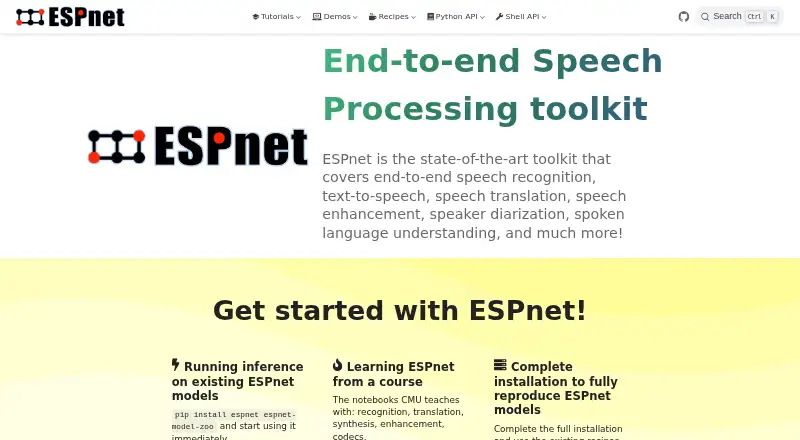
Open-source speech toolkit for recognition, text-to-speech, translation, enhancement, and related tasks.
How it plugs in
Signal on Text-to-Speech Software8.8#4 of 223
ESPnet is a free, Apache-licensed toolkit from the ESPnet community. Its scope includes recognition, text-to-speech, translation, enhancement, diarization, speaker processing, and other speech tasks. You can run existing models or train your own with recipes and optional dependencies. It runs through Python on Linux, macOS, Windows, APIs, self-hosted setups, and Docker images.
Review
In a line
ESPnet provides an end-to-end, open-source toolkit for speech processing. The ESPnet community started the project in 2018.
What it does
ESPnet provides recipes for automatic speech recognition, text-to-speech, speech translation, speech enhancement, speaker diarization, spoken-language understanding, and related work. It also includes speaker embeddings, singing-voice synthesis, speech codecs, language modeling, dialogue systems, and self-supervised learning.
Its recipes cover preparation, feature processing, training, decoding, and scoring for specific speech corpora. To run existing models, install ESPnet and espnet-model-zoo with pip; training uses optional task and training packages.
Real-time transcription, speaker identification, and speaker labeling are supported. The toolkit does not provide voice cloning. Audio can be exported as WAV files.
How it connects
ESPnet provides Python modules for recognition, text-to-speech, enhancement, diarization, translation, speech language models, tokenization, and training. It also offers API access and self-hosted use.
Training can connect with Weights & Biases and TensorBoard for experiment logging. Docker instructions cover CPU and GPU inference images, local builds, and configurable CUDA environments. Published models can run without checking out the full repository.
The software runs on Linux, macOS, and Windows, and can use multi-GPU or distributed training. Full setup may require CMake, SoX, FLAC, a Python environment, and separate task packages.
Good fit
ESPnet suits people who need a self-hosted speech toolkit rather than a hosted speech service. It is aimed at learners using tutorials and notebooks, researchers following complete recipes, and teams running existing models or training models for specific speech tasks.
It can fit projects involving speech recognition, audio transcription, or text to speech, especially when Python access and model training matter. Commercial use is allowed under the Apache License 2.0.
Watch for
Installation is not a single lightweight package. The train extra is required for training and brings Lightning, TensorBoard, Weights & Biases, torch_optimizer, matplotlib, and Dask. Packages for particular tasks may also have to be installed separately.
The installation guide lists continuous-integration support for Ubuntu 18, CentOS 7, and Debian 11, with installation-only support for Windows 10 and macOS 12. ESPnet1 is unsupported; ESPnet2 users can skip installing Kaldi.
This is self-hosted software, so you must manage the environment, dependencies, models, and hardware yourself.
Pricing
ESPnet is free. It is open source under the Apache License 2.0, with no free trial because there is no paid plan. Pretrained-model inference and training are available through optional task extras.
There is no hosted SaaS plan stated. Your costs may instead come from the computer or cloud hardware needed to run inference or training.
Verdict
Choose ESPnet if you want broad speech-processing coverage and control over where models run. Its Python modules, Docker options, and pretrained-model path make it usable for both experimentation and deployed self-hosted workflows.
Skip it if you need a managed service with a simple setup or built-in voice cloning. Before committing, check the operating-system notes, task-specific dependencies, and hardware needed for your recipes.
Our take
ESPnet is a strong choice for teams and researchers that need an open speech stack they can run and modify themselves. Its scope reaches well beyond transcription, with translation, synthesis, enhancement, diarization, and speaker tools in one project. The trade-off is setup work: optional packages, system prerequisites, and hardware planning are part of using it. People seeking a ready-made hosted service, voice cloning, or a simple commercial dashboard should look elsewhere. For self-hosted commercial projects and model training, the free Apache license keeps the software accessible.
- Free Apache-licensed open-source toolkit
- Covers recognition, synthesis, translation, enhancement, and diarization
- Run pretrained models or train with complete recipes
- Python modules, API access, Docker, and self-hosted options
- Available on Linux, macOS, and Windows, with WAV export
- Setup may require CMake, SoX, FLAC, and task-specific packages
- Training needs a separate group of dependencies
- Operating-system support differs by platform
- ESPnet1 is unsupported
- No voice cloning or hosted SaaS plan
- Pick it ifSelf-hosted speech research and model training; Teams needing several speech tasks in one toolkit; Users comfortable managing Python and system dependencies
- Skip it ifYou want a managed speech service with minimal setup; You need voice cloning; You cannot manage task-specific dependencies or hardware
Pricing
ESPnet is free open-source software released under the Apache License 2.0. There is no paid plan or free trial; running training or inference may still require your own hardware or cloud resources.
- ESPnetApache License 2.0 · open-source toolkit · pretrained-model inference and training via optional task extrasFree
- ESPnet open-source toolkitself-hosted research toolkit · optional task and training dependencies · no hosted SaaS plan statedFree
As espnet.github.io lists them, checked 12 Oct 2026.
Questions
Is ESPnet free?
Yes. ESPnet is free and released under the Apache License 2.0. No paid plan or free trial is stated.
What can ESPnet do?
Its coverage includes speech recognition, text-to-speech, speech translation, enhancement, diarization, spoken-language understanding, speaker processing, and related tasks.
Can I run pretrained ESPnet models?
Yes. The homepage recommends installing espnet and espnet-model-zoo with pip for inference on existing models.
Does ESPnet offer an API?
Yes. ESPnet has API access and Python modules for tasks including ASR, TTS, enhancement, diarization, translation, and training.
Which systems can run ESPnet?
ESPnet can be used on Linux, macOS, Windows, through APIs, in self-hosted setups, and with Docker. Installation support varies by operating system.
Does ESPnet clone voices?
No. Voice cloning is unavailable.
Can ESPnet label speakers?
Yes. Speaker identification, speaker labeling, diarization, and speaker representations are supported.
What audio format can it export?
WAV is listed as an export format.