
FauxLens AI Image and Video Detection Review
fauxlens.com · checked 15 Oct 2026
FauxLens checks images and video for AI generation or manipulation, with confidence scores and forensic evidence.
How it plugs in
Signal on AI Deepfake Detection Tools6.4#2 of 20
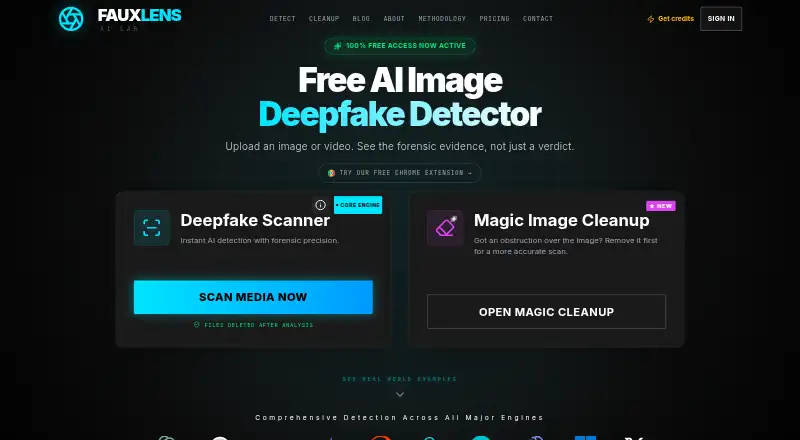
FauxLens examines images and video for indications of AI creation or alteration. It supplies a verdict, a weight-of-evidence confidence score, and signal-level evidence. You can use its web tool, Android app, Chrome extension, or REST API. The Free plan is available, and paid consumer credits start at $2.99 one-time.
Review
In a line
FauxLens is a service for checking whether images or videos were made or altered by AI. Its results combine a verdict with a confidence score and forensic evidence.
What it does
The service examines content credentials and metadata, invisible watermarks, and pixel-level model signals in sequence. Its six-signal engine draws on ELA, PRNU, GAN fingerprints, FFT, shadow physics, and EXIF forensics.
Video scans sample frames, check consistency over time, and compare audio with visuals. The web detector accepts JPEG, PNG, WebP, HEIC, and GIF images, plus MP4 and MOV video files up to 100 MB.
Image cleanup can take out unwanted people, visual noise, and platform overlays. Web cleanup exports keep the original dimensions up to 4K.
How it connects
Access is available through the web tool, Android app, and Chrome extension. The extension scans publicly accessible images from a right-click menu, but cannot handle images requiring sign-in or blocked by cross-origin rules.
Through its REST API, you can submit an image, video, or HTTPS URL and receive structured JSON containing a summary, confidence score, evidence entries, request IDs, and remaining credits. Calls use a bearer token and an Idempotency-Key. The endpoint is POST /v1/analyze at api.fauxlens.com.
Documentation outlines connections for moderation systems, Greenhouse or Lever ATS workflows, social platforms, WordPress, and Contentful. Browser-side API calls are blocked so keys stay on a server. No SDKs are planned, and the API has no webhook callback mode.
Media uploads are handled in an isolated environment and removed after analysis. Scan history stays in the user's browser. The published pages describe hosted services and provide no self-hosting package.
Good fit
The about page positions FauxLens for journalists, HR teams, researchers, and others assessing whether media is authentic. It can check images and video, inspect faces, and provide per-layer evidence for an investigation or workflow.
The homepage lists detection for generators such as OpenAI, Midjourney, Stability, Gemini, Firefly, Flux.1, Canva AI, Ideogram, Bing, and Grok.
Watch for
Confidence is a weight-of-evidence score, not a calibrated probability, and FauxLens does not publish one headline accuracy percentage. Forwarded screenshots, heavy compression, tiny images, and brand-new generators are identified as weak cases.
API keys are limited to 20 requests per minute per key and 30 per minute per account. Requests allow 25 MB; URL fetches allow 50 MB, or up to 200 MB with enterprise credentials. The API is synchronous.
The company says results are informational and should not be the only basis for legal, editorial, hiring, account, or claims decisions. Dedicated voice-cloning detection is not a separate layer, and real-time analysis is not offered.
Pricing
The Free plan costs Free and includes starting credits, full forensic checks, per-signal evidence, file deletion after analysis, and no card requirement. There is no free trial.
For personal scans, Starter is $2.99 one-time for 500 credits, Pro is $9.99 one-time for 2,000 credits, and Max is $19.99 one-time for 5,000 credits. Scans and removals use 10 credits each, and credits never expire.
Prepaid API plans never expire: API Starter is $99.99 one-time for 2,000 scans and 60 requests per minute; API Pro is $349.99 one-time for 10,000 scans and 120 requests per minute; API Scale is $749.99 one-time for 25,000 scans and from 300 requests per minute. API Pro adds priority email support, while API Scale includes founder support.
Verdict
Choose FauxLens if you need a browser-based or API check for suspected AI media and want evidence alongside a result. The free option lets you begin without a card, while one-time credit packs suit occasional use and prepaid API tiers suit automated pipelines.
Treat its output as investigative support rather than proof. Teams handling sensitive decisions should keep human review, especially for compressed files, screenshots, small images, or newly released generators.
Our take
FauxLens fits people who need a practical way to examine suspicious images and video from a browser, phone, extension, or server workflow. Its evidence chain and cleanup tools add context beyond a simple yes-or-no result, and one-time credits avoid a recurring subscription. However, confidence is not a calibrated probability, weak inputs can reduce usefulness, and the company bars sole reliance on results for consequential decisions. The synchronous API, request caps, and lack of self-hosting may also rule it out for some larger deployments. Compare other AI deepfake detection tools before committing.
- Free plan with no card requirement
- Image and video checks with per-signal evidence
- Chrome extension, Android app, web tool, and REST API
- One-time credits never expire
- Cleanup exports retain dimensions up to 4K
- Confidence is not a calibrated probability
- Weak results for screenshots, heavy compression, tiny images, or new generators
- API requests and uploads have size and rate limits
- No real-time analysis or separate voice-cloning layer
- No self-hosting package is provided
- Pick it ifJournalists, HR teams, and researchers checking media authenticity; Teams adding scans to moderation or ATS workflows; Occasional users who prefer non-expiring credit packs
- Skip it ifYou need proof for legal, hiring, editorial, account, or claims decisions; You require real-time scans, webhooks, browser-side API calls, or self-hosting; Your files are often screenshots, heavily compressed, or very small
Pricing
A free plan is available.
- FreeFree credits to start · Full forensic check · per-signal evidence · files deleted after analysis · no cardFree
- StarterOne-time payment · 500 credits · 10 credits per scan/removal · credits never expire$2.99 one-time
- ProOne-time payment · 2,000 credits · 10 credits per scan/removal · credits never expire$9.99 one-time
- MaxOne-time payment · 5,000 credits · 10 credits per scan/removal · credits never expire$19.99 one-time
- API StarterPrepaid; never expires · 2,000 scans · HMAC signing · IP allowlist · 60 requests/minute$99.99 one-time
- API ProPrepaid; never expires · 10,000 scans · 120 requests/minute · priority email support$350 one-time
- API ScalePrepaid; never expires · 25,000 scans · from 300 requests/minute · founder support$750 one-time
As fauxlens.com lists them, checked 15 Oct 2026.
Questions
Does FauxLens have a free plan?
Yes. The Free plan includes starting credits, full forensic checks, per-signal evidence, deleted files after analysis, and no card requirement.
Which files can the web detector scan?
Images can be JPEG, PNG, WebP, HEIC, or GIF. Video uploads support MP4 and MOV up to 100 MB on the consumer web tool.
Can FauxLens scan an image from a webpage?
The Chrome extension can launch a scan for publicly accessible images from the right-click menu. Images behind authentication or blocked by cross-origin policy are not supported.
What does the API return?
The REST API returns one of four summaries, a confidence score, per-layer evidence-chain entries, request identifiers, and remaining credits.
Are uploaded files stored?
Uploads are handled in an isolated environment and deleted after analysis, while scan history remains in your browser.
Can FauxLens results be used as proof?
No. The API documentation calls verdicts informational and says they should not be the sole basis for consequential decisions.
Do credits expire?
No. Consumer credit packs and prepaid API allocations are described as never expiring.
Near it
All alternatives →- NNetarx#1 on this board
- RD
 Resemble Detect#3 on this board
- HA
 Hive AI-Generated Content Detection#4 on this board
- F
 ForgeSpy#5 on this board
- DD
 DuckDuckGoose DeepDetector#6 on this board
- PRPella Research#7 on this board
- DO
 DeepFake-O-Meter#8 on this board
- T
 Tayanch#9 on this board
- DD
 Deepfake Detector#10 on this board
- RD
 Reality Defender#11 on this board