
feat feature-flag platform review
feat.so · checked 15 Oct 2026
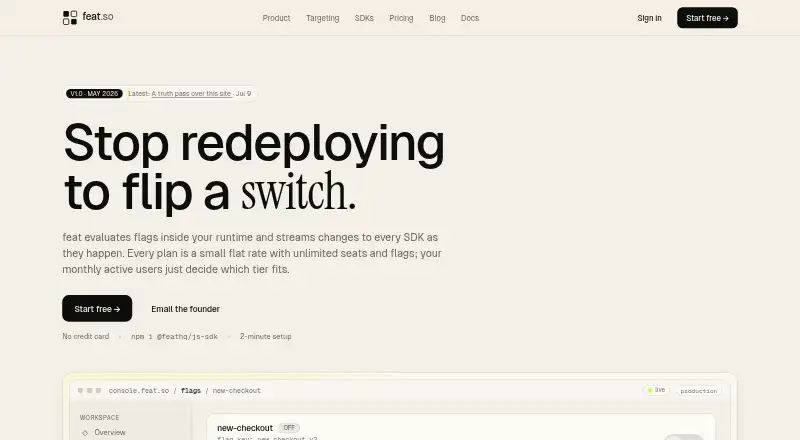
Hosted feature-flag service for early engineering teams, with local server evaluation and streaming updates.
How it plugs in
Signal on Feature Flag Software6.6#7 of 27
Hosted by feat, this feature-flag platform serves engineering and product teams. It supports typed flags, reusable segments, targeting rules, stable percentage rollouts, approvals, progressive rollouts, audit history, and a kill switch. Server SDKs evaluate locally, while browser and mobile SDKs receive resolved values. Plans range from free to enterprise contracts.
Review
In a line
For early engineering teams, feat provides hosted feature flags. It runs on Android, iOS, the web, and through an API.
What it does
Flags may hold boolean, string, number, or JSON values. Rules can join conditions for users, devices, organizations, sessions, and requests with AND or OR logic. Reusable named segments can serve several flags.
Stable bucketing assigns a user, device, or organization to a consistent variation until rollout weights change. Progressive rollouts can move through scheduled percentage steps, and production changes can require environment approvals, comments, and set approver counts.
Changes to flags and kill switches reach connected SDKs through a live stream in under a second. Server SDKs perform each flag read locally, without making a network request.
How it connects
Node.js, Bun, Deno, Go, Python, Ruby, browser JavaScript, and Flutter/Dart have first-party SDKs. Providers are also available for the OpenFeature web, Node.js, and Dart SDKs.
Metric connections support Segment, Mixpanel, PostHog, and custom sources. The maker advertises a REST API, but its reference documentation is still being prepared. feat is not open source.
No evaluation context is sent to feat by backend SDKs. For MAU counting, browser SDKs report hashed identifier-and-kind pairs; browser and mobile clients receive resolved values rather than the complete rules data.
Good fit
feat suits engineering and product teams that need controlled releases, reusable targeting, stable percentage rollouts, and a fast kill switch. Its SDK coverage also fits teams using server, browser, mobile, or Flutter applications.
Every plan includes an audit history. Higher plans add approvals, custom roles, larger usage limits, longer retention, and faster email response targets.
Watch for
The statistical engine, variant tracking, metric connections, and automatic experiment advancement are scheduled for Q3 2026 rather than available now. Slack, webhooks, CLI support, A/B testing, SSO enforcement, SAML, IP allowlisting, Terraform, and SOC 2 Type II are also listed as future work on specific plans.
The REST API reference is still in progress. SOC 2 Type I preparation is underway, SOC 2 Type II is planned, and ISO 27001 is on the roadmap. Check these items if your rollout or compliance plans depend on them.
Pricing
The Free tier costs nothing indefinitely and provides 7,500 MAU, 100 server connections, two projects, unlimited environments and flags, a 30-day audit log, and community support.
Starter costs $19 a month, or $15/mo when billed annually. Growth costs $49 a month, or $39/mo billed annually. Scale costs $149 a month, or $119/mo billed annually. Their included MAU limits are 25,000, 100,000, and 500,000 respectively.
Elastic is $299 a month, or $239/mo base billed annually, with 1M MAU included and $0.20 per 1,000 MAU above that. Enterprise uses custom contracts and adds SCIM, private tenancy, data residency, and a dedicated CSM.
Verdict
Choose feat if you want hosted flags with local server evaluation, sub-second streamed changes, typed values, stable rollouts, and SDKs across common server and client platforms. The free plan gives small teams a way to start, while paid tiers scale MAU, connections, approvals, support, and audit retention.
Look elsewhere if you need the advertised experiment engine, Slack or CLI workflows, a finished API reference, or completed compliance certifications now.
Our take
feat can suit early teams that need feature flags across web, mobile, and server code while keeping backend evaluation context off the service. Its free tier covers modest usage, and paid plans add governance and support as needs grow. The main caution is timing: several experiment, integration, deployment, and compliance items are future work, and REST API references are unfinished.
- Server-side SDKs evaluate flags locally, so individual reads do not require network calls.
- A live stream delivers flag changes and kill-switch updates to connected SDKs in under a second.
- Typed flags, reusable segments, approvals, and stable percentage rollouts are supported.
- The Free tier provides 7,500 MAU with unlimited environments and flags.
- First-party SDK options include Node.js, Go, Python, Ruby, browser JavaScript, and Flutter/Dart.
- The experiment engine and related metric capabilities are scheduled for Q3 2026.
- REST API reference documentation is still in progress.
- Several integrations and controls, including Slack and SAML, are future work.
- SOC 2 Type I preparation is in progress; Type II and ISO 27001 are not complete.
- Pick it ifEarly engineering teams managing staged releases; Teams needing web, mobile, and server SDKs; Projects wanting a free starting tier
- Skip it ifYou need a finished REST API reference today.; You require completed SOC 2 or ISO 27001 certification.; You need built-in experimentation capabilities now.
Pricing
A free-forever tier supports 7,500 MAU. Elastic charges overage above 1M MAU; Enterprise pricing is custom.
- Freefree forever · 7,500 MAU · 100 server connections · 2 projects · unlimited environments · unlimited flags · 30-day audit log · community supportFree
- Starter$15/mo billed annually · 25,000 MAU · 250 server connections · segments · required change comments · webhooks coming Q3 2026 · CLI coming Q3 2026 · 90-day audit log · email support 48h$19/mo
- Growth$39/mo billed annually · 100,000 MAU · 750 server connections · approvals · custom roles · A/B testing coming Q3 2026 · SSO enforcement coming Q3 2026 · Slack integration coming Q3 2026 · 1-year audit log · 99.9% SLA · email support 24h$49/mo
- Scale$119/mo billed annually · 500,000 MAU · 2,500 server connections · gradual rollouts coming Q3 2026 · SAML coming Q3 2026 · IP allowlisting coming Q3 2026 · Terraform provider coming Q3 2026 · SOC 2 Type II coming Q3 2026 · 3-year audit log · email support 8h$149/mo
- Elastic$239/mo base billed annually · 1M MAU included · $0.20 per 1,000 MAU above 1M · uncapped server connections · no grace period · same SLA and support as Scale$299/mo
- Enterprisecustom contracts · SCIM · private tenancy · data residency · dedicated CSMOn request
As feat.so lists them, checked 15 Oct 2026.
Questions
Is feat free?
Yes. Its Free plan has no charge and includes 7,500 MAU, 100 server connections, two projects, unlimited environments and flags, a 30-day audit log, and community support.
Which platforms and SDKs does feat support?
feat runs on Android, iOS, and the web, and offers an API. First-party options include Node.js, Bun, Deno, Go, Python, Ruby, browser JavaScript, and Flutter/Dart.
Does feat have an API?
The maker advertises a REST API, but says its reference documentation is still in progress.
Is feat open source?
No. feat is a hosted service and is not open source.
How does feat handle privacy?
Backend SDKs send no evaluation context to feat. For monthly active-user counting, browser SDKs transmit hashed identifier-and-kind pairs.
What integrations are available?
Segment, Mixpanel, PostHog, and custom sources can provide metrics. Slack integration is listed for Q3 2026.
What experiment features are included?
A statistical engine, variant tracking, metric connections, and automatic rollout advancement are scheduled for Q3 2026.
Near it
All alternatives →- D
 DevCycle#6 on this board
- S
 Statsig#8 on this board
- G
 GrowthBook#5 on this board
- F
 FeatureProbe#9 on this board
- UUnleash#4 on this board
- LE
 LaunchDarkly Experimentation#10 on this board
- FFeaturevisor#3 on this board
- HF
 Harness Feature Management & Experimentation#11 on this board
- F
 Flagsmith#2 on this board
- F
 Featureflip#12 on this board