
Conversion Rate Optimisation Tools
GrowthBook: Experimentation, Feature Flags, and Analytics
growthbook.io · checked 15 Oct 2026
Warehouse data powers GrowthBook's experiments, release controls, and product insight.
How it plugs in
Signal on Conversion Rate Optimisation Tools7.6#1 of 22
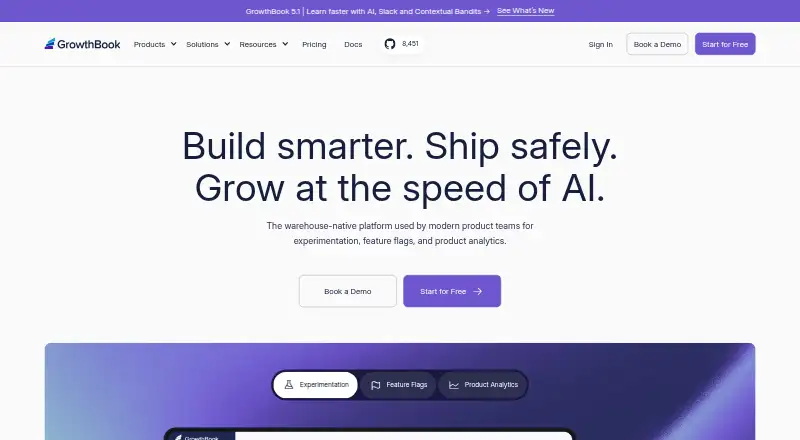
GrowthBook brings experimentation, feature management, and product analytics to data stored in your warehouse. It connects to major warehouses, event tools, developer services, and many SDKs. Teams can use its cloud service or run the open-source edition themselves, including in air-gapped environments.
Review
In a line
GrowthBook centers experimentation, feature management, and product analytics on warehouse data. Web and mobile projects can use either its hosted service or a self-managed deployment.
What it does
A/B testing, guarded releases, and multi-arm bandits are available. The statistical toolkit includes Bayesian and frequentist approaches, sequential analysis, CUPED, post-stratification, and checks for sample-ratio mismatch.
Its flag system handles audience targeting, percentage-based rollouts, fast evaluation, immediate kill switches, and rollback. Product Analytics offers dashboards, journey views, funnel analysis, and SQL Explorer for warehouse queries.
A visual editor, server-side experiments, mobile SDK, and audience targeting address common release and testing workflows. Pro lists automatic rollback for safe rollouts; Enterprise adds ramp schedules and approval workflows.
How it connects
GrowthBook connects to Snowflake, BigQuery, Databricks, ClickHouse, Trino, and Adobe Experience Platform. Event and tracking connections include FullStory, Firebase, Segment, GA4, and RudderStack. It also lists Slack, Discord, GitHub, Datadog, and Vercel Marketplace integrations.
More than 24 SDKs are described, with JavaScript, Python, React, Swift, and Kotlin among the named options. They download and cache flag definitions, evaluating targeting within browsers, servers, or edge runtimes.
A documented REST API includes management and SDK endpoints, webhooks, and OpenAPI documentation. An MCP server can create features, start experiments, clean stale flags, and query product analytics from MCP clients.
GrowthBook follows an open-core approach: most of the code carries an MIT license, while selected directories use the commercial GrowthBook Enterprise License. The same product can be operated on company infrastructure, including Kubernetes, other container platforms, and air-gapped setups. Experimentation platforms and feature flag software are nearby categories to compare.
Good fit
GrowthBook suits individuals and small teams on Starter, small and mid-sized teams on Pro, and organizations operating at scale on Enterprise.
It fits teams that want experiments, feature releases, and product analytics to use warehouse data rather than moving personally identifiable information out for analysis. The platform says analysis accesses aggregate data only.
Its integrations and SDKs can help teams add controlled releases and testing across web, mobile, server, and edge environments.
Watch for
Experiment design, data checks, and initial onboarding may call for technical experience and sustained effort. Reviews also mention a confusing or barebones interface, difficult initial integration, and documentation gaps for multi-organization setups.
Check which deployment and license model fits your requirements. Most code is MIT licensed, but some directories use the commercial Enterprise License. Confirm the plan limits, support level, and whether you need custom environments or enterprise controls.
Pricing
GrowthBook offers Starter at no charge for as many as 3 users and 1 project, with unlimited flags, experiments, and traffic. The free Open Source plans are billed at $0 on premise or self-hosted, with the listed 1-project limits.
The Pro tier is priced at $40 per seat each month and supports up to 30 users and 3 projects, with unlimited feature flags, experiments, and traffic. Enterprise terms are quote-based and may include custom environments, access controls, SSO and SCIM, audit logs, support, training, and a 99.99% uptime SLA.
Cloud hosting is managed on AWS. Enterprise Cloud also lists a 99.99% uptime SLA. Starter includes community support, Pro lists premium support, and Enterprise lists dedicated support and training.
Verdict
Choose GrowthBook if your team already works with a supported warehouse and wants one system for experiments, feature flags, and product analytics. Its API, SDK range, local evaluation, and self-hosting options suit teams with engineering resources.
Look elsewhere if you need a mostly nontechnical setup, a simpler interface, or documentation tailored to multi-organization deployments.
Our take
GrowthBook gives teams a way to tie testing and release controls to warehouse data. Free tiers allow a start with limited users and one project, while Pro expands seats and projects for a per-seat charge. Self-managed and air-gapped deployment options address infrastructure or data-location needs. Setup and validation can still require technical skills, and reported interface and documentation issues may slow teams seeking guided, low-maintenance adoption.
- Free tiers include unlimited feature flags, experiments, and traffic.
- Connects to major warehouses, event tools, and developer services.
- Open-source edition supports self-hosted and air-gapped deployment.
- REST API, webhooks, OpenAPI docs, and 24+ SDKs are listed.
- Local SDK evaluation supports browsers, servers, and edge runtimes.
- Experiment design and data validation may require technical experience.
- Some reviewers report confusing or barebones interface elements.
- Documentation gaps are reported for multi-organization setups.
- Some code uses the commercial Enterprise License.
- Pick it ifTeams running experiments from warehouse data; Organizations needing self-hosted or air-gapped deployment; Products combining feature flags with analytics
- Skip it ifYou need a mostly nontechnical setup with minimal onboarding work; Your team lacks time for data validation and technical integration; You require clearer multi-organization documentation
Pricing
Starter and Open Source editions are free. Pro is priced at $40 per seat each month. Enterprise pricing is quote-based.
- Starter (Cloud)Up to 3 users · 1 project · Unlimited feature flags · Unlimited experiments · Unlimited trafficFree
- Open Source$0 on premise · self-hosted open-source editionFree
- Open Source (Self-Hosted)1 project · Unlimited feature flags · Unlimited experiments · Unlimited trafficFree
- StarterFree · up to 3 users · 1 project · unlimited feature flags · unlimited experiments · unlimited trafficFree
- Proper seat / month · up to 30 users · 3 projects · unlimited feature flags · unlimited experiments · unlimited traffic$40/mo
- Pro (Cloud)per seat / month · Up to 30 users · 3 projects · Unlimited feature flags · Unlimited experiments · Unlimited traffic$40/mo
- EnterpriseCustom pricing · custom environments · ramp schedules · approval workflows · SSO & SCIM · audit logs · 99.99% uptime SLAOn request
- Enterprise (Cloud)Pricing tailored to your scale and licensing requirements · Custom environments · SSO & SCIM provisioning · Dedicated support & training · 99.99% uptime SLAOn request
As growthbook.io lists them, checked 30 Sept 2026.
Questions
Does GrowthBook have a free plan?
Yes. Starter is free for up to 3 users and 1 project, with unlimited feature flags, experiments, and traffic. Open Source editions are also billed at $0 on premise or self-hosted.
What does GrowthBook connect to?
Warehouse connections include Snowflake, BigQuery, Databricks, ClickHouse, Trino, and Adobe Experience Platform. It also lists FullStory, Firebase, Segment, GA4, RudderStack, Slack, GitHub, and others.
Can GrowthBook be self-hosted?
Yes. Company infrastructure can host it through Kubernetes, other container platforms, or air-gapped deployments. A managed cloud service is also available.
Does GrowthBook have an API?
Yes. The project documents a REST API with separate management and SDK endpoints, webhooks, and OpenAPI documentation.
Which testing methods are supported?
GrowthBook supports A/B tests, safe rollouts, and multi-arm bandits. Listed statistical tools include Bayesian, frequentist, sequential testing, CUPED, and sample-ratio-mismatch detection.
How much does Pro cost?
Pro is $40 per seat each month. It covers up to 30 users and 3 projects, with unlimited feature flags, experiments, and traffic.
Near it
All alternatives →- P
 Personyze#2 on this board
- S
 Statsig#3 on this board
- AT
 AB Tasty#4 on this board
- AApertio#5 on this board
- F
 FigPii#6 on this board
- ONOmniconvert Nexus Customer Intelligence#7 on this board
- CEConvert Experiences#8 on this board
- K
 Kameleoon#9 on this board
- NANelio A/B Testing#10 on this board
- AAABtesting.ai#11 on this board