FLAML: Automated Machine Learning and Tuning
microsoft.github.io · checked 2 Oct 2026
FLAML is free, open-source software for automated machine learning and model-setting search.
How it plugs in
Signal on Predictive Analytics Software6.3#5 of 37
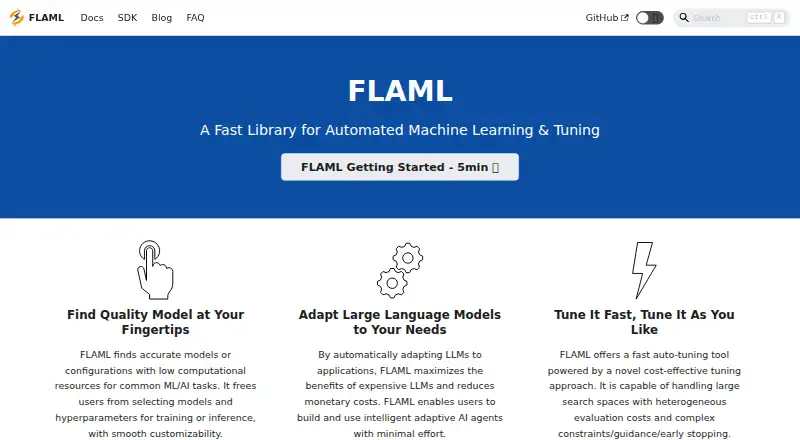
FLAML is a free, MIT-licensed tool for automated machine learning and tuning. It covers classification, regression, forecasting, ranking, and sequence classification, and it can tailor large language models to applications while lowering monetary costs. Python, .NET, API, and self-hosted options run across Linux, macOS, and Windows. Optional integrations extend it to model, data, and distributed-computing tools.
Review
In a line
FLAML automates machine-learning work and searches for useful model settings while keeping computational demands low.
What it does
Its task-oriented AutoML covers classification, regression, time-series and panel forecasting, learning to rank, and sequence classification. Tools support model evaluation, forecasting workflows, and customized learner tuning.
FLAML can tailor large language models to particular applications, helping reduce monetary costs. The flaml.default package recommends data-dependent settings without performing runtime tuning.
The tuning approach accommodates broad search spaces, uneven evaluation costs, constraints, user guidance, and early stopping.
How it connects
The Python package installs with pip or conda; documentation calls for Python 3.10 or newer, while the latest repository version remains below Python 3.14. FLAML also exposes an API, self-hosted operation, and a .NET implementation within the cross-platform ML.NET framework.
Optional packages connect OpenAI models, CatBoost, Vowpal Wabbit, Prophet, statsmodels, and Hugging Face Transformers. Ray and Spark offer parallel tuning, with NNI, BlendSearch, and Azure Synapse as additional options; a single tuning job cannot use Ray and Spark together.
Documentation covers MLflow logging and Azure Machine Learning integration. FLAML also supports AutoML and hyperparameter tuning in Microsoft Fabric Data Science. Its MIT license permits use, modification, sharing, sublicensing, and sale under the license conditions. See AutoML software for related tools.
Good fit
FLAML suits people seeking a programmable, resource-conscious way to automate model selection and tuning. Its coverage includes supervised learning, forecasting, ranking, and language-model adaptation.
It can suit teams working with batch deployment, time-series models, parallel tuning, or restricted learner choices. Linux, macOS, Windows, API, self-hosted, and .NET options accommodate varied setups.
Watch for
Python 3.10 or newer is required by the installation documentation, and the current repository version targets a release before Python 3.14. Optional capabilities need additional packages.
GPU training is unavailable when Spark serves as the parallel backend. Ray and Spark therefore serve as separate choices for a tuning job.
Community help is available through Discord, issues, discussions, and contributions. Security vulnerability reports are directed to Microsoft's security response center for coordinated disclosure rather than public issues.
Pricing
FLAML is free, with a free plan and MIT-licensed distribution.
Verdict
Choose FLAML for open-source AutoML that emphasizes lower computing use and lets you control learners, constraints, and tuning backends. It fits Python or ML.NET workflows for prediction, forecasting, ranking, and language-model adaptation.
Consider alternatives if you require GPU training through Spark or a tuning run that combines Ray and Spark. Compare it with options in Predictive Analytics Software before deciding.
Our take
FLAML is a sensible choice for technical users who want automated model selection without a license fee. Its broad task coverage, optional distributed backends, and language-model adaptation support varied projects. Consider its Python version range and the extra packages needed for optional integrations. Spark users should note the lack of GPU training, while the MIT license permits modification and commercial distribution under its conditions.
- Free, MIT-licensed open-source software
- Covers classification, regression, forecasting, ranking, and sequence classification
- Tuning supports constraints, guidance, varied evaluation costs, and early stopping
- Optional integrations include OpenAI, Hugging Face, Ray, and Spark
- Python 3.10 or newer is required
- The latest version targets Python below 3.14
- Spark parallel tuning does not support GPU training
- Ray and Spark cannot be combined in one tuning job
- Pick it ifProgrammers automating model selection and tuning; Teams needing forecasting or batch ML workflows; Users wanting self-hosted or ML.NET options
- Skip it ifYou require GPU training with Spark; You need Ray and Spark in the same tuning job
Pricing
FLAML is free, with a free plan. Its MIT License permits use, modification, distribution, sublicensing, and sale subject to the license conditions.
Questions
Is FLAML free?
Yes. It has a free plan and uses the MIT License.
Which operating systems can run FLAML?
Listed platforms include Linux, macOS, and Windows, along with API and self-hosted use.
What Python version does FLAML need?
Installation documentation calls for Python 3.10 or newer, and the latest version targets a release before Python 3.14.
What machine-learning tasks does FLAML support?
The documented tasks include classification, regression, time-series and panel forecasting, learning to rank, and sequence classification.
Can FLAML tune models in parallel?
Yes. Ray and Spark are available as parallel backends, but one job cannot use both, and Spark parallel training does not support GPUs.
Does FLAML work with large language models?
Yes. It can adapt large language models to applications in order to reduce monetary costs.
Can I use FLAML with .NET?
Yes. Its .NET implementation uses the cross-platform ML.NET framework, including Model Builder, the ML.NET CLI, and Microsoft.ML.AutoML.