GNU ELPA: GNU Emacs Package Repository Review
elpa.gnu.org · checked 15 Oct 2026
GNU Emacs’s free, standard home for installing extensions.
How it plugs in
Signal on Package Registries7.3#3 of 28
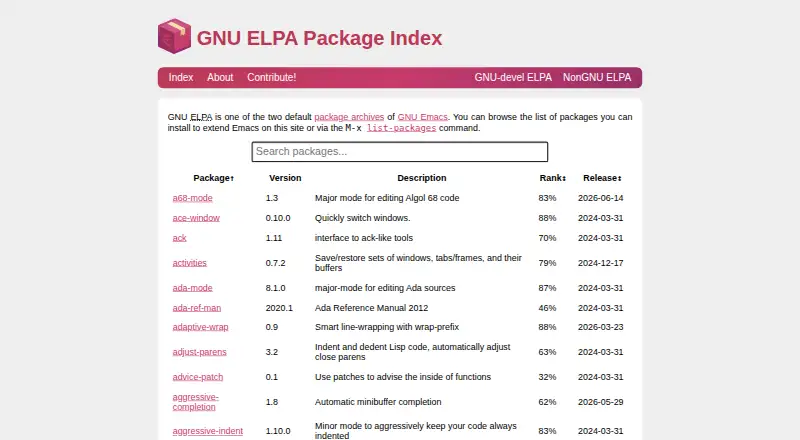
GNU ELPA serves as GNU Emacs’s standard package source. It provides Emacs Lisp add-ons apart from the editor, along with package names, versions, descriptions, manuals and release information. Users browse its web index or install packages inside Emacs. The archive is open source, free to use, and can also be hosted locally.
Review
In a line
GNU ELPA serves as GNU Emacs’s standard package repository. It provides Emacs Lisp add-ons outside the core editor.
What it does
The archive publishes package names, versions and descriptions. Individual entries can additionally present maintainers, dependencies, release files, news, manuals and recent releases.
In Emacs, users can open `M-x list-packages`, browse the available items and install one with `package-install` or the package list. During installation, Emacs fetches needed dependencies and halts if a required one is missing.
Examples in the archive include Org for notes, documents, notebooks, literate programming, to-do lists and planning; Project for finding project files and ignored paths; and OAuth2 for handling access tokens.
How it connects
GNU ELPA is open-source software available through the web or as a self-hosted archive. Emacs selects package sources with the `package-archives` setting, whose default list includes GNU ELPA and NonGNU ELPA. Installed packages normally go under `~/.emacs.d/elpa/`.
An archive is a web-accessible directory of single-file Lisp packages or multi-file tar files. Emacs ships a GNU archive key for checking package signatures, and package dependencies are handled during installation.
The archive also publishes GNU-devel ELPA for development versions. Its documentation explains how to build archive files and serve that directory over HTTP.
Good fit
GNU ELPA suits Emacs users who want the editor's default package source and a catalog with package descriptions and documentation. It also suits those seeking packages governed by GPL-compatible licensing.
The archive includes packages closely tied to Emacs work, such as Org, Project and OAuth2.
Watch for
Installed Emacs packages can run arbitrary code with the installing user's permissions. GNU ELPA's contribution guidance says a compromised maintainer repository may endanger users.
Submitted packages must meet GNU ELPA conventions, use a GPL-compatible license, and have significant contributors sign the FSF copyright assignment. The core function must work on a system using only free software, with case-by-case exceptions.
The archive has a separate development channel, so check whether you need released packages or bleeding-edge versions.
Pricing
GNU ELPA is free to use. There is no paid plan or free trial because the archive itself has a free plan and no charge.
Verdict
Choose GNU ELPA when you use GNU Emacs and want its standard source for installing extensions, with package metadata, dependency downloads and signature checking built into the workflow.
Look elsewhere or review packages carefully if you need a broader package catalog, cannot accept code running with your account's permissions, or do not want the licensing and contributor rules required for this archive.
Our take
GNU ELPA is a straightforward choice for GNU Emacs users who prefer the editor’s default source and free, openly developed packages. Its package pages and automatic dependency handling make routine installation simple. The main trade-off is trust: an installed extension can run with your permissions, and a compromised maintainer repository can affect users. Contributors also face GPL-compatible licensing rules and FSF copyright assignment requirements. Consider GNU-devel ELPA only when development versions are appropriate, and consider local hosting when you need to serve an archive yourself.
- Default package source for GNU Emacs
- Free and open source
- Package entries may provide manuals and release information
- Dependencies are fetched automatically during installation
- Public key supports package signature checking
- Installed packages can execute arbitrary code
- Maintainers and contributors face FSF copyright assignment rules
- Packages must use GPL-compatible licensing
- Separate development archive may contain bleeding-edge versions
- Pick it ifGNU Emacs users installing extensions; Teams wanting a self-hosted Emacs package archive; Users needing packages with GPL-compatible licensing
- Skip it ifYou need software outside the GNU Emacs package ecosystem; You cannot accept extensions running with your user permissions; You want to avoid FSF assignment and licensing requirements
Pricing
GNU ELPA is free. There is no paid tier or trial; the GNU ELPA plan costs free.
- GNU ELPAFree · GNU Emacs packages · GPL-compatible licensing · FSF copyright assignment for significant contributorsFree
As elpa.gnu.org lists them, checked 15 Oct 2026.
Questions
What is GNU ELPA?
GNU ELPA serves as GNU Emacs’s standard package repository. It provides Emacs Lisp extensions apart from the editor.
How can I install a GNU ELPA package?
Inside Emacs, run `M-x list-packages` to browse packages, then install one with `package-install` or from the package list.
Does GNU ELPA handle dependencies?
During installation, Emacs fetches required dependencies and stops when a required dependency cannot be found.
Is GNU ELPA free?
Yes. GNU ELPA is free to use and has no paid plan or free trial.
Can I safely run GNU ELPA packages?
An installed package can execute arbitrary code under your permissions. GNU ELPA’s contribution guidance also says a compromised maintainer repository can create risk.
Can I host GNU ELPA locally?
Yes. The repository documentation explains how to generate archive files and serve the archive directory over HTTP.
What licensing rules apply?
Submitted packages must use a GPL-compatible license, and significant past and present contributors must sign the FSF copyright assignment.