LuaRocks for Lua Packages and Module Hosting
luarocks.org · checked 8 Oct 2026
Tooling for finding, installing, and hosting Lua modules with dependency handling and custom manifests.
How it plugs in
Signal on Package Registries6.6#4 of 28
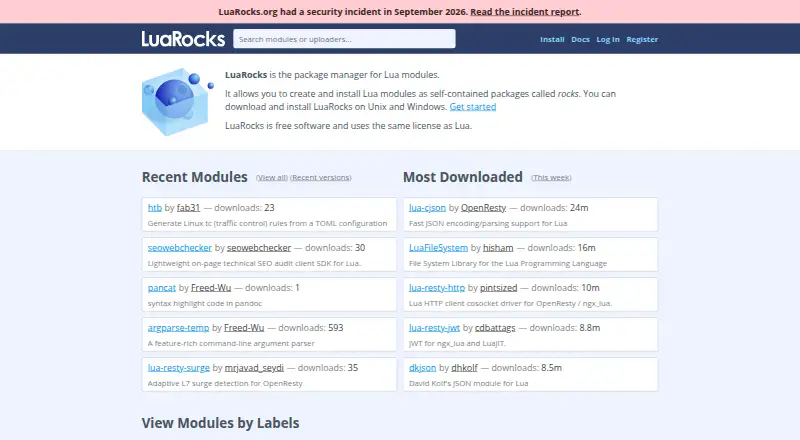
LuaRocks installs Lua modules from rock and rockspec packages, resolving version dependencies and platform matches. Its website maintains module manifests and accepts publishing through a command-line tool and HTTP API. Installation guidance spans Linux, macOS, Windows, Unix systems, FreeBSD, and Cygwin, with offline setup and fallback mirrors.
Review
In a line
LuaRocks handles package installation for the Lua ecosystem. LuaRocks.org stores rocks and rockspecs, which package Lua modules and describe them.
What it does
The command-line tool consults manifests, selects a compatible version and platform, and installs the corresponding package locally. Version requirements in rocks let LuaRocks resolve dependencies and load the needed module version.
It supports online and offline installation. Development releases sit in a separate manifest and are not selected by default.
How it connects
Packages use .rock and .rockspec formats. LuaRocks works with root, per-user, and custom manifests for organizing module collections. Custom manifests can accept contributions or limit changes to their administrators.
The package registry includes manifests compatible with Lua 5.1, 5.2, 5.3, and 5.4. Its HTTP API handles uploads, while an HTTP mirror and daily GitHub backups offer fallback package servers.
LuaRocks is implemented as a pure Lua application without library dependencies, while the current release uses helper tools. Installation instructions cover Linux and other Unix systems, macOS, Windows, BSDs, and Cygwin.
Good fit
Lua developers seeking a package manager for installing modules, resolving dependencies, and selecting versions are the clearest fit.
Module authors can register a module with a rockspec and then publish rock files for a particular version through the `luarocks upload` command.
Watch for
Check that your Lua version and operating system match the available manifests and installation instructions. Custom manifests may be managed either openly or only by designated administrators.
A 2019 security incident page states that packages did not have signing and verification at that time. Helper tools are also used by the current release, even though the application itself has no library dependencies.
Pricing
LuaRocks is free. Its listed plan is a free package manager and module hosting service, and no free trial is listed.
Verdict
Choose LuaRocks if you need Lua-specific package installation, dependency handling, offline setup, or a way to publish modules. Its manifests and compatibility files help organize modules across Lua versions.
Look elsewhere if you require a stated package-signing standard or a different ecosystem. Before adopting it, confirm your platform, Lua version, and the helper tools used by the current release.
Our take
LuaRocks makes sense for Lua projects that need a focused way to find, install, and publish modules. It can resolve dependencies, keep development releases separate, and work without an internet connection after packages are available. The free price removes a budget barrier. However, platform and Lua-version matching still need checking, and the listed security incident notes that packages lacked signing and verification at that time. Teams with strict supply-chain requirements should review those concerns before relying on it.
- Free package management and module hosting
- Resolves version dependencies and platform matches
- Supports offline installation
- Custom manifests organize module collections
- Installation guidance covers Linux, macOS, Windows, Unix, FreeBSD, and Cygwin
- Packages lacked signing and verification during a cited 2019 incident
- The current release uses helper tools
- Lua and platform compatibility must be checked
- Development releases are separate and not installed by default
- Pick it ifLua developers installing modules and dependencies; Module authors publishing rockspec and rock files; Teams maintaining custom Lua module manifests
- Skip it ifYou need a stated package-signing or compliance standard; Your project is not built around Lua modules; You cannot check platform and Lua-version compatibility
Pricing
LuaRocks has a free plan for package management and module hosting. No free trial is listed.
- LuaRocksFree package manager and module hosting serviceFree
As luarocks.org lists them, checked 8 Oct 2026.
Questions
What is LuaRocks?
It handles Lua package installation, while LuaRocks.org stores rocks and rockspecs for Lua modules.
Which package formats does it use?
LuaRocks uses .rock and .rockspec files. A rock is a zip archive containing its rockspec and the files required to install a module.
Can LuaRocks install dependencies?
Yes. Dependency versions recorded in rocks let LuaRocks install required packages and load the appropriate module version.
Which systems does LuaRocks support?
Installation guidance covers Linux, macOS, Windows, Unix systems, FreeBSD, BSDs, and Cygwin.
Can I install packages offline?
Yes. Offline installation is supported.
How can authors publish modules?
Authors can register a module by uploading a rockspec and then upload rock files for a version. The `luarocks upload` command sends publications to LuaRocks.org through its HTTP API.
Does LuaRocks cost anything?
LuaRocks has a free plan for package management and module hosting, and no free trial is listed.