
Container Orchestration Software
Google Kubernetes Engine: Features, Fit, and Pricing
cloud.google.com · checked 21 Oct 2026
On Google Cloud, Google Kubernetes Engine provides managed infrastructure for container-based applications.
How it plugs in
Signal on Container Orchestration Software6.6#3 of 32
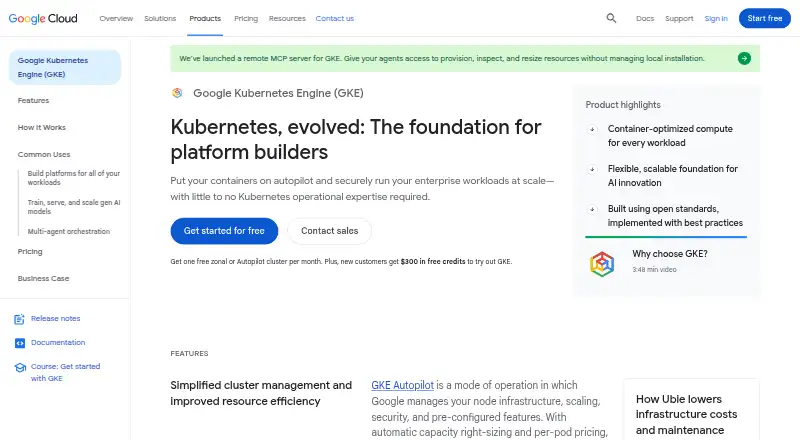
Google Kubernetes Engine (GKE) runs applications packaged in containers on Google Cloud, with Kubernetes coordinating them. Choose Autopilot, where Google handles more of the node management, or Standard, where you configure node pools and other settings. GKE connects with Google Cloud tools for monitoring, deployment, security, and multi-cluster management. A free tier offers monthly credits for one cluster; paid cluster management starts at $0.10 a month, with usage costs to consider.
Review
In a line
GKE is Google's managed Kubernetes environment for container-based applications on Google Cloud. Kubernetes, the open-source system it uses, coordinates applications running in containers.
What it does
GKE manages a cluster’s Kubernetes control plane, the part that coordinates the cluster, from creation to deletion. It can also scale application Pods and cluster nodes automatically.
Autopilot has Google manage node setup, scaling, scheduling, security settings, and upgrades. In Standard, customers can set up node pools, choose machine types, and adjust networking, security, and add-ons; Google continues to run the service infrastructure beneath them.
GPU and TPU support lets GKE run machine-learning and high-performance computing workloads. It also offers workload isolation, security visibility, and tools for organizing clusters across teams.
How it connects
GKE integrates with Google Cloud services such as Cloud Monitoring, Cloud Logging, managed Prometheus, Cloud Build, Cloud Deploy, and Artifact Registry. Other named services include Config Sync, Cloud Service Mesh, Fleets, and AI Hypercomputer.
It provides both the Kubernetes API and a Google Kubernetes Engine API. The latter can be used through REST, client libraries, or the gcloud command-line tool. GKE is a proprietary service, though the Kubernetes software underneath it is open source.
GKE can manage conformant Kubernetes clusters attached to its environment. Google says applications can run unchanged on existing on-premises hardware or in public cloud.
Good fit
Google positions GKE for platform teams building enterprise developer platforms and for teams training or serving AI models. Autopilot may suit teams that want Google to handle more node operations; Standard is for teams that need to configure node pools and related settings themselves.
It can also suit organizations managing clusters across multiple teams or working with GPU and TPU workloads.
Watch for
Autopilot lacks Windows Server node images and Windows container support. Check that limitation if Windows workloads are part of your plans.
GKE still involves Kubernetes, and Standard mode exposes choices such as networking, machine types, and security settings. Check which mode fits your team’s needs and how the full cloud usage cost will work for your workloads.
Pricing
GKE’s free tier provides $74.40 in monthly credits per billing account. Those credits cover a single zonal Standard or Autopilot cluster and reset monthly without carrying forward.
Cluster management costs $0.10 a month, calculated per cluster per hour. Google lists a starting price of $9 a month; the final cost depends on usage, so check the pricing details before budgeting. A free trial is also available.
Verdict
Consider GKE if you need managed Kubernetes on Google Cloud, particularly for multi-team cluster management or GPU and TPU workloads. Autopilot shifts more node work to Google, while Standard leaves more configuration in your hands.
It may be a poorer fit if you require Windows containers in Autopilot or prefer not to work with Kubernetes concepts. Compare the full expected usage cost—not just the cluster management fee—before choosing it.
Our take
GKE is worth considering when your applications need Kubernetes on Google Cloud and your team values managed cluster operations, multi-team organization, or GPU and TPU support. Autopilot reduces the node-management work; Standard offers more configuration control. The free credits can help with one cluster, but they are limited and reset monthly, so they are not a substitute for estimating ongoing usage costs. Look elsewhere or choose another mode if Windows containers are required in Autopilot, or if Kubernetes is more complexity than your team wants to take on.
- Autopilot can manage node provisioning, scaling, scheduling, and upgrades.
- Standard mode allows configuration of node pools, machine types, and networking.
- GKE accommodates clusters as large as 65,000 nodes and supports GPU and TPU workloads.
- Built-in connections support Google Cloud logging and monitoring.
- Fleets and team tools help organize clusters and workloads.
- Autopilot lacks Windows Server node images and container support.
- GKE is proprietary, although the Kubernetes technology it manages is open source.
- Free-tier credits cover one cluster and reset monthly without rollover.
- Standard mode leaves customers responsible for more configuration choices.
- Pick it ifTeams running containerized applications on Google Cloud; Platform teams and teams training or serving AI models; Organizations managing Kubernetes clusters across multiple teams
- Skip it ifYou need Windows Server node images or containers in Autopilot.; You need an open-source managed service rather than Google’s proprietary service.; You cannot estimate or accommodate cloud usage costs beyond the management fee.
Pricing
The free tier provides $74.40 in monthly credits per billing account for one zonal Standard or Autopilot cluster; credits reset monthly and do not roll over. Cluster management costs $0.10 a month, billed per cluster per hour. The listed starting price is $9 a month, but usage affects the total cost.
- Free tiermonthly credits per billing account · $74.40 credit · applies to one zonal Standard or Autopilot cluster · unused credits do not roll overFree
- Cluster management feeper cluster per hour · Cluster life cycle management, autoscaling, cost visibility, infrastructure cost optimization, and multi-cluster management are included at no extra cost$0.10/mo
As cloud.google.com lists them, checked 21 Oct 2026.
Questions
What does Google Kubernetes Engine do?
GKE is Google's managed Kubernetes environment for containerized applications running on Google Cloud.
How do Autopilot and Standard differ?
Autopilot has Google manage more node operations and settings. Standard lets customers configure node pools, machine types, networking, security settings, and add-ons.
Does GKE have a free plan?
Yes. The free tier provides $74.40 in monthly credits per billing account for one zonal Standard or Autopilot cluster. Credits reset monthly and do not roll over.
What does GKE cost?
The listed starting price is $9 a month. Cluster management costs $0.10 a month, billed per cluster per hour; usage affects the total.
Can GKE run Windows containers?
Autopilot does not provide Windows Server node images or Windows container support.
Can GKE run AI workloads?
GKE supports GPU and TPU workloads and connects with AI Hypercomputer for machine learning and high-performance computing.
Is GKE open source?
No. GKE is a proprietary managed Google Cloud service; the Kubernetes technology it manages is open source under the Apache License 2.0.
Near it
All alternatives →- HN
 HashiCorp Nomad#2 on this board
- K
 Kubernetes#4 on this board
- K
 KubeSphere#1 on this board
- MMicroK8s#5 on this board
- KK
 Kubermatic Kubernetes Platform#6 on this board
- OC
 Oracle Cloud Infrastructure Container Registry#7 on this board
- K
 k0s#8 on this board
- ES
 Exoscale Scalable Kubernetes Service#9 on this board
- O
 OKD#10 on this board
- RRancher#11 on this board