jaq: Free jq-Compatible Data Tool
github.com · checked 15 Oct 2026
An open-source jq replacement for querying and transforming structured data.
How it plugs in
Signal on JSON Tools7.7#1 of 29
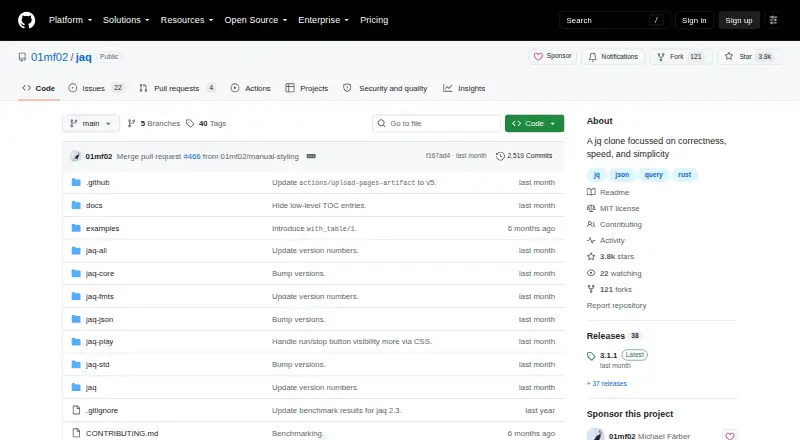
jaq is a Rust implementation of jq for command-line data work and application embedding. It reads and writes JSON, YAML, CBOR, TOML, XML, CSV, and TSV, and can convert between these formats while applying jq filters. Prebuilt binaries, a browser playground, and a Rust library are available at no cost under the MIT license.
Review
In a line
jaq is an open-source, Rust-based replacement for jq, a tool for querying and changing structured data. It is available as a command-line program and as a library for Rust applications.
What it does
You give jaq structured data and a jq filter, then use the result in a terminal workflow or an application. It handles JSON, YAML, CBOR, TOML, XML, CSV, and TSV, including conversion between those formats while transforming the data.
Its extended JSON representation can keep very large integers, byte strings, invalid UTF-8, non-string object keys, comments, Infinity, and NaN. It also adds filters for tasks such as paths, format conversion, byte conversion, Boolean conversion, HTML escaping, and controlled halting.
jaq aims to work as a drop-in jq replacement and preserve jq compatibility in most cases. The project provides a reference manual, a man page, and more than 500 tests.
How it connects
jaq works from the command line and can be embedded through the jaq-core Rust crate, which compiles and runs jq programs inside Rust applications. The library can handle application-defined values and data types beyond JSON, and it is designed for multithreaded use.
The code is MIT-licensed and open source. Binary downloads are provided for Linux, macOS, and Windows; installation is also documented through Homebrew and Cargo. A browser playground lets you try filters interactively without installing the command-line program.
Good fit
jaq suits people who already use jq syntax and need to query or reshape structured files from a terminal. Its additional input and output formats make it useful when a workflow moves data between formats.
Rust developers can use jaq-core as an embedded scripting and filtering library, including with custom values and native Rust filters. The project publishes comparisons with jq and gojq, and reports jaq as faster on many tested benchmarks.
Watch for
Compatibility is an aim rather than a promise that every jq behavior is identical, so check filters that depend on edge cases before switching. Source installation requires Cargo and a Rust toolchain, although prebuilt binaries are available.
jaq does not defend against resource exhaustion. An input or recursive filter can use unlimited time, memory, or stack space, so untrusted workloads need their own limits. Input data and filters cannot start I/O, except that filters may read files before execution.
Pricing
jaq is free. The command-line program and Rust crates are MIT-licensed open-source software, with Linux, macOS, and Windows binaries available. There is no paid plan or free trial because the software has no charge.
Verdict
Choose jaq if you want jq-style queries with support for more data formats, a browser playground, or a Rust API for embedding filters. It is also a reasonable fit when open-source licensing and downloadable binaries matter.
Look elsewhere if you need built-in controls that stop filters from exhausting system resources, or if your workflow depends on jq behavior that has not been checked for compatibility. Teams that do not use the command line or Rust may find its main interfaces less relevant.
Our take
jaq is a practical free option for terminal users who need jq-compatible filtering across JSON and several other structured formats. Rust developers get an embeddable library with custom data-type and multithreading support. The main risk is operational: recursive filters or hostile input can consume unbounded resources, and jq compatibility is not guaranteed in every corner case. Try the online playground first, then choose a prebuilt binary or Cargo installation if its syntax and limits match your workflow.
- Free MIT-licensed command-line tool and Rust library
- Reads and writes JSON, YAML, CBOR, TOML, XML, CSV, and TSV
- Browser playground and binaries for Linux, macOS, and Windows
- Supports custom Rust data types and multithreaded use
- Reports faster results than jq on many benchmarks
- No built-in defense against unlimited time, memory, or stack use
- jq compatibility is intended but not complete in every case
- Source installation needs Cargo and a Rust toolchain
- Pick it ifCommand-line users who already know jq filters; Rust apps that need embedded data transformation; Workflows moving data between supported formats
- Skip it ifYou need automatic resource limits for untrusted or recursive filters; Your workflow requires guaranteed identical behavior to jq; You do not use terminal tools or Rust libraries
Pricing
jaq costs nothing. Its MIT-licensed command-line binaries and Rust crates are open source, with no paid tier or trial.
- jaqMIT-licensed open-source command-line program and Rust libraryFree
- jaq open-source releaseMIT licence · command-line binary and Rust crates · Linux, macOS and Windows binariesFree
As github.com lists them, checked 4 Oct 2026.
Questions
Is jaq free?
Yes. jaq is free, MIT-licensed open-source software, including its command-line program and Rust crates.
What formats can jaq handle?
jaq supports JSON, YAML, CBOR, TOML, XML, CSV, and TSV for input and output, and can convert between them while applying a jq filter.
Can jaq replace jq?
jaq is intended as a drop-in jq replacement and aims to preserve jq compatibility in most cases. Check important edge-case filters before changing tools.
Where can I run jaq?
Prebuilt binaries are available for Linux, macOS, and Windows. The project also supports installation through Homebrew or Cargo and offers a browser playground.
Can developers embed jaq?
Yes. The jaq-core Rust crate compiles and runs jq programs inside Rust applications, including with custom data types and native Rust filters.
Does jaq limit memory or processing time?
No. The project says inputs or recursive filters can consume unlimited time, memory, or stack space, so callers must provide their own resource controls.
Can I try jaq without installing it?
Yes. An online browser playground is available for interactive use.