kube-score Review
kube-score.com · checked 8 Oct 2026
Open-source static checks for Kubernetes configurations, with command-line, browser, and CI/CD use.
How it plugs in
Signal on Infrastructure Testing Tools6.6#7 of 28
kube-score reviews Kubernetes YAML or JSON before deployment. It checks security and resilience concerns such as probes, limits, policies, and stable APIs. The MIT-licensed tool runs on Linux, macOS, Windows, Docker, Homebrew, Krew, or in a browser demo. It supports Helm, Kustomize, clusters, CI/CD, and several report formats.
Review
In a line
kube-score examines Kubernetes object definitions through static analysis. Its guidance focuses on strengthening application security and resilience.
What it does
Provide kube-score with Kubernetes YAML or JSON, whether plain manifests or output rendered by Helm or Kustomize. Among its checks are container limits, NetworkPolicy targets, and PodDisruptionBudget configuration.
It also reviews pod anti-affinity, container probes, security context, and stable API usage. Additional checks can compare resource requests with limits, inspect container ports, and assess seccomp profiles.
How it connects
Its documented workflows include Helm, Kustomize, static YAML, Docker, and resources pulled from an existing Kubernetes cluster. kube-score also works in CI/CD and emits human-readable, JSON, CI, or SARIF reports; SARIF is described as helping connect with CI platforms.
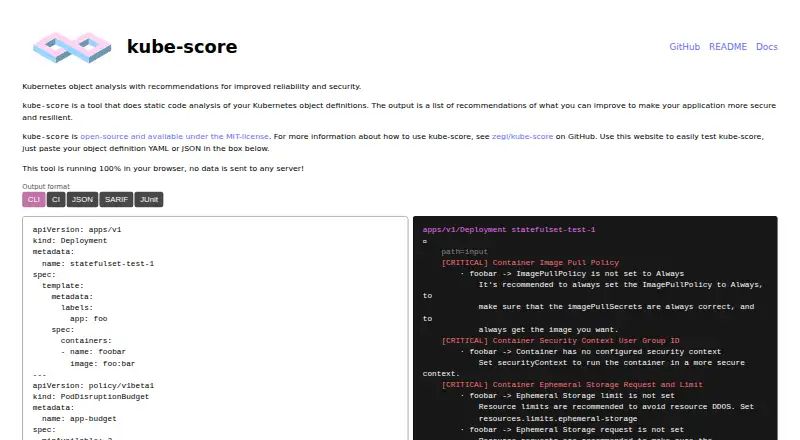
The project is released as MIT-licensed open source. macOS, Linux, and Windows have prebuilt binaries, while Docker, Homebrew, and Kubernetes Krew provide other installation routes. The online demo takes YAML or JSON and states that processing stays in the browser rather than being sent to a server.
Tests may be skipped globally or for individual objects, and optional tests may be enabled globally or per object. A source build needs Go 1.21 or newer.
Good fit
kube-score works well for teams checking Kubernetes manifests for ordinary security and resilience concerns ahead of release. It fits command-line workflows, CI/CD checks, and reviews of Helm or Kustomize output.
For CI runs, a critical finding produces exit code 1; warnings can be selected as the threshold instead. Reports can be adapted to people or automated systems.
Watch for
For the most useful result, the documentation advises submitting every application deployed in the same namespace. Plan your input accordingly.
No custom-policy or drift-detection capability is listed. Compiling it yourself needs Go 1.21 or later, while ready-made binaries and package options are available.
Pricing
kube-score has no charge and is distributed under the MIT open-source license.
Verdict
Choose kube-score when you want a no-cost way to inspect Kubernetes definitions and enforce checks in a delivery pipeline. Its browser demo lets you review files without uploading them, while local binaries and package options cover common operating systems and container workflows.
It is less suitable when you need custom policy authoring or drift detection, or when your review process cannot assemble applications from the same namespace. For broader comparisons, see Infrastructure Testing Tools.
Our take
kube-score is a practical fit for Kubernetes teams seeking pre-deployment static checks without a subscription. It addresses many common configuration risks, runs locally or in CI/CD, and provides machine-readable reports. The MIT license allows open-source use and modification. Prepare complete namespace inputs for dependable analysis and confirm that its available platforms fit your workflow.
- Free, MIT-licensed open-source project
- Checks security and resilience settings in Kubernetes objects
- Runs in CI/CD with adjustable failure thresholds
- Supports Helm, Kustomize, clusters, Docker, and static files
- Provides human-readable, JSON, CI, and SARIF output
- No custom policy feature is listed
- No drift detection is listed
- Best results require all applications in a namespace as input
- Building from source needs Go 1.21 or later
- Pick it ifTeams checking Kubernetes manifests before deployment; CI/CD pipelines that need configurable pass or fail checks; Users wanting local, Docker, or browser-based analysis
- Skip it ifYou need custom policies or drift detection; You cannot provide complete namespace application definitions; Your environment cannot use the listed platforms or installation methods
Pricing
The tool is free and MIT-licensed open source; no paid plans or free trial are listed.
- Free and open sourceMIT-licensed tool; no paid plans listedFree
As github.com lists them, checked 8 Oct 2026.
Questions
What does kube-score analyze?
It performs static checks on Kubernetes object definitions supplied as YAML or JSON and suggests security and resilience improvements.
Can kube-score run in CI/CD?
Yes. A critical error yields exit code 1, while warnings can be selected as the exit threshold. CI and SARIF reports are available.
Which tools can provide input?
The documented inputs include Helm, Kustomize, static YAML files, Docker, and resources obtained from an existing Kubernetes cluster.
Does kube-score send browser-demo data to a server?
According to the website, its YAML or JSON demo processes files entirely in the browser and does not transmit them to a server.
What operating systems are supported?
Prebuilt binaries are listed for macOS, Linux, and Windows; Docker, Homebrew, and Kubernetes Krew are also offered as installation methods.
How much does kube-score cost?
kube-score is available at no cost under the MIT open-source license, and no paid plans or free trial are listed.
Can I change which checks run?
Tests can be ignored globally or per object, and optional tests can be turned on globally or for individual objects.