Latitude review: AI agent monitoring and debugging
latitude.so · checked 15 Oct 2026
Open-source platform for tracing, monitoring, and fixing production AI agents.
How it plugs in
Signal on AI Prompt Generators7.4#2 of 28
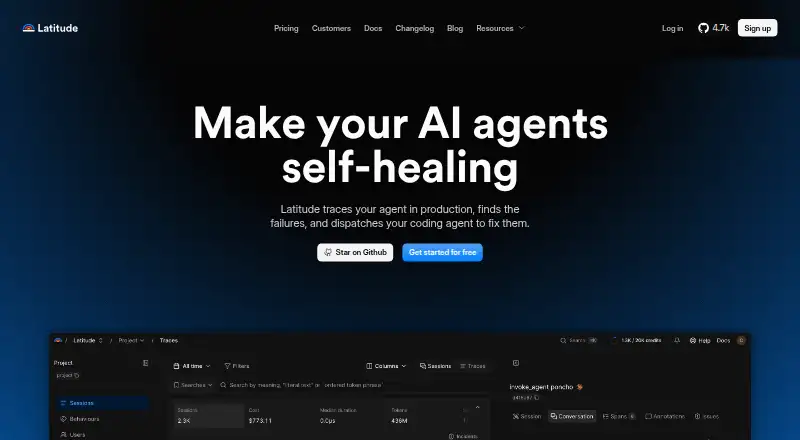
Latitude is an MIT-licensed platform for improving production AI agents. It records agent traffic, groups failures, and provides tools for search, monitoring, experiments, evaluations, and regression testing. Teams can use managed cloud hosting or run it themselves, connect through SDKs and an API, and send alerts to Slack or email.
Review
In a line
Latitude helps teams improve production AI agents by exposing and addressing operational problems. It captures agent activity and helps teams review failures over time.
What it does
Latitude records agent activity as spans and arranges connected traces into sessions for examining multi-turn conversations. Its Observe tools expose providers, models, tokens, latency, cost, errors, tool calls, user activity, and agent memory.
Semantic search, exact text search, metadata filters, and behavior clustering help locate recurring failure patterns. Users can annotate traces, spans, and outputs, then turn those annotations into signals and evaluations.
Monitors can follow signals, saved searches, or raw traffic and alert users in the app, by email, or via Slack. Datasets can capture failed traces for local simulation and regression testing, while experiments measure traffic differences across releases, models, or user groups.
How it connects
Latitude provides TypeScript and Python telemetry SDKs and supports any OpenTelemetry-compatible runtime. It also offers an API, command-line tool, MCP server, webhooks, and coding-agent skills for programmatic control.
Documented connections include Slack and GitHub. During setup, teams can connect Claude Code, Cursor, Codex, OpenCode, Hermes, or another coding agent. Its MCP server lets coding agents inspect and manage workspaces, projects, traces, annotations, and datasets.
The software runs through a web interface, API, Linux, or self-hosted deployments. Managed cloud, single-machine Docker Compose, Kubernetes with Helm, and Railway deployments are documented.
Good fit
Latitude suits teams running production AI agents that need complete execution paths, including tool calls and multi-turn sessions. It fits work that turns recurring failures into tracked issues, datasets, and reusable evaluations.
It can also suit collaborative AI product teams that need shared monitoring, experiments, alerts, and coding-agent assistance. The MIT license and self-hosting options support organizations that want to run the software themselves.
Watch for
Self-hosting requires Git, Docker and Docker Compose, Node.js, and pnpm; tmux and tmuxinator are optional recommendations. Kubernetes users need a cluster and Helm.
For hosted use, Latitude states that customer data and its managed inference are processed and stored in AWS eu-central-1 in Frankfurt, Germany. Its SDKs redact common security-sensitive attributes by default, and customers can add more redaction patterns.
Retention is 30 days on Starter, 90 days on Pro, and customized for Enterprise. Pro usage is credit-based, with extra credits costing $20 per 10K, which can raise costs for high-traffic agents.
Latitude says it is SOC II certified. Its security documentation said ISO 27001 audit work and a GDPR readiness review were in progress, with completion expected by the end of May 2026.
Pricing
Starter is free and comes with 20K monthly credits, 30-day data retention, unlimited seats, and support through a general Slack channel.
Pro costs $99 a month. The plan supplies 100K monthly credits, 90-day retention, unlimited seats, priority support, and SOC2 and ISO27001 reports. Additional credits are priced at $20 for each 10K.
Enterprise has a price on request. It adds custom credit volume and retention, custom on-premises or cloud deployment, role-based access controls, team training, SAML single sign-on, SOC2 and ISO27001 reports, an uptime and support agreement, and dedicated support.
Verdict
Choose Latitude if your AI agents already run in production and you need a record of what happened when they fail. Its tracing, clustering, annotations, datasets, and evaluations cover a path from detection to regression checks.
It is also a fit when self-hosting, open-source code, or programmatic control matters. Check the infrastructure requirements and data-retention periods first. High-volume deployments should model credit use before selecting Pro, while organizations needing custom deployment or support will need an Enterprise quote.
Our take
Latitude is aimed at organizations operating AI agents rather than people building one-off prompts. It brings traces, failure patterns, alerts, experiments, and regression datasets into one workflow, with coding-agent connections for follow-up fixes. A no-cost Starter tier provides an entry point, while self-hosting and an MIT license provide control over deployment. Before choosing it, confirm that your team can run the required tooling, that Frankfurt data processing fits your policies, and that Pro credit pricing matches expected traffic.
- MIT-licensed open-source software with managed-cloud and self-hosted options
- Traces multi-turn sessions, tool calls, costs, errors, and latency
- Turns failed traces into datasets that support regression testing
- Alerts available in-app, by email, and through Slack
- API, SDKs, CLI, webhooks, and MCP server support
- Self-hosting needs Docker, Node.js, pnpm, and related tooling
- Pro additional credits are priced at $20 per 10K
- Starter retains data for only 30 days
- High-volume usage can make credit costs expensive
- ISO 27001 auditing and GDPR readiness were not yet complete
- Pick it ifTeams operating production AI agents; Organizations needing open-source or self-hosted observability; AI product teams linking failures to evaluations
- Skip it ifYou do not operate production AI agents; You cannot support the listed self-hosting requirements; Credit-based pricing does not fit high-traffic workloads
Pricing
A free Starter plan covers 20K credits a month. Pro is $99 a month for 100K credits, with $20 per extra 10K. Enterprise pricing is customized.
- Starter20K credits/month · 30d data retention · unlimited seats · general-channel Slack supportFree
- Pro/month · 100K credits/month · 90d data retention · unlimited seats · priority support · extra credits $20 per 10K · SOC2 & ISO27001 reports$99/mo
- Enterprisecustom credit volume · custom retention · custom on-premises or cloud deployment · RBAC · team training · SAML SSO · SOC2 & ISO27001 reports · uptime/support SLA · dedicated supportOn request
As latitude.so lists them, checked 15 Oct 2026.
Questions
Is Latitude open source?
Yes. Latitude is fully open source under the MIT license.
Does Latitude have a free plan?
Yes. Starter is free and offers 20K monthly credits, 30-day retention, unlimited seats, and support in a general Slack channel.
Where can Latitude run?
Latitude supports managed cloud and self-hosted deployment. Documented options include Docker Compose, Kubernetes with Helm, and Railway.
Which SDKs does Latitude provide?
Latitude provides TypeScript and Python telemetry SDKs and supports any runtime compatible with OpenTelemetry.
Can Latitude send alerts to Slack?
Yes. Monitor alerts can appear in the app, arrive by email, or be sent through Slack.
What does Pro cost?
Pro is priced at $99 a month and comes with 100K monthly credits. Each additional 10K credits costs $20.
Does Latitude connect to coding agents?
Setup documentation names Claude Code, Cursor, Codex, OpenCode, and Hermes, plus another coding agent. Its MCP server lets agents manage Latitude data.