libSQL: Free Open-Source SQLite Fork
github.com · checked 30 Sept 2026
Open-source SQLite fork offering embedded replicas, remote connections, and SQLite compatibility.
How it plugs in
Signal on Embedded Databases6.4#8 of 30
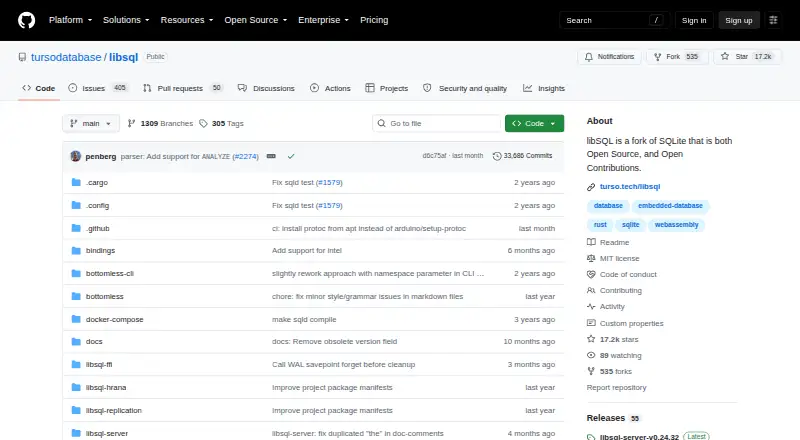
Turso maintains libSQL as an open-source SQLite fork. It preserves SQLite’s file format, API compatibility, and ability to operate within an application without a network connection. It adds embedded replicas, remote access through a server, and extra extensions. The project is free, MIT-licensed, and available for self-hosting across several platforms.
Review
In a line
Turso maintains libSQL as a free, open-source SQLite fork. This relational database works either inside an application or via a remote server.
What it does
Applications use libSQL with SQL while retaining SQLite file-format support and API compatibility. It can run locally without a network connection.
An application can use libSQL’s embedded-replica support to keep a replicated database copy on hand. Listed additions include ALTER TABLE changes for column types and constraints, randomized ROWID values, WebAssembly user-defined functions, and a virtual write-ahead-log interface.
How it connects
The libSQL server gives applications remote SQLite access. Its guide says clients submit SQL over HTTP to sqld server instances. The repository lists official TypeScript/JavaScript, Rust, and Go drivers; Python and C drivers are experimental, while PHP, D, and Ring drivers are community projects.
The code is open source under the MIT license. The project names Beekeeper Studio, Outerbase, TablePlus, Dataflare, and libSQL Studio among its GUI options. Docker instructions cover primary and replica servers, while cluster connections can use gRPC with TLS certificates and private keys.
It can be used as an embedded database when the database should live inside an application process.
Good fit
libSQL suits teams that want SQLite compatibility with embedded replication or remote access. The documentation presents it as a choice for mission-critical workloads that need a battle-tested SQLite foundation.
It can fit self-hosted deployments and applications written for its listed platforms and drivers, including macOS, Linux, JavaScript, Rust, Python, Go, C, and WebAssembly.
Watch for
Because libSQL follows SQLite’s single-writer model, requirements for concurrent writes deserve careful review.
The maintainers treat libSQL and Turso Database as distinct projects. For new projects, they point users to Turso Database, where new features are being developed, while libSQL continues to be maintained.
Driver support varies: some are experimental and others are maintained by the community. Check driver status and the deployment model before committing.
Pricing
libSQL is free. The project offers a free plan, and its MIT license permits use of the open-source code.
Verdict
Choose libSQL when you need a SQLite-based database that can stay embedded in an app while also supporting replicas or a remote SQL server. Its open code, compatibility goals, listed drivers, and self-hosting instructions give teams several ways to deploy it.
Think twice if your project needs more than one writer at a time, or if you want the newest Turso features in a new project. In those cases, compare the single-writer constraint and Turso’s separate product direction before deciding.
Our take
libSQL is a practical choice for applications that value SQLite’s local, file-based model but need replication or an HTTP-accessible server. Its free cost and MIT license remove common budget and licensing barriers. The main constraint is SQLite’s single-writer design, and some drivers are not final or are maintained by the community. For a new project, the maintainers direct users to Turso Database, where new features are being developed. Existing systems seeking an actively maintained SQLite fork may find libSQL a suitable fit.
- Preserves SQLite file-format and API compatibility
- Runs inside an app without a network connection
- Keeps a replicated database copy inside the app
- Free and MIT licensed
- Remote SQL access through an HTTP server
- Follows SQLite’s single-writer limitation
- Some drivers are experimental or community maintained
- New projects are steered toward Turso Database for ongoing feature development
- Remote clusters require TLS certificate configuration
- Pick it ifSQLite-based apps needing embedded replicas; Teams wanting free, self-hosted database software; Projects using the listed SQL drivers
- Skip it ifYou need several concurrent database writers; You need the latest features being developed in Turso Database; Your preferred language relies on an experimental driver
Pricing
libSQL is free, with a free plan and MIT-licensed source code. There is no paid tier listed in the facts.
Questions
Is libSQL free?
Yes. libSQL has a free plan, and the project is licensed under MIT.
Can libSQL run without a network connection?
Yes. It is designed to run inside an application process and retain SQLite’s embedded, offline capability.
What is an embedded replica?
It is a replicated copy of a database kept inside an application, allowing the app to maintain synchronized local data.
Does libSQL keep SQLite compatibility?
The project aims to preserve SQLite’s file format and API compatibility while adding extra APIs and extensions.
Which programming languages have drivers?
The repository identifies TypeScript/JavaScript, Rust, and Go as official drivers. Python and C are experimental; PHP, D, and Ring drivers are community projects.
What is libSQL’s main limitation?
libSQL follows SQLite’s single-writer model, meaning only one writer can operate at a time.
Should a new project use libSQL or Turso Database?
The maintainers treat them as separate projects and point new projects to Turso Database, where new features are being developed.