listmonk: Self-Hosted Newsletter and Mailing-List Manager
listmonk.app · checked 15 Oct 2026
Open-source software for self-managed newsletters, mailing lists, and transactional messages.
How it plugs in
Signal on Email Marketing Software7.7#1 of 187
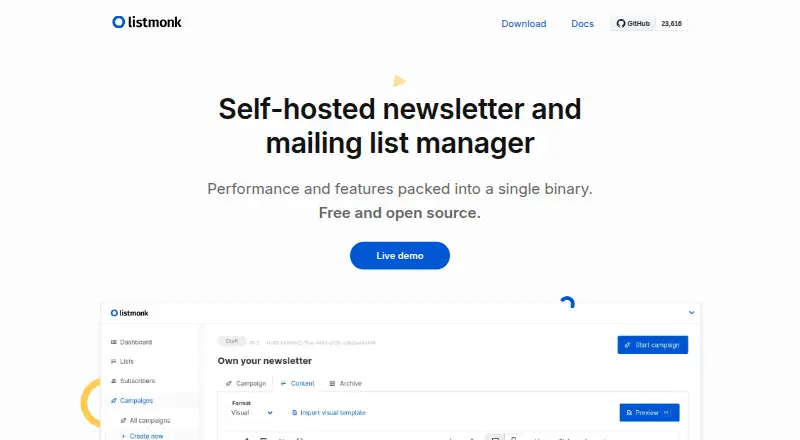
listmonk is a free, open-source application for sending newsletters, one-way campaigns, and transactional messages. You host it yourself with PostgreSQL 12 or newer. It provides subscriber lists, SQL-based segmentation, campaign analytics, multiple template editors, a JSON HTTP API, role controls, and delivery through email or messenger services.
Review
In a line
listmonk handles newsletters, one-way mailing lists, and transactional messages on infrastructure you operate. The project ships as one binary and uses the AGPLv3 free-software licence.
What it does
Lists may use single or double opt-in, while subscribers can be managed and queried into SQL-based segments. The project says it can handle millions of subscribers.
Campaign reporting covers performance, bounces, and top links. For composing email, you can choose a drag-and-drop builder, WYSIWYG editor, Markdown, HTML, or plain text; templates also accept Go expressions and over 100 Sprig functions.
A transactional API sends messages from saved templates. Messenger endpoints can submit campaign JSON for channels such as SMS, FCM, WhatsApp, and other non-email delivery.
How it connects
Dashboard operations are available through JSON-based, REST-like HTTP endpoints. Requests can use BasicAuth or authorization tokens, and the project publishes an automatically generated OpenAPI/Swagger document.
Subscriber data can be synchronized by API, CSV import, or direct access to basic subscriber and list tables. Messenger web services accept campaign JSON for delivery providers, with community implementations for AWS Pinpoint, Mailersend, Novu, FCM, and Resend.
OIDC single sign-on, detailed user and list permissions, and privacy features for exporting or erasing subscriber data are supported. The software runs on Linux, macOS, Windows, and the other listed 64-bit systems, and a Docker image is available. Clients and integrations listed by the project are community contributions rather than official packages.
Good fit
It suits teams that want to host their own newsletter and mailing-list system, keep subscriber data under their control, and avoid per-subscriber fees.
The software fits organizations that need large lists, SQL-based audience segments, campaign reporting, reusable templates, and programmatic sending through an API. It also works for transactional email and non-email delivery through messenger endpoints.
Watch for
You must provide a PostgreSQL database version 12 or newer. This is self-hosted software, so deployment and database operation are your responsibility.
The documented SDKs and integrations come from the community and are not official. Documentation warns that nightly builds have not been tested and could include bugs, so production use calls for a stable build.
Email delivery uses SMTP connections and rate limits. Confirm that your mail service and any messenger service fit your sending needs.
Pricing
listmonk is free. Its self-managed offering is open source and states unlimited subscribers, lists, and campaigns; PostgreSQL is required.
There is no paid plan or hosted price listed in the supplied facts.
Verdict
Choose listmonk if your team can run a server and PostgreSQL and wants an open-source system with a public API, detailed permissions, and flexible message templates.
It is a poor match if you need a managed service that handles hosting and the database for you. Teams depending on official third-party SDK support should also check each integration carefully, since the listed clients are unofficial.
Our take
listmonk makes sense for technical teams seeking a no-license-cost mailing system they can operate themselves. It combines large-list management, SQL audience queries, campaign reporting, and template choices with API-based automation. Operating it requires PostgreSQL 12 or newer, deployment work, and careful validation of unofficial integrations. Organizations wanting vendor-managed infrastructure or a simpler hosted setup should look elsewhere. Those comfortable with self-hosting get a flexible base for newsletters, one-way campaigns, and transactional messages without a per-subscriber charge.
- Free and open-source under AGPLv3
- Handles lists described as supporting millions of subscribers
- JSON HTTP API covers dashboard capabilities
- Supports several email template editing methods
- Built-in analytics track bounces and top links
- Requires self-hosting and PostgreSQL 12 or newer
- Community SDKs and integrations are unofficial
- Nightly builds have not been tested and may contain bugs
- Delivery depends on SMTP and rate-limit settings
- Pick it ifTeams that can run PostgreSQL and their own server; Newsletter and mailing-list work plus API-driven messages; Organizations needing SQL subscriber segmentation
- Skip it ifYou need a managed hosted service; You require officially supported third-party SDKs; You cannot operate PostgreSQL 12 or newer
Pricing
The self-hosted offering is free and open source, with unlimited subscribers, lists, and campaigns stated. PostgreSQL 12 or newer is required.
- Self-hostedFree and open source; requires a PostgreSQL databaseFree
- Self-hosted listmonksingle binary · PostgreSQL database required · unlimited subscribers, lists and campaigns statedFree
As listmonk.app lists them, checked 4 Oct 2026.
Questions
Is listmonk free?
Yes. The self-hosted offering is free software released under AGPLv3.
What database does listmonk require?
Running it requires PostgreSQL version 12 or later.
Does listmonk have an API?
Yes. JSON REST-like HTTP endpoints expose dashboard capabilities, with BasicAuth and authorization-token options. An OpenAPI/Swagger document is generated automatically.
Can listmonk send transactional messages?
Yes. Its transactional API uses saved templates, and messenger endpoints can submit JSON for SMS, FCM, WhatsApp, and other delivery services.
Which systems can run listmonk?
The project offers 64-bit binaries for Darwin, FreeBSD, Linux, NetBSD, OpenBSD, and Windows, along with a Docker image.
Can subscribers be imported or synchronized?
Yes. External systems can synchronize subscribers through APIs, CSV import, or direct access to simple subscriber and list tables.
Does listmonk support single sign-on?
Yes. OIDC single sign-on is supported alongside API tokens and granular user and list roles and permissions.