
MarkLogic: Multi-Model Database and Data Platform
progress.com · checked 15 Oct 2026
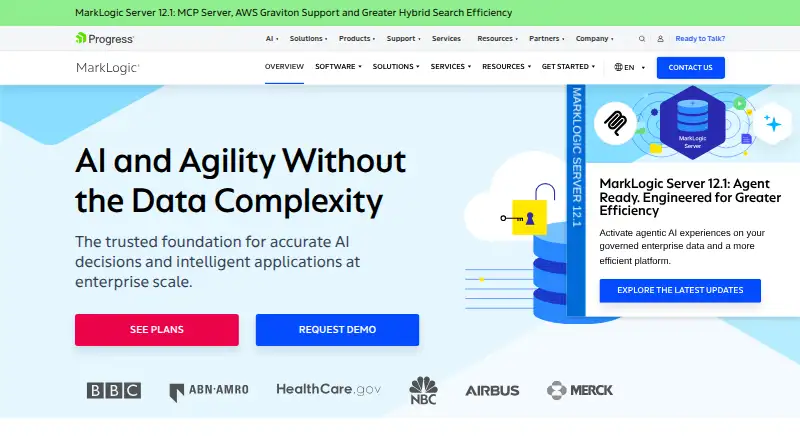
MarkLogic is a semantic data platform with a multi-model database, search, analytics and AI features.
How it plugs in
Signal on NoSQL Databases6.7#5 of 30
MarkLogic combines document, graph, relational, geospatial, vector, temporal and binary data in one database. It offers SQL, SPARQL and REST access, built-in search, data integration and semantic AI features. You can run it on your infrastructure, in public or private clouds, or use managed SaaS. A free Developer plan supports up to 1TB for noncommercial work.
Review
In a line
MarkLogic is an enterprise data platform built around a multi-model database and semantic AI technology. It stores several data types together and supports search, analytics and relationships.
What it does
The server stores JSON, XML, text, binary, geospatial and semantic data in one database. Relational views allow SQL analytics, while graph features store RDF triples and support SPARQL queries.
Its built-in index makes content searchable as it is loaded. Search includes phrases, Boolean logic, stemming, wildcards, facets, snippets, proximity boosting and relevance ranking.
MarkLogic Data Hub takes data from source systems, indexes it, then helps harmonize, master and enrich that data. The platform also includes transactions, clustering, high availability, disaster recovery and point-in-time recovery.
How it connects
A REST interface supports document create, read, update and delete operations, search, analytics and faceted-search applications. An open-source Node.js client adds asynchronous search, document management, batch loading, transactions, aggregates and server-side JavaScript extensions.
Connectors and APIs are available for MuleSoft, Apache NiFi and Kafka. The ecosystem also lists Hadoop, Esri and business-intelligence tools. Authentication can integrate with LDAP, Kerberos and SAML.
MarkLogic is proprietary software, although its connectors and APIs are open source. It can run on premises, in virtualized systems, public or private clouds, hybrid environments and containers. See Document Databases and Multimodel Databases for related categories.
Good fit
MarkLogic suits organizations that need one system for mixed data, search and relationship analysis. Listed industries include financial services, insurance, pharma, manufacturing, media, national security and government.
It can support multi-region deployments, SQL reporting, semantic graphs, geospatial work and vector search. Managed SaaS handles installation, upgrades, backups, monitoring and user management.
Watch for
The free Developer License is for nonproduction use, supports up to 1TB and expires after six months unless renewed. Production installation guidance recommends at least eight vCPUs and 8 GB of memory per vCPU on each host, with synchronized cluster clocks.
Check operating-system limits before deployment. MarkLogic 12 supports Windows Server 2019/2022, Windows 10 development, Docker, RHEL 8/9, Amazon Linux 2023 and AWS Graviton with stated limitations.
The core server is proprietary. Confirm licensing, infrastructure responsibility and required capabilities before choosing self-hosting or a managed plan.
Pricing
Developer: free (billed free), up to 1TB with all database capabilities for noncommercial use. A free trial is also available.
Bring-Your-Own License: price on request; customer-selected cloud infrastructure, with multi-cloud, private and hybrid cloud support and customer-controlled version updates.
Enterprise: price on request; unlimited data storage on a core-based subscription, with optional advanced capabilities and tools. Managed SaaS: price on request; 24/7 infrastructure management, SOC 2 Type 2-certified monitoring, continuous security scanning, DDoS protection and managed upgrades.
Progress Data Platform: price on request; the full MarkLogic suite, semantic AI and modeling, business-rules automation and more than 100 enterprise connectors.
Verdict
Choose MarkLogic if your team needs mixed data models, immediate search, semantic queries and enterprise recovery options in one platform. Its APIs, SDK and connectors support custom applications and data pipelines, while deployment can stay in your infrastructure or move to managed SaaS.
The free Developer plan is useful for noncommercial evaluation within its 1TB and six-month limits. Production buyers should request quotes and clarify storage, hosting, support and security requirements. Teams wanting open-source database software should note that MarkLogic’s core server is proprietary; see Database Software for a wider starting point.
Our take
MarkLogic is a fit for enterprises bringing documents, graphs, relational views, geospatial data and search into one governed system. It offers several deployment choices, recovery features, SQL and SPARQL access, and a managed option that takes on infrastructure work. The free Developer plan can support evaluation, but its nonproduction rule, 1TB ceiling and six-month expiry limit long-term use. Production pricing is quote-based, and the proprietary core may rule it out for teams that require a fully open-source database.
- Stores document, graph, relational, geospatial, vector, temporal and binary data
- Built-in search indexes content immediately and ranks results
- Supports SQL, SPARQL, REST and an open-source Node.js client
- Runs on premises, in clouds, hybrid setups or managed SaaS
- Includes high availability, disaster recovery and point-in-time recovery
- Developer plan is noncommercial, capped at 1TB and expires after six months
- Production setup guidance calls for substantial CPU and memory
- Core server is proprietary rather than open source
- Most paid plans list price on request
- Pick it ifEnterprises managing mixed data with search and semantic queries; Teams needing self-hosted, hybrid or managed deployment choices; Organizations building governed data hubs and integrations
- Skip it ifYou need a fully open-source database core; You require a published production price; Your workload cannot meet the stated host requirements
Pricing
A free Developer plan supports up to 1TB for noncommercial use. Bring-Your-Own License, Enterprise, Managed SaaS and Progress Data Platform plans are all price on request, with different hosting, storage and management features.
- Developerfree · Up to 1TB · all database capabilities · noncommercial useFree
- Bring-Your-Own Licensenot stated · Customer-selected cloud infrastructure · multi-cloud, private and hybrid cloud support · customer-controlled version updatesOn request
- Enterprisenot stated · Unlimited data storage · core-based subscription · optional advanced capabilities and toolsOn request
- Managed SaaSnot stated · 24/7 infrastructure management · SOC 2 Type 2-certified monitoring · continuous security scanning · DDoS protection · managed upgradesOn request
- Progress Data Platformnot stated · Full MarkLogic suite · semantic AI and modeling · business rules automation · 100+ enterprise connectorsOn request
As progress.com lists them, checked 15 Oct 2026.
Questions
Is MarkLogic free?
Yes. The Developer plan is billed free, supports up to 1TB and includes all database capabilities for noncommercial use. A free trial is also available.
What data can MarkLogic store?
It natively stores JSON, XML, text, binary, geospatial and semantic data, with support for document, graph, relational, vector and temporal models.
Does MarkLogic support SQL?
Yes. MarkLogic provides relational views for SQL analytics and also supports SPARQL for semantic graph queries.
Can MarkLogic run in the cloud?
Yes. It can run on public, private or hybrid clouds, customer-selected infrastructure, containers or on premises. Managed SaaS is available.
Is MarkLogic open source?
No. The core server is proprietary. Progress provides open-source connectors and APIs around it.
What limits apply to the Developer License?
It is limited to nonproduction use, allows up to 1TB of data and expires after six months unless renewed.
Which integrations are listed?
The ecosystem lists APIs and connectors for MuleSoft, Apache NiFi, Kafka, Hadoop, Esri and business-intelligence tools.
Near it
All alternatives →- AHApache HBase#4 on this board
- MMemgraph#6 on this board
- AD
 Aerospike Database#3 on this board
- AD
 Amazon DynamoDB#7 on this board
- A
 ArcadeDB#2 on this board
- AE
 Amazon ElastiCache#8 on this board
- AC
 Apache Cassandra#1 on this board
- F
 Firestore#9 on this board
- AC
 Apache CouchDB#10 on this board
- RRavenDB#11 on this board