MicroShift: OpenShift Kubernetes for Edge Systems
microshift.io · checked 8 Oct 2026
MicroShift adapts OpenShift Kubernetes to edge deployments and compact hardware.
How it plugs in
Signal on Local Kubernetes Tools6.3#7 of 23
MicroShift brings an edge-focused OpenShift Kubernetes stack to small devices. A lone systemd service hosts its lean control plane and worker node, with frugal demands on CPU, memory, networking, and storage. Linux, macOS, and self-hosted environments are supported; production use is available on hardware or hypervisors certified for Red Hat Enterprise Linux 9.
Review
In a line
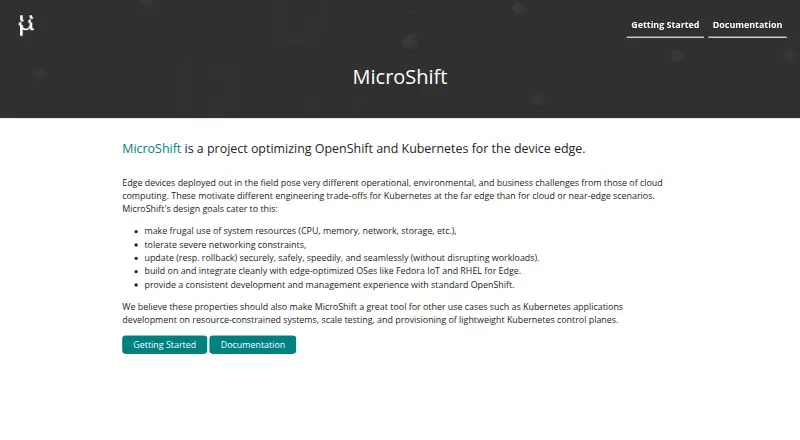
MicroShift is an OpenShift Kubernetes project built for small form-factor systems and edge computing. Its design favors low resource use and operation through difficult network conditions.
What it does
A single systemd service bundles MicroShift's lean OpenShift control plane with its worker node. DNS, an ingress router, service certificates, OVN-Kubernetes networking, and LVMS storage make up the listed infrastructure.
Its design goals include secure, safe, fast updates that do not interrupt workloads. OLM, Gateway API, cert-manager, and SR-IOV are optional components supplied in separate RPM packages.
How it connects
MicroShift is available for x86_64 and aarch64 systems and uses CRI-O as its container runtime. A local container registry and add-on catalog are supported, while graphical management and multi-node clusters are not.
The repository lists an Apache-2.0 license. MicroShift Upstream lets contributors and testers build from the original sources with OKD payload images, without Red Hat subscriptions or pull secrets. Prebuilt artifacts appear on the Releases page, with nightly RPMs on COPR. Local Kubernetes Tools offers a broader view of related software.
Good fit
MicroShift suits teams placing OpenShift Kubernetes on edge systems or other small installations. Its design seeks frugal CPU, memory, network, and storage consumption.
Production deployments may use bare metal or hypervisors supported and certified for Red Hat Enterprise Linux 9. The stated minimums are two CPU cores, 2GB of RAM, and 2GB of free root storage.
Watch for
There is no support for multi-node clusters or a graphical interface in MicroShift. Check those limits before choosing it for a larger or visually managed setup.
The supported operating system is Red Hat Enterprise Linux 9.8, with Extended Update Support listed in the requirements. The Kubernetes version follows the MicroShift release; MicroShift 4.22 comes from OpenShift Container Platform 4.22.
Upstream deployment options also list CentOS 9, CentOS 10, Fedora, Ubuntu, and macOS through Podman machine in rootful mode. RPM and DEB packages built in a container can run on the listed systems.
Pricing
MicroShift is a paid product with pricing on request. MicroShift Upstream provides a no-cost build for upstream development and testing, without requiring Red Hat subscriptions or pull secrets.
Verdict
Choose MicroShift when you need an OpenShift-based Kubernetes installation with a small footprint, edge focus, and a single-service setup. It is also a fit for teams comfortable with command-line and self-hosted deployment on supported Linux systems.
Look elsewhere if you require multi-node clusters, a graphical interface, or a published price. Review the operating-system, architecture, and hardware requirements before committing, especially for production on Red Hat Enterprise Linux 9.
Our take
MicroShift is a focused option for running OpenShift Kubernetes where hardware and connectivity are constrained. Its single-service architecture, built-in infrastructure services, and edge orientation make the intended use clear. The trade-offs are equally clear: no multi-node clusters, no graphical interface, and pricing that requires a request. Upstream is intended for development and testing rather than a general paid deployment. Teams should confirm their operating system, CPU architecture, storage, and production platform support before selecting it.
- Frugal CPU, memory, network, and storage requirements
- A single systemd service hosts the control plane and worker node
- DNS, ingress, service CA, networking, and storage are provided
- Upstream development and testing require neither Red Hat subscriptions nor pull secrets
- No multi-node cluster support
- No graphical interface
- Paid pricing is available only on request
- Production support requires specified Red Hat Enterprise Linux 9 platforms
- Pick it ifEdge computing and small-form-factor OpenShift deployments; Self-hosted setups with limited resources
- Skip it ifYou need multi-node clusters or a graphical management interface; You need a public price before choosing a plan
Pricing
The commercial product is paid with pricing on request. MicroShift Upstream is free for upstream development and testing.
- MicroShift UpstreamUpstream development and testing build; no Red Hat subscriptions or pull secrets requiredFree
As github.com lists them, checked 8 Oct 2026.
Questions
Is MicroShift free?
The paid product has pricing on request. MicroShift Upstream is a free build for upstream development and testing, and it does not require Red Hat subscriptions or pull secrets.
Which systems can run MicroShift?
The stated supported system is Red Hat Enterprise Linux 9.8 with Extended Update Support. Upstream options also list CentOS 9, CentOS 10, Fedora, Ubuntu, and macOS through rootful Podman machine.
What hardware does MicroShift require?
The minimums list x86_64 or aarch64, two CPU cores, 2GB of RAM, and 2GB of free root storage.
What container runtime does it use?
MicroShift uses CRI-O. It also supports a local container registry and has an add-on catalog.
How is MicroShift packaged?
Optional components are separate RPM packages. RPM and DEB packages built in a container can be installed on the listed operating systems, and prebuilt artifacts are published on the repository Releases page.