KubeSolo: Free Single-Node Kubernetes
kubesolo.io · checked 7 Oct 2026
Open-source, single-node Kubernetes for lightweight and offline environments.
How it plugs in
Signal on Local Kubernetes Tools6.3#6 of 23
KubeSolo is a free, MIT-licensed Kubernetes distribution for one machine. It keeps the full Kubernetes API while removing clustering machinery, and runs on Linux or through containers on macOS and Windows WSL2. It supports common Kubernetes features, offline operation, several CPU architectures, and Docker-compatible commands through its d2k component.
Review
In a line
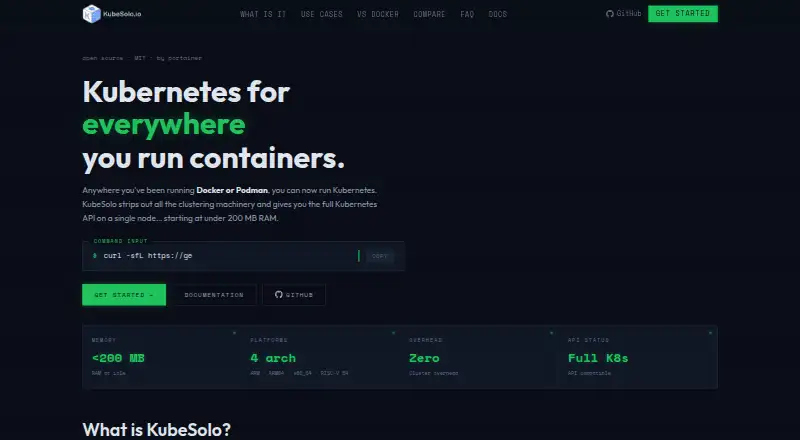
KubeSolo is an open-source Kubernetes distribution for a single node. It provides the full Kubernetes API without the machinery used to coordinate a cluster.
What it does
You can run standard Kubernetes manifests, Helm charts, custom resources, role-based access control, service accounts, health checks, restart rules, and resource limits on one machine.
KubeSolo includes networking through an integrated CNI and CoreDNS, with ClusterIP, NodePort, and LoadBalancer service types. It also includes local storage through Rancher's local-path-provisioner and supports CSI drivers.
The d2k component lets Docker command-line tools, scripts, and continuous-integration jobs connect to a KubeSolo node through a Docker-compatible API secured with mutual TLS. A Prometheus metrics endpoint and ready-made Grafana dashboards cover component health, certificate expiry, and database size.
How it connects
KubeSolo is MIT-licensed open-source software and exposes the Kubernetes API. It works with standard manifests, Helm, CRDs, RBAC, and namespace isolation.
Portainer Edge Agent can provide central fleet management, GitOps deployments, cross-node RBAC, and remote lifecycle management. Managing several KubeSolo instances centrally needs a multi-cluster management tool such as Portainer.
It can run fully offline without cloud connectivity or external registries. Linux installations support ARM, ARM64, x86_64, and RISC-V 64; kubesoloctl can run it in a Docker container on macOS and Windows WSL2.
Good fit
KubeSolo suits edge devices, factory and operational-technology systems, IoT hardware, developer workstations, remote sites, and kiosks.
The design targets resource-constrained devices, including systems with less than 1 GB of RAM. Its idle memory use is described as under 200 MB, and offline operation helps where cloud access or an external registry is unavailable.
Watch for
This is single-node software, not a multi-node cluster. Central control of multiple instances requires a separate multi-cluster management solution, and KubeSolo is not currently CNCF-certified.
Linux installation requires a modern distribution, sudo access, curl, iptables, and libsqlite3-dev. The target system should not have a container engine installed or active. Supported Linux distributions include Ubuntu, Debian, Alpine, CentOS, and Raspbian.
Some operators, add-ons, and CSI drivers that expect /var/lib/kubelet may need configuration for KubeSolo's custom kubelet directory. For machines with 1 GB of RAM or more, the documentation says standard lightweight distributions are generally a better fit.
Pricing
KubeSolo is free. It has a free plan and no free trial.
Verdict
Choose KubeSolo when one compact machine needs Kubernetes compatibility, including in offline or remote settings. It is also a reasonable option for teams that want open-source code, Docker-compatible commands, and familiar Kubernetes objects without running a cluster.
Look elsewhere if you need multi-node clustering, CNCF certification, or software that works without checking Linux installation requirements and kubelet-directory compatibility. For a broader set of local choices, see Local Kubernetes Tools.
Our take
KubeSolo makes sense for a single computer or constrained device that still needs Kubernetes objects and APIs. Its free MIT license, offline mode, broad CPU support, and low idle memory use keep the entry cost low. The trade-off is its strict one-node scope: it does not form a multi-node cluster, and several installation and compatibility checks may matter for add-ons or storage drivers. Consider it when simplicity and local operation matter more than cluster scale or CNCF certification.
- Free plan
- MIT-licensed open-source Kubernetes distribution
- Under 200 MB RAM at idle
- Runs offline without cloud or external registries
- Supports ARM, ARM64, x86_64, and RISC-V 64
- Single-node by design; no multi-node clusters
- Not currently CNCF-certified
- Some add-ons and CSI drivers may need kubelet-path configuration
- Linux setup requires several system packages and sudo access
- Pick it ifEdge, IoT, factory, kiosk, and remote-site deployments; Developer workstations needing one local Kubernetes node; Offline systems with limited memory
- Skip it ifYou need a built-in multi-node cluster; Your add-ons require the default /var/lib/kubelet path; You require current CNCF certification
Pricing
KubeSolo costs nothing: its listed plan is free, and there is no free trial.
Questions
Is KubeSolo free?
Yes. KubeSolo has a free plan and no free trial.
Does KubeSolo support multi-node clusters?
No. KubeSolo is single-node by design. Managing several instances centrally requires a multi-cluster management solution such as Portainer.
Which systems can run KubeSolo?
Linux distributions include Ubuntu, Debian, Alpine, CentOS, and Raspbian. macOS and Windows can use container mode with WSL2.
Can KubeSolo run without internet access?
Yes. It can operate fully offline without cloud connectivity or external registries.
How much memory does KubeSolo use?
The site describes idle memory use as under 200 MB. Its FAQ also describes it for resource-constrained devices, including systems with less than 1 GB of RAM.
Is KubeSolo CNCF-certified?
No. Its FAQ says KubeSolo is not currently CNCF-certified.