
Software-Defined Storage Software
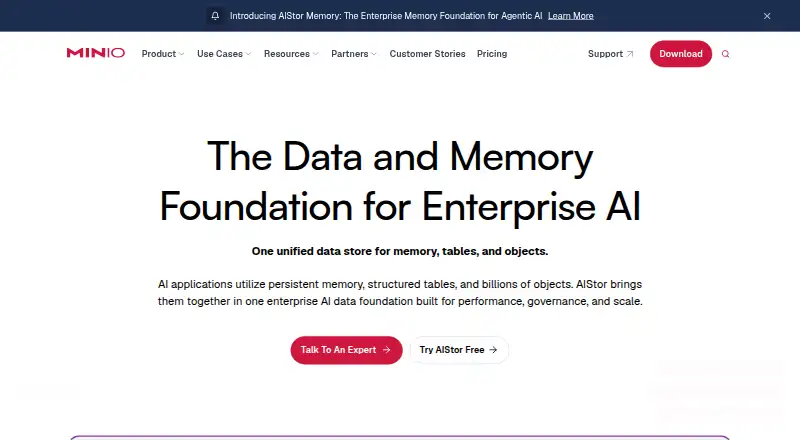
MinIO AIStor: AI Data Storage for Memory, Tables and Objects
min.io · checked 15 Oct 2026
Enterprise AI data storage for memory, tables, objects and files.
How it plugs in
Signal on Software-Defined Storage Software6.7#2 of 30
MinIO AIStor is a commercially licensed, self-hosted data store for AI workloads. It combines agent memory, Apache Iceberg tables, S3-compatible objects and files. It runs on major operating systems, Kubernetes and other deployment options, with a free single-node plan and paid multi-node subscriptions priced on request.
Review
In a line
MinIO AIStor is an enterprise data store that keeps AI-agent memory, tables, objects and files together. It is commercially licensed rather than open source.
What it does
AIStor Memory keeps agent context, workspaces, secrets, artifacts and telemetry after temporary runtimes end. AIStor Tables stores Apache Iceberg tables for analytics, feature stores, lakehouses and structured AI datasets.
Its S3-compatible object storage holds models, checkpoints, training data, embeddings, documents, media and logs. MinIO reports microsecond access latency and up to 23.5 TiB/s in WARP benchmarking, and describes scaling from edge deployments to exabyte-scale clusters.
How it connects
AIStor supports S3, S3 Express, SFTP, an Iceberg Catalog and Delta Sharing protocols. It offers S3 API compatibility plus SDKs for Go, Python, Java, .NET, JavaScript, Haskell, C++ and Rust.
It can send bucket events to systems including Kafka, MQTT, MySQL, PostgreSQL, Redis, Elasticsearch, NATS, AMQP and webhooks. Deployments include Linux, Windows, macOS, Kubernetes Helm, OpenShift and Podman. See Storage Management Software and Software-Defined Storage Software for related categories.
Good fit
AI teams and enterprises that need one store for agent state, Iceberg tables and S3 data may fit AIStor. It also suits organizations needing replication, audit trails, lifecycle rules, object versioning and cross-region copies.
Security and administration features include encryption, key management, a data firewall, immutability, quality-of-service controls and an administration console. Identity options include built-in users, OIDC, Active Directory/LDAP single sign-on, groups, policies and child access keys.
Watch for
The free edition is for single-node deployments that can be self-supported and do not need resilience beyond one node. Multi-node use requires a paid plan, and Enterprise Lite is limited to capacity below 400 TiB.
Recommended production sizing starts at eight dedicated hosts, eight drives per server, 100GbE networking, 16 CPU or vCPU per host and 128GB available memory per host. MinIO recommends directly attached NVMe or SSD drives with XFS; SAN, NAS, ext4, RAID and LVM can reduce performance or consistency.
AIStor is commercially licensed, and the former AGPLv3 community edition is frozen and no longer maintained.
Pricing
AIStor Free costs free of charge for a single-node deployment with the full feature set, community Slack and documentation support. Redistribution is prohibited.
AIStor Enterprise and Enterprise Lite are price on request. Enterprise supports multi-node, unlimited scale and premium support; Enterprise Lite supports multi-node deployments below 400 TiB, with optional direct-to-engineer support.
Both enterprise plans include a 60-day free trial. Enterprise support includes 24/7/365 direct-to-engineer help with a less-than-four-hour SLA; Lite's optional support has a less-than-five-day SLA.
Verdict
Choose AIStor when your organization wants a commercially supported, self-hosted foundation for AI-agent memory, Iceberg tables and S3-compatible data in one system. Its deployment choices, APIs, replication modes and security controls suit larger operational environments.
Look elsewhere if you need open-source licensing, a resilient multi-node setup at no cost, or a small deployment that cannot meet the recommended hardware baseline. Teams under 400 TiB can consider Enterprise Lite; larger deployments move to Enterprise.
Our take
AIStor makes sense for organizations standardizing AI data on self-hosted infrastructure and willing to manage dedicated hardware. The free plan is useful for single-node, self-supported work, but it does not provide protection beyond that node. Paid subscriptions add multi-node scaling, trials and support, with Enterprise Lite capped below 400 TiB. Buyers should verify storage design, networking and identity requirements before choosing a plan. Its commercial license also matters to teams that expected the older community edition model.
- Combines agent memory, Iceberg tables, objects and files
- S3-compatible access with multiple language SDKs
- Supports replication, immutability, encryption and audit trails
- Runs on Linux, Windows, macOS and Kubernetes
- Free single-node plan with full feature set
- Free plan has no resilience beyond one node
- Enterprise Lite is limited to capacity below 400 TiB
- Production sizing starts at eight dedicated hosts
- Commercial license; former AGPLv3 edition is not maintained
- Paid pricing is available only on request
- Pick it ifEnterprise AI data teams needing self-hosted storage; Organizations combining S3 data and Iceberg tables; Operations needing replication and compliance controls
- Skip it ifYou require open-source licensing; You need resilient multi-node storage at no cost; Your deployment cannot meet the recommended hardware baseline
Pricing
AIStor Free is free of charge for single-node use. Enterprise and Enterprise Lite are price on request; both offer a 60-day free trial, with Lite below 400 TiB.
- AIStor Freefree of charge · single-node deployment · full feature set · community Slack and documentation support · redistribution prohibitedFree
- AIStor EnterpriseRequest enterprise Pricing · multi-node deployment · unlimited scale · premium supportOn request
- AIStor Enterprise LiteRequest enterprise Lite Pricing · multi-node deployment · below 400 TiB · direct-to-engineer support optionalOn request
- Enterprisesubscription based on usable storage capacity · multi-node horizontal scaling · unlimited scale · premium SUBNET support · 24/7/365 direct-to-engineer support under 4-hour SLA · 60-day free trialOn request
- Enterprise Litesubscription based on usable storage capacity · multi-node horizontal scaling · below 400 TiB · Lite SUBNET diagnostics/security reporting · optional direct-to-engineer support under 5-day SLA · 60-day free trialOn request
As min.io lists them, checked 15 Oct 2026.
Questions
Is MinIO AIStor open source?
No. AIStor uses MinIO's commercial license. The former AGPLv3 community edition is frozen and no longer maintained.
Does AIStor have a free plan?
Yes. AIStor Free is free of charge for single-node deployments, with the full feature set plus community Slack and documentation support.
What does AIStor store?
It stores agent memory, Apache Iceberg tables, S3-compatible objects and files, including models, datasets, embeddings, documents, media and logs.
Which APIs and SDKs are available?
AIStor is S3 API compatible and lists SDKs for Go, Python, Java, .NET, JavaScript, Haskell, C++ and Rust.
What platforms can run AIStor?
Installation options include Linux, Windows, macOS, Kubernetes Helm, OpenShift and Podman. It also offers web and API access.
What is the Enterprise Lite capacity limit?
Enterprise Lite is for capacity below 400 TiB. Deployments exceeding 400 TiB are upgraded to Enterprise.
Does AIStor offer a trial?
Enterprise and Enterprise Lite each include a 60-day free trial.