NebulaGraph Graph Database Review
nebula-graph.io · checked 15 Oct 2026
Graph database with an open-source core, managed cloud service and self-hosted options.
How it plugs in
Signal on Graph Databases7.7#1 of 39
NebulaGraph provides a distributed database for connected data. It models entities and typed relationships, works with nGQL and openCypher-compatible syntax, adds native ISO-GQL in Enterprise v5.0, and offers built-in vector search. Teams can host it themselves or choose NebulaGraph Cloud on leading public-cloud platforms. A no-cost plan and 14-day cloud evaluation are available.
Review
In a line
NebulaGraph is a distributed graph database for storing and querying connected data. Its open-source core can run on your own machines, while NebulaGraph Cloud is a managed option.
What it does
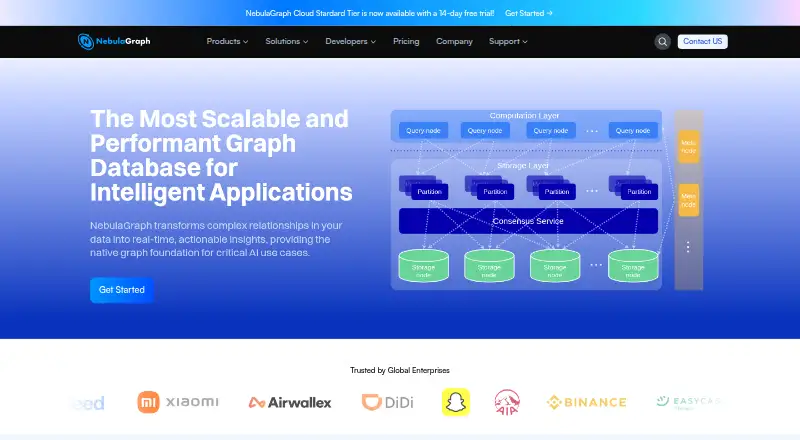
NebulaGraph represents entities with vertices and relationships with typed, property-bearing edges. Its Graph, Storage and Meta components operate independently, so compute and storage can be expanded separately.
The company says the system stores and processes graphs containing trillions of vertices and edges, with millisecond responses for complex queries. More than 50 graph algorithms, analytics capabilities and native vector search support work that combines graph and unstructured data.
NebulaGraph Studio is a web tool for making schemas, importing data, writing nGQL queries and exploring graphs. Listed uses include social networks, recommendations, fraud detection, cybersecurity, network analysis, knowledge graphs and supply chains.
How it connects
Its query options include nGQL and openCypher compatibility, while Enterprise v5.0 adds native ISO-GQL. Official clients cover Java, Python, C++ and Go, with a native console; Spark and Flink connectors support data workflows. PHP, Node.js, .NET, JDBC and several ORM clients are also available, but the documentation gives them no uptime guarantee.
You can import varied data formats and connect existing ingestion pipelines. The Apache 2.0 license permits modification, deployment and use in commercial software-as-a-service products.
Run it on Linux, macOS or Windows, through an API, or as a self-hosted deployment. NebulaGraph Cloud can create clusters on Microsoft Azure, AWS and Google Cloud, with on-premises, public-cloud and hybrid deployment choices.
Good fit
NebulaGraph suits teams that need a graph database for highly connected information, graph algorithms or vector-and-graph data together. Its listed applications cover recommendations, fraud, security, knowledge graphs and network analysis.
It also fits organizations choosing between self-hosting and a managed service. Cloud offers no-code setup, visual exploration, built-in demos and hourly pay-as-you-go billing.
Watch for
NebulaGraph does not support ACID transactions. Check whether that matches your data-workflow requirements before adopting it.
Building from source calls for x86_64 hardware, 4 GB of RAM and 10 GB of SSD space; Linux kernel 4.15 or newer is recommended. The manual favors local NVMe SSDs and advises against HDD, remote NAS and SAN storage.
The no-cost cloud evaluation lasts 14 days and permits one instance with 2 vCPUs, 4 GB of RAM and 10 GB of storage. Documentation does not provide an uptime guarantee for some additional clients.
Pricing
The free Open-source Edition provides a subset of core features with community collaboration and support. NebulaGraph Cloud also offers a 14-day evaluation without payment details, using one instance with 2 vCPUs, 4 GB of RAM and 10 GB of storage.
NebulaGraph Cloud Standard has request-based pricing. Usage is charged hourly for node, storage and data transfer; one node can reach 8 vCPUs, 64 GB of RAM and 320 GB of storage, without high availability.
Cloud Professional is likewise priced on request, with hourly charges for storage nodes, query nodes, disks and transfer. It allows up to 10 query nodes and 10 storage nodes, includes high availability and provides faster technical support. Enterprise Edition is quoted through sales and adds enhanced performance, enterprise-grade stability and security, plus premium support.
Verdict
Choose NebulaGraph if your application depends on relationships across large datasets and you want open-source code, several deployment models and graph-focused tooling. The free edition is a way to run the core system without a license charge, while Cloud handles setup and operations.
Look elsewhere if ACID transactions are essential, if your storage cannot meet the local-SSD guidance, or if you need a published price for a managed plan. Review client support and cloud limits before moving production data.
Our take
NebulaGraph is a reasonable choice for connected-data projects that need self-hosting or a managed cloud service. Its open-source license, graph algorithms, vector search and broad client list cover many technical setups. The main cautions are the lack of ACID transactions, hardware expectations for self-managed installations and request-based pricing for paid plans. The 14-day cloud trial lets a team check basic fit with a small fixed instance before discussing larger deployments.
- Apache-licensed open-source core
- Handles graphs containing trillions of vertices and edges
- Built-in vector search links graph structures with unstructured data
- Available for self-hosting and on Azure, AWS or Google Cloud
- Free edition plus a 14-day cloud evaluation
- No ACID transaction support
- Paid cloud and enterprise prices require a request
- Self-hosting guidance favors local NVMe SSDs
- Some additional clients have no uptime guarantee
- Pick it ifConnected-data applications and graph analytics; Teams choosing between self-hosting and managed cloud; Projects using graph and vector data together
- Skip it ifYou require ACID transactions; You need published prices for paid cloud plans; Your infrastructure cannot use the recommended local SSD setup
Pricing
The core Open-source Edition is free. Cloud has a 14-day trial, then hourly charges for infrastructure and data transfer; Standard, Professional and Enterprise prices are available on request.
- Open-source Editionsubset of core features · community collaboration and supportFree
- NebulaGraph Cloud Standardpay-as-you-go per hour; node, storage and transfer charges · single node up to 8 vCPUs, 64 GB RAM and 320 GB storage · no high availability$0.05
- NebulaGraph Cloud Professionalpay-as-you-go per hour; storage-node, query-node, disk and transfer charges · up to 10 query nodes and 10 storage nodes · high availability · faster technical support$0.49
- Enterprise Editioncontact sales · enhanced performance · enterprise-grade stability and security · premium supportOn request
As nebula-graph.io lists them, checked 15 Oct 2026.
Questions
Is NebulaGraph free?
Yes. The Open-source Edition is free. NebulaGraph Cloud has a free 14-day trial, while paid cloud and enterprise plans are price on request.
Where can NebulaGraph run?
It supports Linux, macOS and Windows, plus self-hosted, on-premises, public-cloud and hybrid deployments. Cloud clusters can run on Azure, AWS or Google Cloud.
Which query languages does it support?
NebulaGraph supports nGQL and openCypher compatibility. Enterprise v5.0 also advertises native ISO-GQL support.
Does NebulaGraph support vector search?
Yes. NebulaGraph Database includes native vector search for combining graph structures with unstructured data.
What is included in the cloud trial?
The 14-day trial includes one database instance with 2 vCPUs, 4 GB of RAM and 10 GB of storage. No payment information is required.
Are ACID transactions available?
No. ACID transactions are not supported.
Which programming clients are official?
Official clients are available for C++, Java, Python and Go, along with a native console. Java is the only client documented as thread-safe.