Zero Trust Architecture Software
NetFoundry: Identity-Based Zero-Trust Connectivity
netfoundry.io · checked 21 Oct 2026
Identity-led, zero-trust paths for workloads, APIs, devices, and sites.
How it plugs in
Signal on Zero Trust Architecture Software6.7#2 of 19
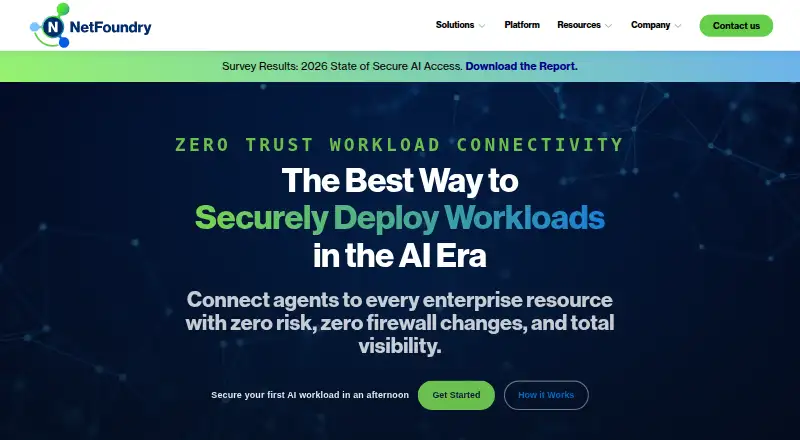
NetFoundry gives AI, API, application, and machine-to-machine workloads identity-based connectivity. Workloads dial out, avoiding open inbound or listening ports and public IP addresses. Deployment can be hosted or customer-operated, with a REST API, SDKs, identity-provider integrations, audit records, and a free self-managed OpenZiti option. Paid plans use pricing on request.
Review
In a line
NetFoundry provides zero-trust networking for workloads, APIs, applications, devices, and sites. Identity and least-privilege policy govern paths rather than VPNs or exposed inbound ports.
What it does
Users, devices, services, and workloads receive identities in NetFoundry; authorization is checked before a path is opened. Endpoints initiate the connection, allowing services to operate without inbound ports or public IP addresses.
OpenZiti forms an encrypted mesh of edge routers that supports smart routing and automatic failover. Device posture checks, TCP and UDP support, and tunnelers for applications without an embedded SDK are included.
How it connects
A REST API handles network creation, identity and service administration, policy configuration, and console automation. The documented interface uses JSON bodies and identity-provider-delegated authentication tokens.
Okta, Microsoft Entra ID, and Google Workspace are documented for SCIM provisioning. Group membership and lifecycle events can create, update, or deprovision network identities. SDKs are available for Go, C, .NET, Java, Node, and Swift.
NetFoundry Cloud describes dedicated controllers and routers on AWS, Azure, Google Cloud, and Oracle Cloud. Customer-owned and air-gapped infrastructure is supported for self-hosting. Downloads list endpoint clients or tunnelers for Windows, macOS, Linux, iOS, Android, and Docker. OpenZiti is open-source under Apache 2.0.
Good fit
NetFoundry targets access control among AI agents, models, tools, APIs, and machine-to-machine services. Its use cases also include workload microsegmentation and links across IT, OT, IoT, and sites.
Organizations comparing zero-trust network access software or business VPN software may consider it when outbound-only paths, identity controls, and customer-run infrastructure matter.
Watch for
The self-hosted quickstart specifies 4 CPUs, 16 GB of RAM, and 50 GB of storage. Offline installations currently run on single-node K3s; documentation describes full Kubernetes support as forthcoming.
Support-package availability varies by region, so confirm it with a representative. Hosted and commercial self-hosted offerings use a pricing discussion instead of a published amount.
Pricing
OpenZiti can be self-hosted and self-managed at no license cost under Apache 2.0, with community support. NetFoundry Cloud uses pricing on request and provides a dedicated network, managed infrastructure, an uptime SLA, and 24×7 support.
NetFoundry-Hosted is quoted on request for a dedicated OpenZiti fabric whose PKI, upgrades, backups, and monitoring NetFoundry manages, with an SLA up to 99.95%. NetFoundry Self-Hosted is also quoted on request for a licensed management suite on customer-owned infrastructure with 24×7 enterprise support.
Verdict
NetFoundry fits designs built around workload identity, outbound initiation, and policy-controlled paths spanning cloud, on-premises, or air-gapped environments. The no-license-cost OpenZiti edition supports technical teams that want to operate the software themselves, while managed offerings provide operations and support.
Consider another product if you need a published price, broad offline Kubernetes support now, or guaranteed support availability in every region.
Our take
NetFoundry suits organizations that check identity before linking AI, APIs, devices, and services, particularly when inbound exposure must remain closed. Hosted deployment shifts much of the infrastructure operation to NetFoundry, while OpenZiti permits free self-management under Apache 2.0. Main considerations are quote-based paid plans, stated self-hosting hardware, and currently limited air-gapped Kubernetes support. Confirm regional coverage and deployment requirements before selecting a plan.
- Outbound initiation avoids open inbound ports and public IP addresses.
- OpenZiti is available for self-hosting under Apache 2.0 at no license cost.
- SCIM supports Okta, Microsoft Entra ID, and Google Workspace.
- REST API and SDKs support automation and application integration.
- NetFoundry-Hosted includes managed PKI, upgrades, backups, and monitoring.
- Paid plans do not publish prices.
- Some support packages are unavailable in certain regions.
- Air-gapped installations currently support only single-node K3s.
- Self-hosting specifies 4 CPUs, 16 GB RAM, and 50 GB storage.
- Pick it ifTeams controlling AI, API, IoT, and machine-to-machine access; Organizations needing hosted or customer-owned deployment; Teams replacing inbound VPN-style access with identity policies
- Skip it ifYou need transparent published pricing before contacting a provider.; You require full Kubernetes support in an air-gapped deployment now.; Your region may not offer the support package you need.
Pricing
OpenZiti is free to self-host and self-manage with community support under Apache 2.0. NetFoundry Cloud, NetFoundry-Hosted, and NetFoundry Self-Hosted use pricing on request, with managed services or enterprise support depending on the plan.
- OpenZitiSelf-hosted and self-managed · Apache 2.0 · community supportFree
- NetFoundry CloudDedicated network · managed infrastructure · uptime SLA · 24×7 supportOn request
- NetFoundry-HostedDedicated OpenZiti fabric · managed PKI, upgrades, backups and monitoring · SLA up to 99.95%On request
- NetFoundry Self-HostedLicensed management suite · customer-owned infrastructure · 24×7 enterprise supportOn request
As netfoundry.io lists them, checked 21 Oct 2026.
Questions
Does NetFoundry require a VPN?
NetFoundry is built to provide zero-trust connectivity without VPNs or open inbound ports. Endpoints initiate connections, and identity plus policy authorize them.
Is there a free NetFoundry option?
Yes. OpenZiti may be self-hosted and self-managed under Apache 2.0 at no license cost, with community support.
Which identity providers integrate with NetFoundry?
SCIM provisioning is documented for Okta, Microsoft Entra ID, and Google Workspace. It can adjust network identities as groups and identity lifecycles change.
Where can NetFoundry run?
Dedicated hosted controllers and routers are described for AWS, Azure, Google Cloud, and Oracle Cloud. Self-Hosted can operate on customer-owned, on-premises, or air-gapped infrastructure.
What platforms have endpoint clients?
Downloads list clients or tunnelers for Windows, macOS, Linux, iOS, and Android, along with Docker-based tunneling.
What does NetFoundry cost?
OpenZiti is free. NetFoundry Cloud, NetFoundry-Hosted, and NetFoundry Self-Hosted are priced on request.
Near it
All alternatives →- TTwingate#1 on this board
- CG
 Cloudflare Gateway#3 on this board
- CPCloudbrink Personal SASE#4 on this board
- CO
 Cloudflare One#5 on this board
- MDMicrosoft Defender for Business#6 on this board
- PA
 Prisma Access#7 on this board
- SCSonicWall Cloud Secure Edge#8 on this board
- CSCato SASE Platform#9 on this board
- CP
 Check Point Harmony SASE#10 on this board
- IC
 iboss Cloud#11 on this board