NVIDIA Magpie TTS Multilingual Review
build.nvidia.com · checked 15 Oct 2026
NVIDIA’s multilingual neural text-to-speech model with API access, voice cloning and self-hosting options.
How it plugs in
Signal on Text-to-Speech Software7.6#37 of 223
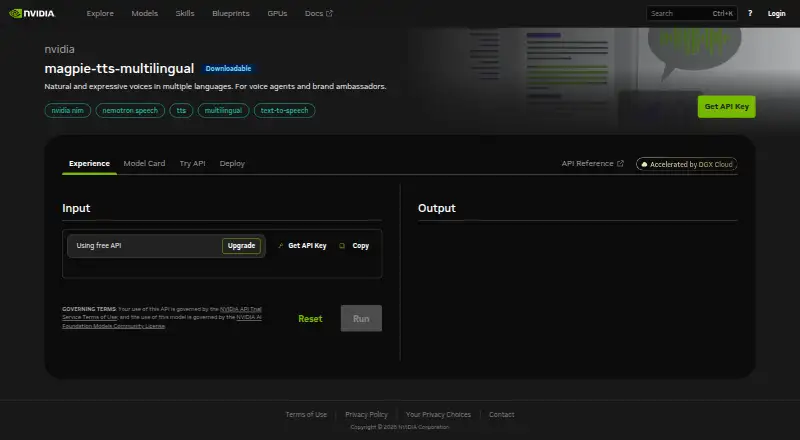
NVIDIA Magpie TTS Multilingual turns text into speech in 12 languages. It offers male and female speakers, optional zero-shot voice cloning, batch and long-form generation, and WAV output. You can use hosted HTTP endpoints or deploy NIM containers on NVIDIA hardware. A free plan and 90-day trial are available, with production licensing from $4,500/yr.
Review
In a line
NVIDIA Magpie TTS Multilingual is a neural text-to-speech model that generates spoken audio in 12 languages. It is available through hosted endpoints or self-hosted NVIDIA containers. Text-to-speech software
What it does
The model converts written text into mono 16-bit PCM WAV audio sampled at 22.05 kHz. Each supported language has at least one male and one female speaker.
Optional zero-shot voice cloning accepts a mono 16-bit PCM WAV reference. NVIDIA recommends a clip lasting 3 to 10 seconds. A voice from one locale can also be paired with text in another language to create accented speech.
Batch and long-form modes use sliding windows for very long text. The model has about 364 million parameters.
How it connects
Magpie provides HTTP endpoints for listing voices and synthesizing speech, protected by an NVIDIA API key. NVIDIA also states that Nemotron Speech supports gRPC and HTTP APIs.
You can download NIM as NGC or Docker containers and run it in the cloud, a data center or a workstation. NVIDIA documents Azure, AWS, GCP, OCI and other cloud partners.
The listed runtime integration is Riva 2.15.0. Supported systems are Linux and Linux for Tegra, with listed compatibility for NVIDIA A100, A30, A10, H100, L4 and L40 GPUs. It is not open source.
Good fit
Magpie suits teams building multilingual voice features, including applications that need voice cloning or control over where audio is processed. Commercial use is allowed.
It fits deployments that can use NVIDIA GPUs and that need a hosted API or self-managed NIM installation. Self-hosting can keep audio data under the developer’s deployment control.
Watch for
Offline output is limited to 20 seconds per request; NVIDIA recommends streaming for longer text. The streaming HTTP response is raw LPCM without a WAV header, so playback clients must convert it.
Voice identifiers are model-specific. Invalid or misspelled names cause synthesis errors. An independent review also reports that the high-performance path depends on NVIDIA TensorRT, which limits AMD, Intel and Apple Silicon choices.
Reported issues include occasional duplicated audio at the end of generations and intermittent popping or crackling on Jetson AGX Thor; NVIDIA said newer Riva releases fixed the reproduced crackling case. API trial terms prohibit production use without a subscription and restrict sensitive data unless expressly allowed.
Pricing
Magpie uses a freemium model. The free NVIDIA Developer Program includes NIM API endpoints, downloadable NIM for research, development and testing, and use of up to 16 GPUs. Access is billed free while membership is active.
NVIDIA AI Enterprise costs $4,500 a year, billed per GPU per year, for production NIM licensing. The pricing note also lists a 90-day trial and paid access from $4,500/yr.
Verdict
Choose Magpie if you need speech in many languages, optional reference-voice cloning and the choice between an API and self-hosting. It is a practical match for organizations already operating NVIDIA GPUs or willing to use NVIDIA’s runtime and licensing terms.
Look elsewhere if you need open-source code, broad non-NVIDIA hardware support, unrestricted production use during a trial, or longer offline requests without streaming work. Check voice names, data rules and the required audio conversion before committing.
Our take
Magpie TTS is a reasonable choice for multilingual products that can run on NVIDIA infrastructure and need either a managed endpoint or a self-hosted deployment. Voice cloning, accented speech and long-form modes add useful flexibility. The trade-offs are specific: it is not open source, the strongest performance path depends on NVIDIA TensorRT, and offline requests stop at 20 seconds. Teams must also follow trial data restrictions and plan for raw LPCM conversion when streaming. The free developer plan provides API access and research, development and testing use, while production NIM licensing is listed through NVIDIA AI Enterprise.
- Speech generation in 12 languages
- Optional zero-shot voice cloning
- Hosted API and self-hosted NIM containers
- Batch and long-form inference support
- Commercial use is allowed
- Not open source
- High-performance path depends on NVIDIA TensorRT
- Offline requests are capped at 20 seconds
- Streaming output lacks a WAV header
- Reported duplicate and crackling audio issues
- Pick it ifMultilingual voice applications using NVIDIA GPUs; Teams needing API access or self-hosting; Projects requiring optional voice cloning
- Skip it ifYou need open-source code or broad AMD, Intel and Apple Silicon support; You require unrestricted production use during a trial; You cannot handle streaming audio conversion
Pricing
A free NVIDIA Developer Program plan covers API access and research, development and testing. Production NIM licensing costs $4,500 a year per GPU through NVIDIA AI Enterprise, with a 90-day trial listed.
- NVIDIA Developer Programfree access during membership · NIM API endpoints · downloadable NIM for research, development and testing · up to 16 GPUsFree
- NVIDIA AI Enterpriseper GPU per year · Production NIM licensing$4,500/yr
As docs.api.nvidia.com lists them, checked 15 Oct 2026.
Questions
How many languages does Magpie TTS support?
It generates speech in 12 languages, with at least one male and one female speaker for each language.
Can Magpie clone a voice?
Yes. Zero-shot cloning accepts mono 16-bit PCM WAV audio at 22.05 kHz. A 3-to-10-second reference clip is recommended.
What audio format does it produce?
Generated audio is mono 16-bit PCM WAV at 22.05 kHz. Streaming HTTP responses are raw LPCM without a WAV header.
Can I run Magpie TTS myself?
Yes. NIM can be downloaded as NGC or Docker containers for cloud, data-center or workstation deployment.
What hardware and systems are supported?
The model lists Linux and Linux for Tegra, plus NVIDIA A100, A30, A10, H100, L4 and L40 GPUs.
Is there a free plan?
Yes. The NVIDIA Developer Program provides free access while membership is active, including API endpoints and downloadable NIM for research, development and testing.
How much does production licensing cost?
NVIDIA AI Enterprise costs $4,500 a year, billed per GPU per year. A 90-day trial is also listed.
Are there data-use restrictions?
Trial terms prohibit production use without a subscription and restrict confidential, health, payment-card and other sensitive data unless expressly allowed.