Qwen3-TTS: Speech Generation, Voice Design, and Pricing
github.com · checked 7 Oct 2026
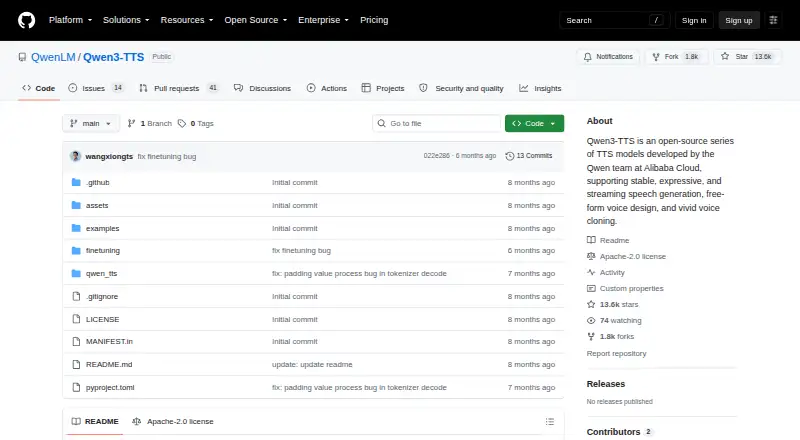
Qwen3-TTS is an open-source speech-generation model series that can design and clone voices.
How it plugs in
Signal on Text-to-Speech Software7.6#42 of 223
Qwen3-TTS turns text into speech and can create a voice from a written description or reference audio. Generation is available in streaming and non-streaming modes; the lineup includes 0.6B and 1.7B variants and covers 10 languages. You can run it locally or use Alibaba Cloud’s paid API. The models are released under Apache-2.0 at no charge, though local installation calls for compatible computing hardware.
Review
In a line
Alibaba Cloud’s Qwen team developed Qwen3-TTS as a collection of text-to-speech models. It generates speech, designs voices, and clones voices from reference audio.
What it does
Speech can be generated in either streaming or non-streaming mode. The models support 10 languages and can use custom voices, voice descriptions written in natural language, or reference audio to clone a voice.
For cloning, provide a reference recording along with its transcript; the project cautions that relying on the speaker embedding alone can lower quality. Generated audio can be exported as WAV.
How it connects
The repository carries an Apache-2.0 license. Its Python package and model weights are available for local use, with downloads linked through Hugging Face and ModelScope. A local web demo runs with the qwen-tts-demo command.
DashScope APIs from Alibaba Cloud provide hosted options for voice design, cloning, and custom voices. To use the API, configure an API key; if using the DashScope SDK, install its latest version. vLLM-Omni handles offline inference, and online serving is slated for a later release.
Good fit
Qwen3-TTS may suit people who want to generate speech or experiment with voice design and cloning using open-source models. The local web demo offers a way to use the project through a browser interface.
It also offers a hosted API option for teams that would rather not load the models locally.
Watch for
Local setup involves installing a Python package and loading model weights. The project advises starting with a clean Python 3.12 environment and shows model loading on CUDA; FlashAttention 2 can lower GPU memory requirements when hardware is compatible.
The reported 97 ms latency is described as a low end-to-end synthesis figure, not a guarantee for every setup. Local offline inference is supported through vLLM-Omni, but online serving with it is still planned.
Pricing
There is no charge for the open-source models, which use the Apache-2.0 license and allow commercial use. Separately, Alibaba Cloud’s international API pricing is $0.115 per 10,000 input characters for voice design and voice cloning; output is free. Each API option lists a free quota of 110,000 characters.
Verdict
Qwen3-TTS is a fit for those seeking open-source speech generation and voice design or cloning, provided they can manage local setup or use Alibaba Cloud’s API. Check hardware compatibility before planning a local installation, and note that cloning works from audio plus a transcript. If your plan depends on vLLM-Omni for online serving, wait until that support is available.
Our take
Consider Qwen3-TTS for speech generation, voice design, or cloning when you want locally runnable open-source models. Its license permits commercial use, while Alibaba Cloud’s paid API provides a hosted option and a stated free character quota. Local setup requires care with Python and compatible hardware, and voice cloning needs reference audio plus its transcript for the intended input. Look elsewhere if your workflow depends on online serving through vLLM-Omni today.
- Apache-2.0 licensing permits commercial use.
- Supports voice design, voice cloning, and speech generation.
- Streaming and non-streaming modes are available.
- Includes a local web demo and downloadable models.
- Supports 10 languages and WAV export.
- Local setup advises Python 3.12 and compatible CUDA hardware.
- Voice cloning requires reference audio and a transcript.
- vLLM-Omni does not yet support online serving.
- Hosted API voice design and cloning are priced by input characters.
- Pick it ifPeople looking for open-source speech tools with voice design; Teams that can run models locally or use DashScope APIs
- Skip it ifYou need vLLM-Omni online serving now; You cannot accommodate local setup or compatible hardware and do not want a hosted API
Pricing
The open-source models cost nothing and permit commercial use. Alibaba Cloud API use is separate: voice design and cloning cost $0.115 per 10,000 input characters, with output free and a listed 110,000-character free quota for each.
- Qwen3-TTS open-source modelsThe project is released under the Apache-2.0 license; no price is stated. · 0.6B and 1.7B models · 10 languagesFree
As github.com lists them, checked 7 Oct 2026.
Questions
Is Qwen3-TTS free?
The open-source models are available at no charge under Apache-2.0. Alibaba Cloud API use has separate per-character rates and listed free quotas.
Can I use Qwen3-TTS commercially?
Yes. The project lists the Apache-2.0 license, and commercial use is allowed.
Can Qwen3-TTS clone a voice?
Yes. Cloning takes reference audio and its transcript; the project warns that omitting the transcript may reduce quality.
Can I run it on my own computer?
The project offers a Python package and downloadable models for local loading. It recommends a fresh Python 3.12 environment and demonstrates CUDA use.
What does the API cost?
Alibaba Cloud lists $0.115 per 10,000 input characters for voice design and voice cloning. Output is free, and each lists a 110,000-character free quota.
What audio format can it export?
WAV.
Does it support online serving through vLLM-Omni?
Not currently. vLLM-Omni supports offline inference, with online serving planned for a later release.
Near it
All alternatives →- S3Supertonic 3#41 on this board
- M
 MeloTTS#43 on this board
- NNeuphonic#40 on this board
- OCOracle Cloud Infrastructure Speech#44 on this board
- GSGPT-SoVITS#39 on this board
- FSFestival Speech Synthesis System#45 on this board
- W
 Whisper#38 on this board
- SASmallest AI Lightning TTS#46 on this board
- NMNVIDIA Magpie TTS#37 on this board
- TCTencent Cloud Text to Speech#47 on this board