OP3 Podcast Analytics: Features, Limits, and Pricing
op3.dev · checked 15 Oct 2026
Free, open-source podcast download analytics with public stats, exports, and an API.
How it plugs in
Signal on Podcast Analytics Software7.3#1 of 26
OP3 tracks podcast download requests through a feed URL prefix. It gives each measured show a public stats page, historical spreadsheet exports, and API access. The service is free, open source, and privacy-focused, with optional listening-time data from supported apps. It runs on the web and through an API, and supports custom-prefix hosting setups.
Review
In a line
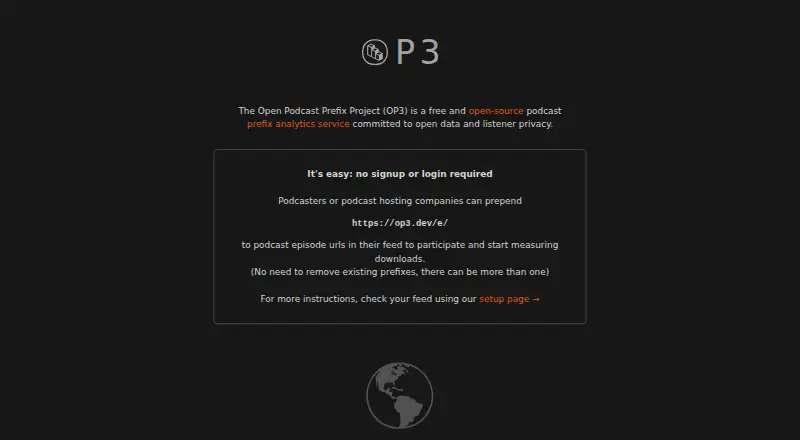
OP3 is a free, open-source service for measuring podcast downloads. Podcasters and hosting companies add its redirect prefix to episode links in a feed.
What it does
OP3 counts qualifying requests for episode files and builds a public statistics page for each measured show. Pages include download totals, detailed breakdowns, and spreadsheet exports covering the full history.
Its counting rules exclude non-GET requests, tiny range requests, repeat requests within 24 hours, and identified bots or preloaders. A download is a server-request estimate, not proof that someone listened.
Optional listen-time statistics use anonymized, aggregate streaming-payment data from supported podcast apps, including Fountain, Podverse, Castamatic, PodcastGuru, CurioCaster, TrueFans, Podfriend, and Breez.
How it connects
Add OP3's prefix before episode URLs without removing another prefix. A setup checker helps verify the feed. The setup guide names Megaphone, Transistor, and Castopod as hosts that allow a custom prefix.
The public API provides show details, raw hits, episode counts, transcript queries, top-app queries, and weekly or monthly download queries. It accepts TSV and three JSON output styles. API calls need a bearer token tied to an API key, and the API specification and project code use the MIT license.
OP3 runs on the web and through its API. Its repository includes deployment scripts for Cloudflare, and the service says listener IP addresses are hashed and encrypted, kept out of the API, and not matched with outside data. It uses no cookies.
Good fit
OP3 suits podcasters and podcast hosting companies that want no-cost download measurement, a public data page, and spreadsheet history. Its open code and published API can also suit teams that want to inspect or reuse the collected data.
The redirect service uses a global content-delivery network with edge locations in more than 335 cities across over 125 countries.
Watch for
OP3 measures server requests, so its download figure can be higher than the number of actual listens. Listen-time reporting is optional and limited to the named supported apps.
API hit-query results can be filtered by URL or hashed IP address only for the most recent 90 days. Check that your host supports a custom prefix before changing a feed.
Pricing
The Free plan is free and needs no signup or login. It includes a public stats page, download metrics, spreadsheet exports, and API access. There is no separate free trial.
Verdict
Choose OP3 if you need a free way to measure podcast downloads and value public data, open-source code, and privacy controls. It is a practical second measurement source alongside hosting analytics; see podcast analytics software for other categories.
Avoid relying on OP3 alone for exact listener or listening-time totals. Teams needing older hit-query filtering, or hosts without custom-prefix support, should check those constraints first.
Our take
OP3 is a strong fit for podcasters and hosting companies that want download analytics without a subscription. Public pages, exports, an API, and MIT-licensed code make the data easy to access and inspect. Privacy protections and global delivery add useful safeguards. The main caution is measurement scope: OP3 reports filtered server requests, not guaranteed listens, and detailed hit filtering stops at 90 days. Confirm that your host accepts a custom prefix and that its supported apps cover any listen-time reporting you need.
- Free plan includes public stats, exports, and API access
- Open-source project and API use the MIT license
- Hashes and encrypts listener IP addresses
- No cookies and no third-party IP matching
- Global CDN spans more than 335 cities
- Downloads are server-request estimates, not confirmed listens
- Hit-query filtering covers only the last 90 days
- Listen-time data depends on supported podcast apps
- Requires a host that supports a custom prefix
- Pick it ifPodcasters wanting free, public download analytics; Hosting companies adding prefix-based measurement; Teams that want open code and API access
- Skip it ifYou need download numbers to equal verified listens; Your hosting service cannot add a custom feed prefix; You require hit filtering older than 90 days
Pricing
The core product is free with no login required.
- FreeNo signup or login required · public stats page · download metrics · spreadsheet exports · API accessFree
- OP3 Sponsorship$100/mo · Sponsorship to help fund development$100/mo
As op3.dev lists them, checked 15 Oct 2026.
Questions
Does OP3 require a subscription?
No. Its Free plan is free, requires no signup or login, and includes stats, exports, and API access.
How does OP3 measure downloads?
You place OP3's redirect prefix before episode URLs in your podcast feed. It counts qualifying requests for those files.
Are OP3 downloads the same as listens?
No. OP3 describes a download as an upper-bound server-request measure, so it may not represent an actual listen.
Can I access OP3 data by API?
Yes. The API offers show, hit, episode, transcript, top-app, and weekly or monthly query resources. A bearer token linked to an API key is required.
What hosting services are named as compatible?
OP3's setup guide names Megaphone, Transistor, and Castopod as services that support a custom prefix.
Does OP3 protect listener IP addresses?
OP3 says it hashes and encrypts IP addresses before storage, keeps them out of the API, and does not combine them with third-party data. It uses no cookies.