OpenCouch review: free self-hosted AI companion
github.com · checked 8 Oct 2026
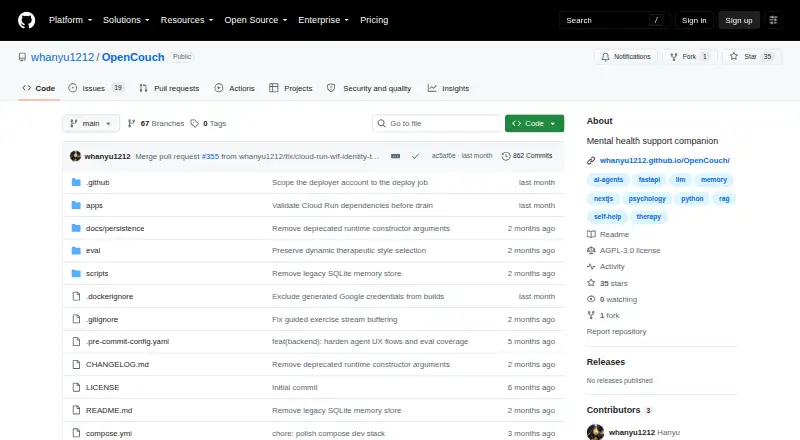
A self-hosted companion for reflection, emotional support, and practical coping.
How it plugs in
Signal on AI Mental Health Chatbots6.1#9 of 21
OpenCouch is a pre-beta chat companion that runs under your control for everyday emotional support and self-reflection. Memory carries across sessions, 13 guided exercises track progress, and each turn passes through safety checks before a reply is generated. Web, terminal, and API access are available; live model calls need an OpenAI API key, while durable storage uses Postgres.
Review
In a line
OpenCouch is an open-source AI companion for day-to-day support, reflection, and coping. It targets self-hosted use and remains in pre-beta.
What it does
Three memory layers retain semantic facts, episodic arcs, and procedural rules between sessions. Guest and incognito conversations disappear after use.
Thirteen state-tracked exercises guide users through multiple turns, preserving consent and progress as they continue.
Before generating a response, the system classifies each turn for safety. A specialist crisis agent may receive the conversation, and the system keeps a durable audit record with crisis resources.
How it connects
A Next.js web client and text terminal sit alongside a FastAPI service that exposes REST and WebSocket endpoints. The text runtime is built on the OpenAI Agents SDK; actual model calls need an OpenAI API key.
Postgres alone is supported for durable thread state, long-term memory, active sessions, crisis records, and feedback. Local deployment is documented through Docker Compose, with Postgres and FastAPI plus an optional web container.
Observability covers structured logs, state diagnostics, and OpenTelemetry/OTLP export. The repository uses the GNU Affero General Public License v3.0.
Good fit
OpenCouch is for people who want an emotional-support companion on their own web or Linux environment, or who prefer an API connection. Its stated focus is reflection and guided wellness exercises, not clinical treatment.
Persistent context, tracked exercises, safety routing, and crisis records suit projects that need continuity and explicit handling of safety events.
Watch for
The maintainers describe the project as pre-beta and still stabilizing, with a closed beta planned. Voice is likewise pre-beta and being dogfooded while that experience is refined.
Durable data requires Postgres; no other backend is supported. Guest and incognito sessions remain temporary, and live model responses require an OpenAI API key.
OpenCouch states that it is not a therapist, diagnostic instrument, emergency service, or substitute for professional mental-health care or medical advice.
Pricing
OpenCouch is available at no software charge as open-source code, with a free plan and no trial.
Separate costs still apply: model execution needs an OpenAI API key, and persistent operation needs a Postgres database.
Verdict
Consider OpenCouch if you want to host and inspect an open-source companion with retained context, structured exercises, and a route for safety escalation. Web, terminal, and API options provide multiple connection methods.
Treat it as an early-stage project rather than a finished care service. Expect to configure Postgres, an OpenAI key, and your own deployment; diagnosis, emergencies, and professional treatment belong with qualified services.
Our take
OpenCouch fits technically capable users seeking a free, self-controlled companion for emotional support and reflection. Layered memory and tracked exercises provide continuity, while per-turn safety classification and crisis records add explicit safeguards. Maturity is the main compromise: the project is pre-beta, voice remains under stabilization, and deployment calls for Docker Compose, Postgres, and an OpenAI API key. It is for reflection and coping, not clinical or emergency replacement.
- Free software under the GNU Affero General Public License v3.0
- Three memory layers retain context between sessions
- 13 consent-aware exercises track progress across turns
- Safety classification precedes each generated response
- Web, terminal, REST, and WebSocket access
- Pre-beta project undergoing active stabilization
- Only Postgres supports durable storage
- Live model calls need an OpenAI API key
- Voice remains in pre-beta development
- Not a therapist, diagnostic service, or emergency resource
- Pick it ifSelf-hosted projects for emotional support and reflection; Teams needing memory, exercises, and safety escalation; Users comfortable operating Postgres and Docker Compose
- Skip it ifYou require clinical, diagnostic, or emergency care; You want a completed voice product; You cannot run Postgres or supply an OpenAI API key
Pricing
The open-source software and free plan have no trial. Account separately for the OpenAI API key and Postgres needed for live models and durable use.
Questions
Is OpenCouch free?
Yes. It is free open-source software with a free plan; no separate trial is offered.
Where can OpenCouch run?
Access includes web, API, Linux, and self-hosted deployments. The local instructions use Docker Compose with Postgres and FastAPI.
Does OpenCouch remember conversations?
Yes. Semantic facts, episodic arcs, and procedural rules form its three-layer memory across sessions. Guest and incognito sessions are temporary.
What does OpenCouch need for real model responses?
An OpenAI API key is required for live model calls. Postgres is required for durable persistence and is the sole supported backend.
Is OpenCouch a therapist or emergency service?
No. The project disclaims being a therapist, diagnostic tool, emergency service, or replacement for professional care or medical advice.
How does OpenCouch handle safety?
Each turn is safety-classified before generation. A specialist crisis agent can receive the case, with a durable audit log and crisis resources.
Is voice available?
Voice is described as pre-beta and intended for dogfooding while the product experience is stabilized.