
Opik: AI Tracing, Testing, and Monitoring
comet.com · checked 21 Oct 2026
Opik traces, tests, and monitors AI agents and applications that use language models.
How it plugs in
Signal on MLOps Platforms7.7#1 of 29
Opik helps teams follow the steps an AI agent takes, test prompts and agent behavior, and monitor results in production. It connects with AI frameworks and model providers, and offers a public API and Python and TypeScript SDKs. Teams can use its free cloud plan or run the open-source platform themselves; paid cloud plans start at $19 a month.
Review
In a line
Opik is an open-source platform for tracing, evaluating, and monitoring AI applications and agents that use language models.
What it does
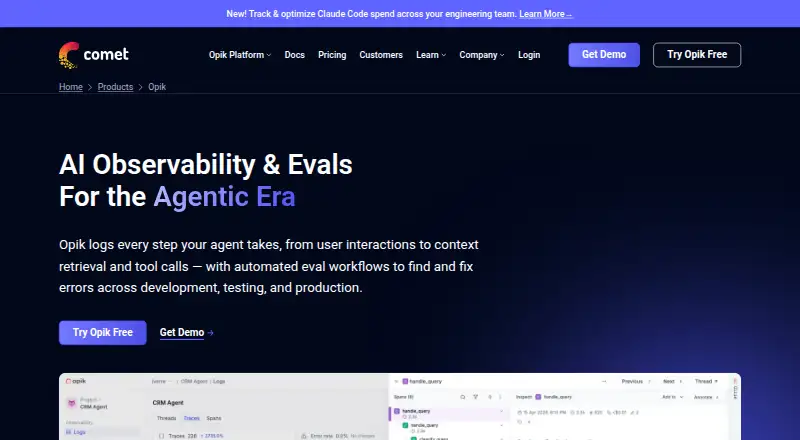
Opik records model responses, tool calls, retrieval steps, and other agent actions. Teams can inspect these steps, add feedback to traces or conversations, and use audit logs to review activity.
For testing, it offers prompt versioning, dataset comparisons, test suites with pass-or-fail checks, and an agent playground. Its evaluation tools cover outcomes such as relevance, task completion, and hallucinations. In production, it can evaluate traces as they arrive, alert when criteria fail, and track token use and model costs.
How it connects
Opik lists integrations with more than 40 AI frameworks, model providers, and gateways. Named examples include LangChain, LangGraph, LlamaIndex, OpenAI, Anthropic, Gemini, and Amazon Bedrock.
A REST API and Python client are available, and the pricing page lists Python and TypeScript SDKs. Its code is released under the Apache-2.0 license. Teams can use the cloud service or self-host it on Linux, macOS, or Windows; local setup assumes Git and Docker, while Kubernetes is the production deployment option.
The MCP server lets Claude Code, Cursor, VS Code Copilot, Codex, and opencode query traces, score outputs, and run evaluations from chat. Self-hosted deployments include guardrails for detecting or blocking personal information, topics, and custom unsafe content.
Good fit
Opik is aimed at teams building applications or agents that make calls to a language model. It suits teams that need to inspect multi-step behavior, compare prompts, test agent tasks, or watch model quality and costs in production.
The free cloud plan is positioned for development and testing. Teams wanting the full feature set under their own hosting can choose the open-source version, though it does not include user-management features.
Watch for
Self-hosting requires setup and operations work: local installation uses Git and Docker, and Kubernetes is the documented production option. Self-hosted deployments also omit user-management features.
A Gartner Peer Insights reviewer said it took time to fully understand the product. Check whether the plan's team, trace-volume, retention, and support limits fit your needs before choosing.
Pricing
Free Cloud costs free and includes up to 10 team members, 25,000 spans a month, and 60-day data retention. The self-hosted Open Source plan is also free.
Pro Cloud costs $19 a month. It includes up to 50 team members and 100,000 spans a month, with customizable span limits and retention periods. Enterprise pricing is available on request and includes custom usage plans, flexible deployment, SSO, dedicated support, and listed compliance options.
Verdict
Opik is a practical option for teams that need to see how language-model agents behave, check their outputs, and monitor usage after launch. Its cloud and self-hosted choices, integrations, and free entry points offer room to evaluate it before committing to a paid plan.
Before adopting it, weigh the self-hosting requirements and missing user-management features against the control it provides. Smaller teams can start with Free Cloud, while teams that need higher limits or enterprise support should compare the paid plan terms with their usage needs.
Our take
Choose Opik if your team builds language-model apps or agents and needs to follow their steps, test outcomes, or track usage and costs in production. Its free cloud and open-source plans make it possible to start without a subscription, and its integrations cover many common frameworks and providers. It is less suited to teams that do not need this kind of AI monitoring or cannot take on the setup work of self-hosting. Check span limits, retention, and user-management needs before settling on a plan.
- Traces model calls, tools, and retrieval steps across agent runs
- Evaluates results and can alert on failed production criteria
- Tracks token use and model costs
- Integrates with more than 40 frameworks, providers, and gateways
- Free cloud and self-hosted open-source options are available
- Self-hosted use does not include user-management features
- Production self-hosting uses Kubernetes
- A reviewer said it took time to fully understand the product
- Free and Pro Cloud plans have span and retention limits
- Pick it ifTeams building apps or agents that call language models; Teams needing agent traces, testing, evaluations, or cost monitoring; Teams comparing cloud and self-hosted AI observability
- Skip it ifYou do not need to inspect or evaluate language-model app behavior; You need self-hosted user management included; You need more usage or retention than the cloud plan limits allow
Pricing
Free Cloud and self-hosted Open Source plans are free. Pro Cloud is $19 a month, with usage and retention limits; Enterprise pricing is on request. Compare span volume, retention, and support needs before choosing.
- Free CloudFree plan · Up to 10 team members · 25k spans/month · 60-day retentionFree
- Open SourceFree · Full AI observability and agent testing · self-hostedFree
- Pro CloudPer month · Up to 50 team members · 100k spans/month · 60-day retention · customizable span limits and retention$19/mo
- EnterpriseCustom · Unlimited team members · custom usage plans · flexible deployments · SSO · dedicated support and SLAs · SOC 2, ISO 27001, ISO 9001, HIPAA and GDPROn request
As comet.com lists them, checked 21 Oct 2026.
Questions
Is Opik free?
Yes. Free Cloud supports up to 10 team members, 25,000 spans a month, and 60-day retention. The self-hosted Open Source plan is also free.
How much does Opik Pro cost?
Pro Cloud costs $19 a month. It includes up to 50 team members and 100,000 spans a month, with customizable span limits and data retention.
Can I host Opik myself?
Yes. The Open Source plan is self-hosted and free. Local setup assumes Git and Docker; Kubernetes is the production deployment option. Self-hosting omits user-management features.
What does Opik integrate with?
It lists more than 40 AI framework, model-provider, and gateway integrations, including LangChain, LangGraph, OpenAI, Anthropic, Gemini, and Amazon Bedrock.
Can Opik track model costs?
Yes. It tracks token usage and model costs, including for production traces.
Does Opik have a public API?
Yes. It includes a REST API and Python client, and lists Python and TypeScript SDKs.