ML Experiment Tracking Software
Metaflow: Open-Source Workflows for Data and AI
metaflow.org · checked 15 Oct 2026
Python workflows, open source, for operating data science, machine learning, and AI work at scale.
How it plugs in
Signal on ML Experiment Tracking Software7.6#1 of 39
Teams can use Metaflow’s free Python library to create data science, machine learning, and AI workflows. It records flows, experiments, versions, and artifacts while supporting local development and execution through customer cloud accounts or Kubernetes. Official support covers macOS and Linux, with a browser Sandbox and integrations for workflow and cloud services.
Review
In a line
Metaflow gives data scientists and engineers a free, open-source Python library for data-intensive applications across development, deployment, and operation.
It provides one interface for modeling, deployment, versioning, workflow scheduling, compute, and data handling.
What it does
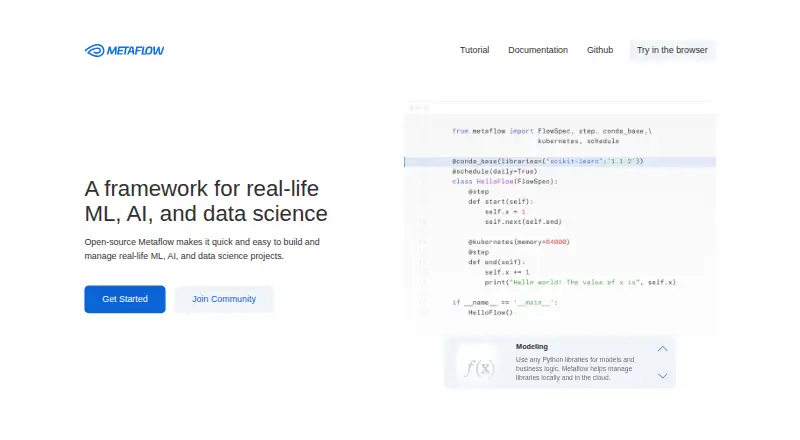
You write workflows as regular Python, build and debug them locally, then deploy them to production with one command. Metaflow records flows, experiments, variables, and artifacts automatically for reproducibility and debugging.
Cloud execution can draw on CPUs, GPUs, large-memory machines, and thousands of parallel tasks. Branches and foreach steps can run in parallel locally or in separate remote containers. The library also includes patterns for moving data through workflows and reaching warehouses or data lakes.
How it connects
The Apache License 2.0 project is distributed as a Python package for macOS and Linux; pip and conda-forge installation paths are documented. Windows users are directed to WSL rather than native support.
Documented workflow connections include AWS Batch, AWS Step Functions, Kubernetes, Argo Workflows, and Apache Airflow. Infrastructure guides cover AWS, Azure, Google Cloud, on-premises Kubernetes, and artifact storage in S3, Azure Blob Storage, or Google Cloud Storage.
A public API documents clients, runners, deployers, storage, cards, event tools, and flow or step decorators. Secrets can connect to AWS Secrets Manager, Azure Key Vault, and Google Cloud Secret Manager.
Good fit
Data scientists and ML or AI engineers can use Metaflow to take Python projects from a laptop into scheduled, scalable production jobs. Its automatic metadata and version tracking support experiment tracking, reproducibility, and debugging.
With an AWS, Azure, Google Cloud, or Kubernetes environment, teams can run in their own account or cluster while retaining existing infrastructure and security policies. ML experiment tracking software is another useful comparison point.
Watch for
A local-only setup cannot scale compute outside the machine or provide production-grade deployments. Production scaling therefore requires infrastructure templates deployed in your cloud account or Kubernetes cluster.
Metaflow targets work with scaling, criticality, or complexity needs. Its documentation says small notebook experiments without those requirements may gain little from it. Official package support covers macOS and Linux; Windows requires WSL.
Pricing
Metaflow costs nothing: the Apache-2.0 Python library is open source and can be self-hosted with cloud or Kubernetes infrastructure.
The Metaflow Sandbox also lets you explore AWS, Azure, Google Cloud, and Kubernetes setups in a browser for free.
Verdict
Metaflow fits Python-based data or AI work that needs tracked experiments, versioned artifacts, parallel execution, and a route from local development to cloud or Kubernetes production. It is especially relevant when you can operate your own infrastructure and want an open-source license.
Look elsewhere if you only run small notebooks, need native Windows support, or want production scaling without deploying and maintaining cloud or Kubernetes resources. For existing orchestration estates, its Airflow, Argo, and Step Functions connections can be weighed against Flyte or Prefect.
Our take
Metaflow is a practical choice for teams building Python workflows that must grow beyond notebooks. The free Apache-licensed package covers experiment tracking, data and artifact versioning, parallel tasks, and deployment to infrastructure you control. Its browser Sandbox makes it easier to explore supported cloud stacks. The main trade-off is operational: production scaling depends on your own cloud account or Kubernetes cluster, and Windows users need WSL. Small, noncritical notebook projects may gain little from adopting it.
- No-cost, open-source software under Apache License 2.0
- Automatic records of flows, experiments, variables, and artifacts
- Uses customer cloud accounts or Kubernetes clusters for scale
- Targets AWS, Azure, Google Cloud, and on-premises Kubernetes
- Runs parallel branches and foreach tasks
- Local-only use cannot scale external compute
- Production capabilities depend on a self-hosted cloud or Kubernetes setup
- Native Windows support is unavailable
- Small notebook experiments may see little benefit
- Pick it ifData scientists moving Python work into production; ML and AI teams needing tracked, scalable workflows; Teams running their own cloud or Kubernetes infrastructure
- Skip it ifYour work is limited to small notebooks with no scaling or production requirements; You require native Windows support; You want managed production infrastructure without self-hosting
Pricing
Metaflow is free, including its open-source Python library and browser Sandbox. Production scaling uses your own cloud or Kubernetes infrastructure.
- Open-source MetaflowApache-2.0 Python library · self-hosted cloud or Kubernetes infrastructureFree
As docs.metaflow.org lists them, checked 15 Oct 2026.
Questions
Is Metaflow free?
Yes. The Python library is open source under Apache 2.0 and has no charge; its browser Sandbox is free as well.
What operating systems support Metaflow?
The official package supports macOS and Linux. Windows users are directed to WSL rather than native support.
Can Metaflow run in the cloud?
Yes. It can use a customer’s AWS, Azure, or Google Cloud account, or a Kubernetes cluster, including on-premises Kubernetes.
Which workflow tools integrate with Metaflow?
Documented integrations cover AWS Batch, AWS Step Functions, Kubernetes, Argo Workflows, and Apache Airflow.
Does Metaflow track experiments?
Yes. Flows, experiments, variables, and artifacts are recorded automatically to aid reproducibility and debugging.
Can I try Metaflow without installing it?
Yes. Through Metaflow Sandbox, a browser session can explore AWS, Azure, Google Cloud, and Kubernetes infrastructure.
Is Metaflow suitable for small notebooks?
Its documentation says small notebook experiments lacking scaling, criticality, or complexity requirements may gain little from Metaflow.